The Church of England, under the enlightened leadership of the Archbishop of Canterbury Justin Welby, is leaving no stone or monument unturned as it purges all celebration of slave traders and the like from its premises.
Well, not quite all. Robert Tombs in the Spectator – Why is St Paul’s Cathedral commemorating a Benin slave trader?
The Church’s 12,500 parishes and 42 cathedrals have been urged to scrutinise their buildings and churchyards for tainted memorials, which ought to be removed, relocated or altered. Ignoring them, parishioners have been told, is not acceptable. Becky Clark, the director of churches and cathedrals, who is responsible for the oversight of buildings, has spoken of 'the responsibility to ensure they include, welcome and provide safe spaces for all.'
In pursuit of this policy, Bristol Cathedral has removed a window dedication to Edward Colston. St Margaret’s, Rottingdean, in Sussex, removed two headstones in its graveyard which contained 'racial slurs'. St Peter’s, Dorchester, has covered up a plaque commemorating a plantation owner’s role in suppressing a slave rebellion as it 'commemorates actions and uses language which are totally unacceptable to us today'.
Archbishop Welby himself has recently urged the removal from Jesus College Chapel of a memorial to Tobias Rustat, a 17th century benefactor involved in the Royal African Company. Becky Clark has stated that:
'Responding (to such memorials) in the right way is a Christian duty. Doing nothing is not an option.'
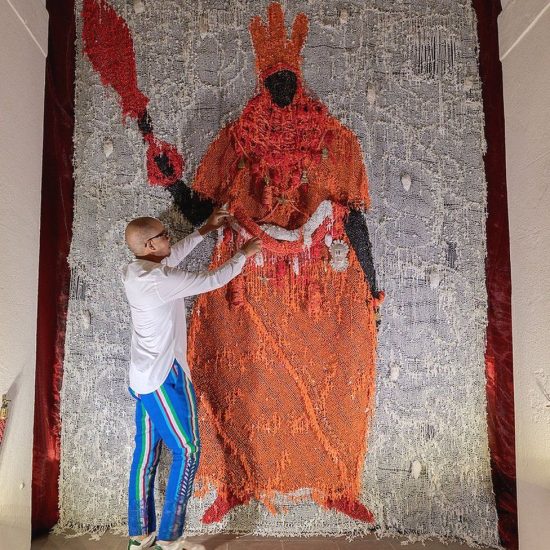
The message is strong and unambiguous. Or so it appears. How then can one explain the appearance in the crypt of St Paul’s Cathedral last month of a new memorial to 'unconditionally celebrate or commemorate' a major slave owner and trader? What the Cathedral describes as 'a bold new artwork' is a twelve-foot-tall bright red effigy of the ruler of the African kingdom of Benin, Oba Ovonramwen, who was deposed by a British expedition in 1897. There is no doubt about the celebratory intention of this work: its artist, Victor Ehikhamenor, describes it as 'reawakening Oba Ovonramwen and every other person that was violated during that oppressive attack on the Benin Kingdom.'
When the perpetrators of the 'oppressive attack' reached Ovonramwen’s palace, they found, according to F.N. Roth, the expedition's doctor, 'several human sacrifices, live women-slaves gagged and pegged on their backs to the ground, the abdominal wall being cut in the form of a cross, and the uninjured gut hanging out. These poor women were allowed to die like this in the sun.'
Benin had been a major slave-owning kingdom with a long history of violent slave raiding and trading — an activity that was ended by the British intervention. The famous and beautiful bronzes (many of which were seized and are now in European museums) were made with brass obtained by trading slaves. There can be no doubt that Ovonramwen was one (to use the Church’s words) 'who contributed to or benefited from the tragedy that was the slave trade'.
Does this installation in his honour help to 'include, welcome and provide safe spaces for all'? There must be many Londoners whose recent forebears were slaves of the Oba or similar African rulers. I wonder whether their feelings have been in the slightest degree considered.
There are two possible explanations for this. The first is ignorance. Or:
The second possible explanation is far more troubling: that they actually approve of an installation which, deliberately or not, embodies a racialised distortion of morality: complicity in slavery is an unforgivable sin for a white person but morally innocuous for a black person. Proclaiming the emancipatory and anti-racist message of Christianity, St Paul wrote that: 'There is neither Jew nor Greek, there is neither slave nor free …For ye are all one in Christ Jesus.' Not in St Paul’s cathedral, however.
The BBC interviewed the artist Victor Ehikhamenor last month, and, of course, were suitably impressed.
Through memorials to hundreds of historical British figures, St Paul's presents a version of the past. But in an ongoing art project the cathedral authorities are attempting to bring new perspectives.
Ehikhamenor's 12ft-tall work (3.7m), Still Standing, was specially commissioned as part of the 50 Monuments in 50 Voices project to tell different stories.
"There is something very powerful about seeing an oba standing there next to the panel memorialising the Benin campaign," the cathedral's chancellor, Dr Paula Gooder, told the BBC.
The work is also a reminder of "the enduring legacies and losses of colonial war", the exhibit's co-curator Prof Dan Hicks said.
St Paul's has decided not to get rid of any of its monuments, recognising that "people had different values" in the past, and instead wants to "engage in a conversation with history," Dr Gooder explained.
Ehikhamenor is in no doubt as to his role in that conversation.
"To the British people [Rawson] was a hero, to the family he was a hero, but it could also be that to some other people he was a war criminal," the artist said.
He feels that in the whole debate about reparations and the push for the looted artefacts to be returned home to Nigeria, Rawson's "painful" role in the whole affair has been forgotten.
"Sometimes we have to remind people that [atrocities] happened."
Ehikhamenor is from the same Edo culture and artistic tradition as the bronzes, and his piece is inspired by Oba Ovonramwen, the Benin monarch who was exiled by the British in 1897.
The installation depicts a larger-than-life figure of the oba standing in full regalia, and with the instruments of his power.
"This is me reawakening Oba Ovonramwen and every other person that was violated during that oppressive attack on the Benin Kingdom," said the artist.
No mention of the slavery.
[Image: Graham Lacdao/St Paul's]
On display in a building this is at the heart of the British establishment, it is not a lecture, nor is it forcing any particular stance on people.
But the radiance of the piece commands attention, challenging the viewer to take another look at a historical episode, and consider the continuing impact of the destruction of the ancient Benin Kingdom.
For Ehikhamenor, the past should always be up for review.
"History is constantly changing. In as much as people like to think that history is fixed, history is a constantly moving train."
Isn't it though. And by now we appreciate – or we should appreciate – that Europeans were by no means the only ones engaged in slavery. It's not simply a tale of European villains and African heroes.
For some more context, Michael Mosbacher wrote about this last month in the Telegraph:
Britain’s statue wars have reached St Paul’s Cathedral. A new artwork, has been unveiled this week in its crypt to mark the 125th anniversary of the fall of the Kingdom of Benin. Still Standing by Nigerian born artist Victor Ehikhamenor is a mixed media representation of Oba Ovonramwen, the ruler of the Kingdom of Benin at the time of its conquest by Britain in 1897. The object, a nearly 4 meter high tapestry or wall hanging made using rosary beads and Benin bronze ornaments, is meant to contextualise a brass memorial panel in the crypt to Admiral Sir Harry Holdsworth Rawson, who led the 1897 expedition.
Why does the Admiral’s memorial brass apparently need contextualisation? In January 1897 James Phillips, Acting Consul General of the British territory of the Niger Coast Protectorate, led a party of nine white colonial officials and 250 or so African porters to the Kingdom of Benin. They were ambushed. Four of the colonialists, including Phillips, were killed on 6 January and a further three either died on that day or subsequent to being taken prisoner. Many African porters were killed.
In retaliation the British launched a punitive expedition against the Kingdom of Benin led by Admiral Sir Harry Holdsworth Rawson. British forces captured Benin City and the palace of the Oba – or King – of Benin on 18 February 1897 and with it the territory of the Kingdom was incorporated into the British colony that would become Nigeria. The Oba’s palace and other ceremonial buildings were richly adorned with ornate ivory carvings and bronzes predominantly dating from the sixteenth century onwards. These were taken, along with a huge quantity of uncarved ivory, by the British forces with the justification that the sale of these items would defray the costs of the expedition. In truth, many of the looted items ended in the private possession of the British officers leading the expedition.
The “return” of the looted items, many of which are now in European and American museums not least the Pitt Rivers, has become a cause celebre for progressive opinion. A $100 million project to build a museum in Benin City in Nigeria to house “returned” objects is now underway.
Of course, the Benin raid clearly would not pass muster today. It is undeniable that many of those involved in the raid enriched themselves with it. But if we are to judge historical figures by contemporary standards this should also apply to the Oba of Benin.
The Kingdom of Benin, right up to its downfall in 1897, held slaves and practiced human sacrifice. It grew rich on the back of the Atlantic slave trade. Its forces captured other Africans and sold them to European slave traders. As Professor Dan Hicks, who commissioned and curated the work now being displayed in St Paul's acknowledges in his book The Brutish Museums: “The Kingdom grew in power and scope during its involvement in European and transatlantic trade from the 16th century, at first with Portuguese traders, and later British and French – central among which was the slave trade”.
There is some debate as to the relative importance of the slave trade versus the trade in ivory – which is not exactly seen today as a noble undertaking either. What is clear is that slaving was at least as important to the rise of Benin than it was to the rise of Britain, and very probably considerably more so. Oba Ovonramwen was at the pinnacle of the Kingdom of Benin’s pyramid of exploitation. If it is inappropriate to commemorate Admiral Sir Harry Holdsworth Rawson in St Paul’s crypt without contextualisation, should the same not apply to the Oba?
 Mick Hartley
Leave a comment