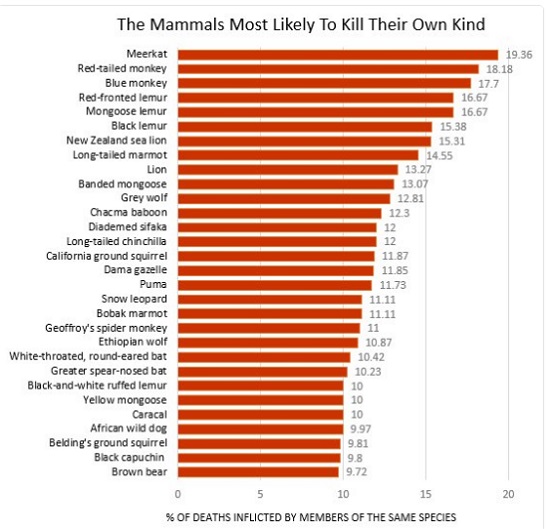
The results are in, and no, we're not the most violent mammals – at least in terms of killing each other, that is. That'd be meerkats:
A study on violence in more than 1,000 mammals has revealed that pretty much all of them are murderous, but meerkats are the most bloodthirsty of all.
Evolutionary biologists, led by José María Gómez from the University of Granada in Spain, conducted the study in order to understand human violence in an evolutionary context. They found that when Homo sapiens first came into existence, roughly one in 50 of us were killed by members of our own species. This made us typically violent for a primate, though around six times more murderous than an average mammal.
Our murderous tendencies have shifted over time though. Gómez’s research found that we became considerably more violent during the Iron Age and Medieval period of Africa, Europe and Asia, but over the past few centuries, have become significantly less violent than when humans first existed. This suggests that as we formed large, organized states, complicated social structures have kept our violent urges in check.
But where do meerkats fit in? The researchers weren’t focused on these unexpectedly lethal creatures, but Ed Young at The Atlantic organized the research to rank the top 30 most murderous mammals. Meerkats come well ahead of lions, wolves, and leopards. Roughly one in five meerkats die at the hands of their own species.
From the original paper:
The psychological, sociological and evolutionary roots of conspecific violence in humans are still debated, despite attracting the attention of intellectuals for over two millennia. Here we propose a conceptual approach towards understanding these roots based on the assumption that aggression in mammals, including humans, has a significant phylogenetic component. By compiling sources of mortality from a comprehensive sample of mammals, we assessed the percentage of deaths due to conspecifics and, using phylogenetic comparative tools, predicted this value for humans. The proportion of human deaths phylogenetically predicted to be caused by interpersonal violence stood at 2%. This value was similar to the one phylogenetically inferred for the evolutionary ancestor of primates and apes, indicating that a certain level of lethal violence arises owing to our position within the phylogeny of mammals. It was also similar to the percentage seen in prehistoric bands and tribes, indicating that we were as lethally violent then as common mammalian evolutionary history would predict. However, the level of lethal violence has changed through human history and can be associated with changes in the socio-political organization of human populations. Our study provides a detailed phylogenetic and historical context against which to compare levels of lethal violence observed throughout our history.
So Steven Pinker was right. We are becoming progressively less violent – and certainly less violent than our evolutionary history would suggest.


 Mick Hartley
Leave a comment