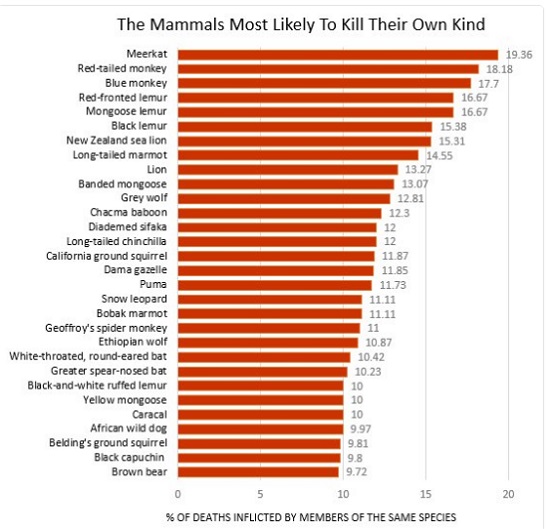
The results are in, and no, we're not the most violent mammals – at least in terms of killing each other, that is. That'd be meerkats:

A study on violence in more than 1,000 mammals has revealed that pretty much all of them are murderous, but meerkats are the most bloodthirsty of all.

Evolutionary biologists, led by José María Gómez from the University of Granada in Spain, conducted the study in order to understand human violence in an evolutionary context. They found that when Homo sapiens first came into existence, roughly one in 50 of us were killed by members of our own species. This made us typically violent for a primate, though around six times more murderous than an average mammal.

Our murderous tendencies have shifted over time though. Gómez’s research found that we became considerably more violent during the Iron Age and Medieval period of Africa, Europe and Asia, but over the past few centuries, have become significantly less violent than when humans first existed. This suggests that as we formed large, organized states, complicated social structures have kept our violent urges in check.

But where do meerkats fit in? The researchers weren’t focused on these unexpectedly lethal creatures, but Ed Young at The Atlantic organized the research to rank the top 30 most murderous mammals. Meerkats come well ahead of lions, wolves, and leopards. Roughly one in five meerkats die at the hands of their own species.
Mammals-kill

From the original paper:

The psychological, sociological and evolutionary roots of conspecific violence in humans are still debated, despite attracting the attention of intellectuals for over two millennia. Here we propose a conceptual approach towards understanding these roots based on the assumption that aggression in mammals, including humans, has a significant phylogenetic component. By compiling sources of mortality from a comprehensive sample of mammals, we assessed the percentage of deaths due to conspecifics and, using phylogenetic comparative tools, predicted this value for humans. The proportion of human deaths phylogenetically predicted to be caused by interpersonal violence stood at 2%. This value was similar to the one phylogenetically inferred for the evolutionary ancestor of primates and apes, indicating that a certain level of lethal violence arises owing to our position within the phylogeny of mammals. It was also similar to the percentage seen in prehistoric bands and tribes, indicating that we were as lethally violent then as common mammalian evolutionary history would predict. However, the level of lethal violence has changed through human history and can be associated with changes in the socio-political organization of human populations. Our study provides a detailed phylogenetic and historical context against which to compare levels of lethal violence observed throughout our history.

So Steven Pinker was right. We are becoming progressively less violent – and certainly less violent than our evolutionary history would suggest.

Posted in

7 responses to “Bloody meerkats”

  1. tolkein Avatar
    tolkein

    Only where States exist where there is strong (generally, but not necessarily) religious opposition to murder of others. Of course, where the State is strong enough that opposition can be overridden – see Nazi Germany, and any number of Enlightenment states, such as Revolutionary France, Mexico, and any number of Communist States (Russia, not just Revolution and Civil War, but collectivisation and the deliberate starving of millions of peasants, then the Great Purge, Cambodia, Red China throughout its history till the death of Mao).
    The only exceptions to the Enlightenment states I can think of were Japan, and there Japan was a deeply racist state with no religious or other barriers to ‘othering’ Chinese and other peoples, and Turkey, which committed the genocide of the Armenians and, under the nice Enlightened secular Kemal Ataturk, ethnically cleansed Asia Minor, murdering many and deporting the rest of Greek communities that had been there for 3,000 years.
    I’m not as optimistic as Pinker that the murderous impulses are not still there.

    Like

  2. Mick H Avatar
    Mick H

    Oh I don’t think Pinker – or anyone else – is saying that the impulses aren’t still there. He’s simply arguing that, despite it all, things are generally, for most of us, getting better. And I think he’s right.

    Like

  3. tolkein Avatar
    tolkein

    No, that’s not what he’s saying.
    His specific case is that as we’ve got more progressive we have become less violent, and attributes this to the success of Enlightenment values. You may note that I have a dim view of the Enlightenment if its progeny include the French Revolution and the unleashing of 20 years of war in Europe, the growth of nationalism, the Bolshevik and Chinese Revolutions and Pol Pot. And revanchism and nationalism found its source in the French Revolution. And what happens when 2 nationalisms clash? Ask the Serbians, the Bosnians, the Croats for an up to date comment.
    It’s the usual policy based evidence making approach by secuar progressives. Find a hypothesis that justifies your own pieties and then search for evidence to support it, and ruthlessly exclude evidence to the contrary. Then utter smug condescending comments about our ancestors.
    And, really, is modern Chicago or Detroit, or Caracas or Joburg much safer than mediaeval England? Not according to the evidence it isn’t.

    Like

  4. tolkein Avatar
    tolkein

    And do ask Professor Pinker for his explanation for the carnage in Syria, or Darfur, or towards the Yazidis. Doesn’t look like progress to me

    Like

  5. tolkein Avatar
    tolkein

    I do like your photos

    Like

  6. Mick H Avatar
    Mick H

    Well thanks!

    Like

  7. brian Avatar
    brian

    “And do ask Professor Pinker for his explanation for the carnage in Syria, or Darfur, or towards the Yazidis.”
    One of the biggest obstacles in the way of Pinker’s thesis was WWII and the carnage that surrounded it. How could we possibly be getting less murderous when hundreds of millions of us were massacred in this fairly recent event? The reason is that there have always been spikes in violence: Syria, Sudan, DRC and Sudan represent such a spike but a much smaller one than, say, the Taiping Rebellion.
    I think Pinker was persuasive when he argued that the general trend is downwards, but I also think that our modern weapons and may mean that some future spikes will be horrendous.

    Like

Leave a reply to tolkein Cancel reply