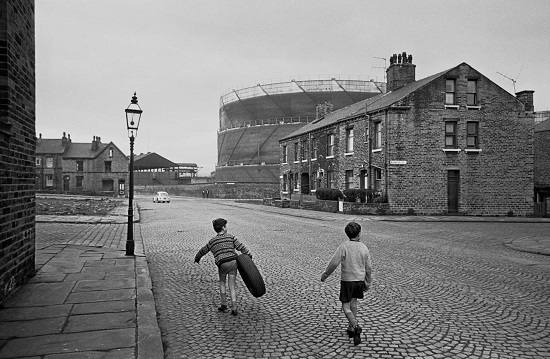
More "grim up north" photos, this time from photographer Nick Hedges:
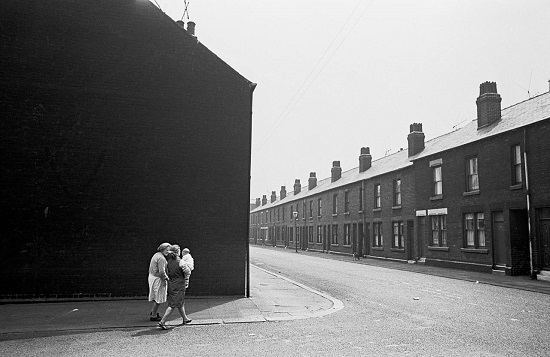
Hedges-sheffield-1969
Family walking round the corner, Sheffield 1969
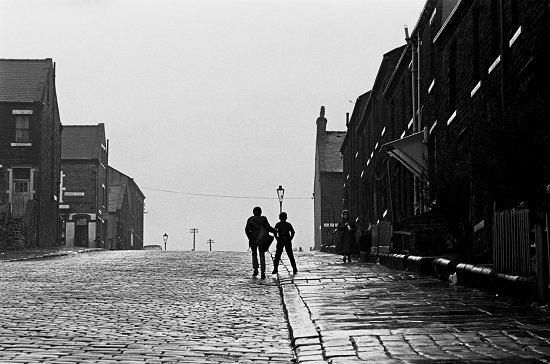
Hedges-Bradford3-1969
Delivering newspapers, Bradford 1969
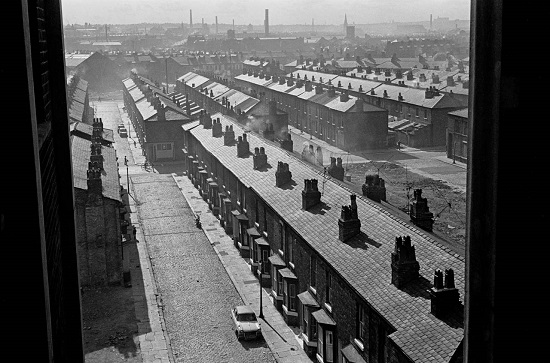
Hedges-Salford-1971
Salford back to back and terraced housing, 1971
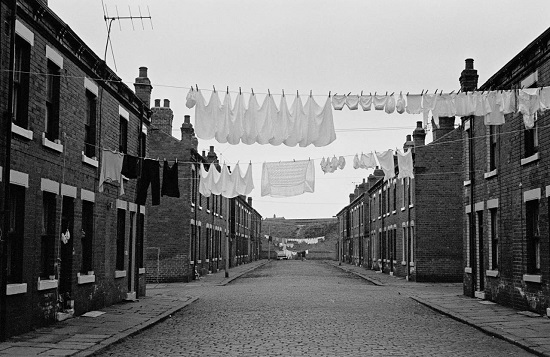
Hedges-Leeds-1970
Washing hanging out to dry across back to back housing street, Leeds 1970
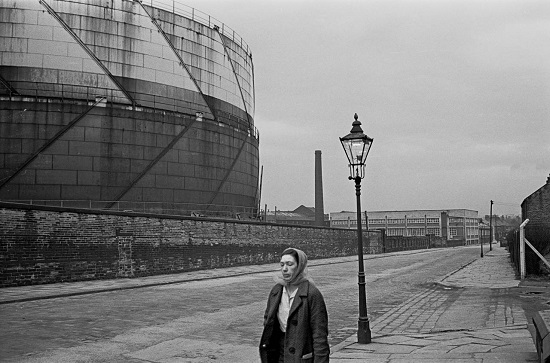
Hedges-Bradford5-1969
Street scene by gas works, Bradford 1969
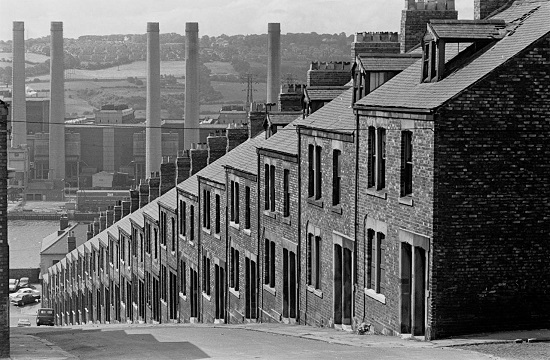
Hedges-Newcastle-1969
Street of terraced housing Newcastle upon Tyne, 1969
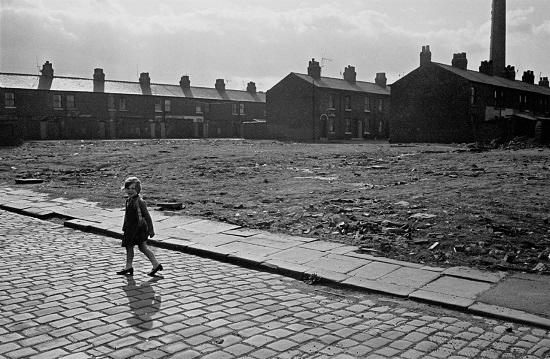
Hedges-Salford-1969
Child crossing waste ground, Salford 1969
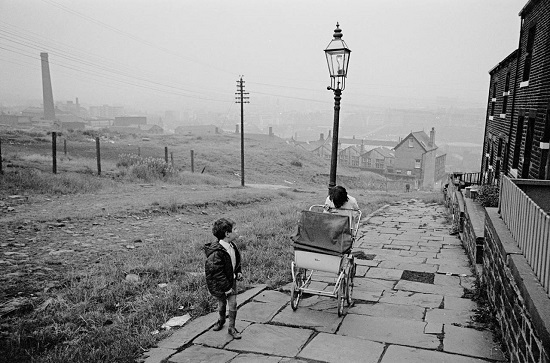
Hedges-Bradford-1970
Pushing a pram up an unadopted road, Bradford 1970
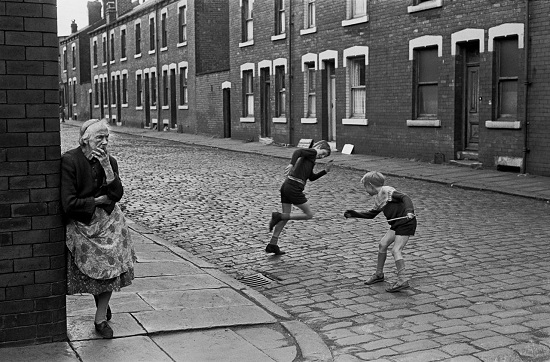
Hedges-Leeds2-1970
Elderly lady standing at her street corner, back to back housing, Leeds 1970
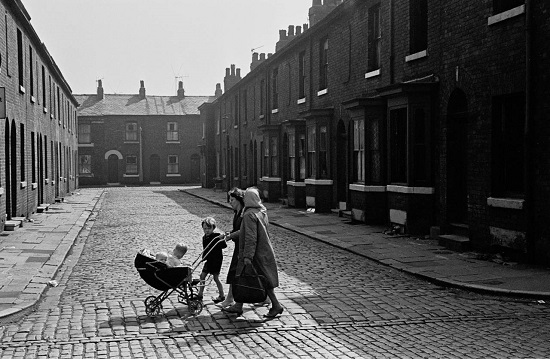
Hedges-Salford-1970
Street scene Salford, 1970

Hedges-Bradford4-1969
Trophy for the street game, Bradford 1969
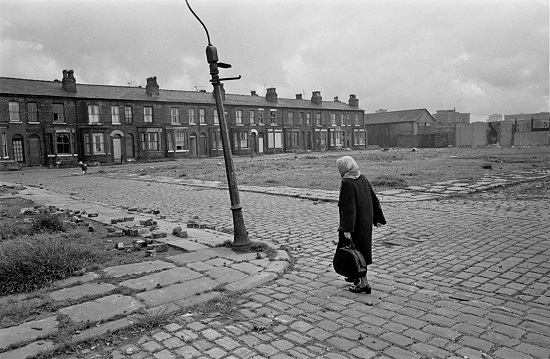
Hedges-Salford2-1971
Pensioner crossing derelict land towards her home, Salford 1971

Hedges was commissioned by the housing charity Shelter, soon after its founding in 1966, to document the state of Britain's slums, and the wretched living conditions so many people had to endure - so these are grim by intention. Nor is it all up north – quite a few of the photos are in London. The pictures of the now-demolished Rothschild Dwellings in Whitechapel are worth seeing. But these northern shots have a certain thematic unity. 

Most of the photos are of the slum dwellers rather than the streets, and now, to mark Shelter's 50th anniversary, they're seeing if they can trace any of the subjects.

Bill Brandt, previously, with an earlier generation of "grim up north" classics from the Thirties.

It's surprising to think, now, that these old slums still existed as recently as the late Sixties and early Seventies. That no doubt was Shelter's point – to highlight the poverty and squalor left behind by Harold Wilson's "white heat of the technological revolution". This campaign, with its powerful images, will have played its part in hastening the destruction of these old slums, and their replacement with the tower blocks and council estates that came in their wake. These, in turn, came to symbolise the squalor of big city working class areas with their graffiti-covered courtyards, stairwells that stank of piss, and drug-related violence.

Meanwhile the old streets, with their fabled community spirit and all the rest, acquired in retrospect a nostalgic sheen – witness these photographs, and the way we view them now. 

Ah well – that's the way it goes.

Posted in

4 responses to “Slum streets”

  1. Dom Avatar
    Dom

    “These, in turn, came to symbolise the squalor of big city working class areas with their graffiti-covered courtyards …”
    I don’t understand you and graffiti. One day, you photograph it like it’s street art, next day it’s a symbol of squalor. In philly, it was squalor and nothing else, and there was a sense of theft behind it, taking someone’s private property.

    Like

  2. Mick H Avatar
    Mick H

    Well, there’s the graffiti which is tagging, and is messy, which is a Bad Thing, and then there’s the graffiti which is street art, which is a Good Thing. The latter will usually be at a site where it’s either derelict property or somewhere like a skateboard park, or the owner sponsors the artist.
    I hope I’ve cleared that up…

    Like

  3. TDK Avatar
    TDK

    I lived in houses identical to the Leeds back-to-backs during my student years. They are still there. The doored yards mid way along are where the bins were stored and where the lavatories were situated. These were still being replaced by in home facilities in 1979 – grants were available.
    My first house until 1997 was in a through terrace; it fronted an unadopted road to the front which looked pretty much like the Bradford pram pic including the scabby paving, except there were houses on both sides and the house doors were facing the pavement.
    That latter house was in an area that was up and coming. Think Islington in 1960s. You can find thousands of such enclaves. Hebden Bridge could have been in any of these pictures yet is populated by arty middle classes.
    There’s some intellectual baggage that comes with the judgement ‘slum’. I dare say many were beyond saving in the 1960s, yet thousands of homes good and bad, were demolished in cities to replace them with ghastly “modern” replacements like Quarry Hill Flats, or Hunslet Grange flats, both in Leeds. Neither survived 40 years. Both became true slums and were demolished to be replaced by small starter homes that in square footage are inferior to the houses that they ultimately replaced.
    Looking at the photos, many don’t appear to me, to be so bad. The ones that do have rubble strewn areas (there’s a remote chance they might be bomb sites), probably the result initial clearances, where no one was minded to take the rubbish away.
    Hey: A play area where there’s broken glass and bricks to throw!
    One shows a gas tank in an industrial part of Bradford. It and the industry look used. Well today the industry has gone and the road still looks grime with Staples and some DIY chain. No one walks there anymore

    Like

  4. Martin Adamson Avatar
    Martin Adamson

    And there are no men in the photos because they are all at work.

    Like

Leave a comment