Newly opened, in 1910:
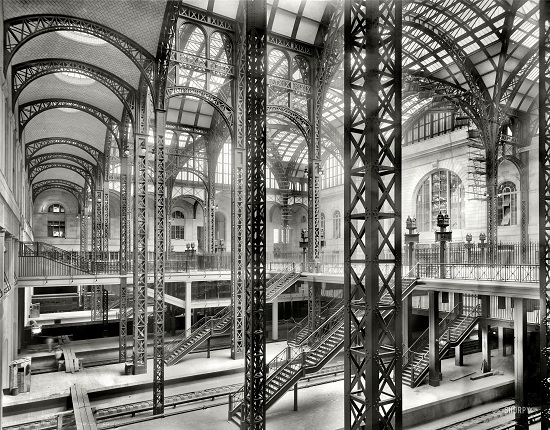
[Photo: Shorpy/Detroit Publishing Co.]
Full size here.
The station was demolished in the early 1960s:
The furor over the demolition of such a well-known landmark, and its replacement by what continues to be widely deplored as a mediocre slab, are often cited as catalysts for the architectural preservation movement in the United States. New laws were passed to restrict such demolition. Within the decade, Grand Central Terminal was protected under the city's new landmarks preservation act, a protection upheld by the courts in 1978 after a challenge by Grand Central's owner, Penn Central.
The outcry over the loss of Penn Station prompted activists to question the “development scheme” mentality cultivated by New York's “master builder”, Robert Moses. Public protests and a rejection of his plan by the city government meant an end to Moses's plans for a Lower Manhattan Expressway.
In the longer run, the sense that something irreplaceable had been lost contributed to the erosion of confidence in Modernism itself and its sweeping forms of urban renewal. Interest in historic preservation was strengthened. Comparing the new and the old Penn Station, renowned Yale architectural historian Vincent Scully once wrote, “One entered the city like a god; one scuttles in now like a rat.” This feeling, shared by many New Yorkers, has led to movements for a new Penn Station that could somehow atone for the loss of an architectural treasure.
Here's an Old Penn Station slide show.
 Mick Hartley
Leave a comment