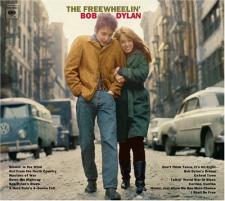
 Well this is unexpectedly sad. Not because of who she was or what she did so much as what she represented: that time in the early Sixties when the Beats met with the folkies and the poets and hipsters, and the whole Greenwich Village scene was full of energy and life.
There was music in the cafes at night,
and revolution in the air.
Somehow, although it's winter and there's snow on the ground, it feels like spring. And, charmingly, they look like a normal fresh-faced young couple in love: nothing glamorous or affected (a telling difference from a couple of years later, and the "uptown" cover of Bringing it all Back Home with the sophisticated Sally Grossman). That was surely a key part of the appeal - and why it's still Dylan's best-remembered album cover.
I'll admit I'm not immune to all that. In New York last May we headed up to the Village looking for the flat on West 4th Street where Dylan lived with Suze, and were pointed by a helpful local in the direction of nearby Jones Street, where this picture was taken. It doesn't get anything like the attention that Abbey Road does, but it's maybe the nearest New York equivalent: the image that sums up that time and place.
All of which is no doubt horribly unfair to the woman herself, Suze Rotolo, who lived her own life after Dylan, yet had to accept that this moment was destined to be what she'd be remembered for. He was, as she put it, "the elephant in the room of my life".
In fact she never talked about Dylan until 2005 when Martin Scorcese interviewed her for No Direction Home. Her subsequent 2009 book, A Freewheelin' Time: A Memoir of Greenwich Village in the Sixties, was actually a much better book than I expected: not a hint of an indiscretion about her time as Dylan's girl-friend, despite how she ended up, thinly disguised, in some of his songs. And not ghost-written either.
There's more on Suze in Rolling Stone.


 Mick Hartley
Leave a comment