
• When the police want – as recently in the case of the planned UKIP march in the East End – they can ban demonstrations on the grounds of preventing serious disorder. They realised that a ruckus was likely with the local Muslims, and, no doubt wisely, told UKIP it wasn’t going to happen.

    Contrast that with protests against Jews in the UK. Yesterday evening, for instance, the United Synagogue in St John’s Wood was holding a series of Israel-related events and the usual pro-Palestinian mob demonstrated loudly outside. The police claimed their hands were tied, and there was “no legal mechanism to ban the protest from taking place”.

    Daniel Sugarman at Jewish News:

    Instead, they designated a few nearby streets to be off limits – both to the protesters and those who had turned out to counter-protest. And when the ‘anti-Zionist’ protesters flagrantly breached the conditions the police had set out, the response from one officer was to acknowledge that breach, but to say that “we don’t want to antagonise the situation”. In the meantime, synagogue attendees were left to argue with police as to why they should be allowed to enter their own place of worship for services.

    There’s one side they don’t want to antagonise – as we’ve seen over the past two years with the endless pro-Palestine marches where the only arrests were of the few counter-demonstrators, like the Iranian man with his “Hamas are terrorists” placard. Or the West Midland police and their banning of the Maccabi Tel Aviv fans, which was really about not antagonising the Islamist-left alliance. They don’t want to antagonise that side because they’re capable of violence. They don’t care about antagonising peaceful groups, like Jews, because there isn’t a threat of violence.

    British Jews have worked hard to build strong relationships with law enforcement. The vigilantism of the 43’ group and the 62’ group, Jewish ex-servicemen who, seeing the failure of law enforcement to act against antisemites, took the law into their own hands, has rightly long been eschewed. The simplest and easiest way to prevent even a trace of such a thought process from re-emerging is for the police to stop making the overwhelming majority of Jews question why they are receiving different treatment to other minority communities.

    Much of the antagonism to Israel, surely, is the shock of seeing Jews defend themselves with violence. It’s not right. They’re meant to be victims.
  • Andrew Doyle adds to the clamour against the puberty blocker trail:

    We need to be honest about what is happening here. An unevidenced and pseudoscientific claim is being assumed to be true, and innocent children will almost certainly be injured as a result. This is wholly unethical. Medical trials are initiated on the principle that the potential benefits outweigh the potential risks. But, as Tavistock whistleblower Dr David Bell has pointed out, these trials will ‘introduce a known risk of systemic physical harm to a physically healthy child. To put it mildly, this is a divergence from normal clinical practice’.

    Why stop at trials for puberty blockers? In some communities in the Democratic Republic of Congo, children believed to be possessed by kindoki – a type of evil spiritual influence – are treated by beating, starvation, burning or forced submersion in water. There is no evidence for the existence of kindoki, and those who believe in such witchcraft represent a minority of the population. So will the government commission a medical trial to ascertain whether beating, starving, burning and submerging a cohort of children is beneficial to their wellbeing?

    The analogy seems extreme, but testing for the presence of demons is no less absurd than doing so for the existence of an innate gendered soul. If evidence for such a phenomenon were to be discovered, and reputable doctors were then to put forward a case that this soul/body incongruence is best treated with medical rather than therapeutic intervention, then a puberty blocker trial might be justified. We are so far from this scenario that it is astonishing it is even being entertained as a possibility.

    Injecting children with a hormone-suppressing drug to investigate supernatural claims is simply not morally defensible. It will doubtless impact most severely on children who are autistic, who suffer from unrelated traumas, or who are likely to grow up gay. While the power of the genderist ideology continues to decline, we need to be alert to those in positions of power who still insist on conflating medicine with metaphysics. Children should never have to pay the price for the delusions of those entrusted with their care.

  • From the Telegraph:

    A study of BBC headlines since the Oct 7 attacks has found three times more were critical of Israel than of Hamas.

    According to research by a media monitoring group, references to Hamas committing possible war crimes appeared once in the broadcaster’s coverage, while those featuring claims of Israeli genocide, famine and starvation appeared 45 times.

    The study of BBC News UK headlines used since the terror group’s attacks on Israel in 2023, which triggered the war in Gaza, found that 11 per cent were critical of Hamas, while more than a third (35 per cent) appeared to be critical of Israel.

    We knew this was happening, of course, but it’s good to have the evidence.

    Hadar Sela, of Camera UK, said: “For two years, BBC News headlines have displayed an almost naive acceptance of any claim made by Hamas, while treating statements made by Israel with the utmost scepticism. Such blatant bias has helped fuel a surge in anti-Semitism within the UK and turned Britain into a hostile environment for the Jewish community.”

    The study examined all 2,542 headlines about the Gaza conflict published on BBC News UK between Oct 7, 2023 and Oct 7, 2025. It found that just one focused on a spate of brutal public executions by Hamas, while 33 headlines in two months carried claims that Israeli forces killed civilians as they sought food from Gaza aid sites.

    Camera claims that Israel has been repeatedly accused by the BBC of using aid as a weapon of war, with the word “starving” or “starvation” appearing 21 times in headlines, the word “famine” 10 times and “war crimes” six. The words “genocide” or “genocidal” appeared in headlines 14 times.

    The study found that Hamas fighters were referred to in headlines as “militants” and “gunmen” rather than terrorists. Camera found only one headline referring to “war crimes” by Hamas and just six about the rape and sexual violence carried out by its fighters on Oct 7 and against captured hostages.

    The bias goes right back to October 7th.

    On Oct 8, 2023, BBC News headlines included “How Hamas staged attack no one thought possible” and “Gaza hospital deluged as Israel retaliation kills and wounds hundreds”.

    Ms Sela said: “News headlines, of course, are not the whole of the story but they do give a sense of the main focus of an article.

    “It is clear from our analysis that just one month after those horrific Hamas atrocities, the focus for BBC News had quickly shifted to holding Israel to account. Since then, we have seen the constant promotion of anti-Israel narratives over impartial reporting in these headlines.

    “In contrast, the evidence that Hamas filmed and put out for the world to see – evidence of hundreds of young festival-goers brutally murdered, whole families living in kibbutzim being slaughtered, of hostages dragged from friends or relatives to the hell of the Hamas terror tunnels to be starved and beaten – they feature far less in headlines.

    “For every one headline that is critical of Hamas, there are three that hold Israel to account.”

    While every news bulletin form Hamas went straight onto BBC headlines.

    Danny Cohen, the former Director of BBC Television, said: “These statistics are shocking but also unsurprising when you consider the influence of BBC Arabic, the BBC’s most toxic open secret.

    “No other newsroom in Britain would tolerate this. Yet the BBC consistently denies BBC Arabic has a systemic problem and the channel continues to be relied upon as a news-gathering service for the wider BBC.

    “The absence of transparency about the BBC’s failures is deepening the anguish of British Jews and feeding the increasingly hostile atmosphere they face in this country. It is impossible to ignore the link between what dominates our news feeds and the climate on our streets.”

    The BBC sets the tone for news reporting in the UK. This has been a huge failure on their part.

    The JC covers this, for a non-paywalled view,

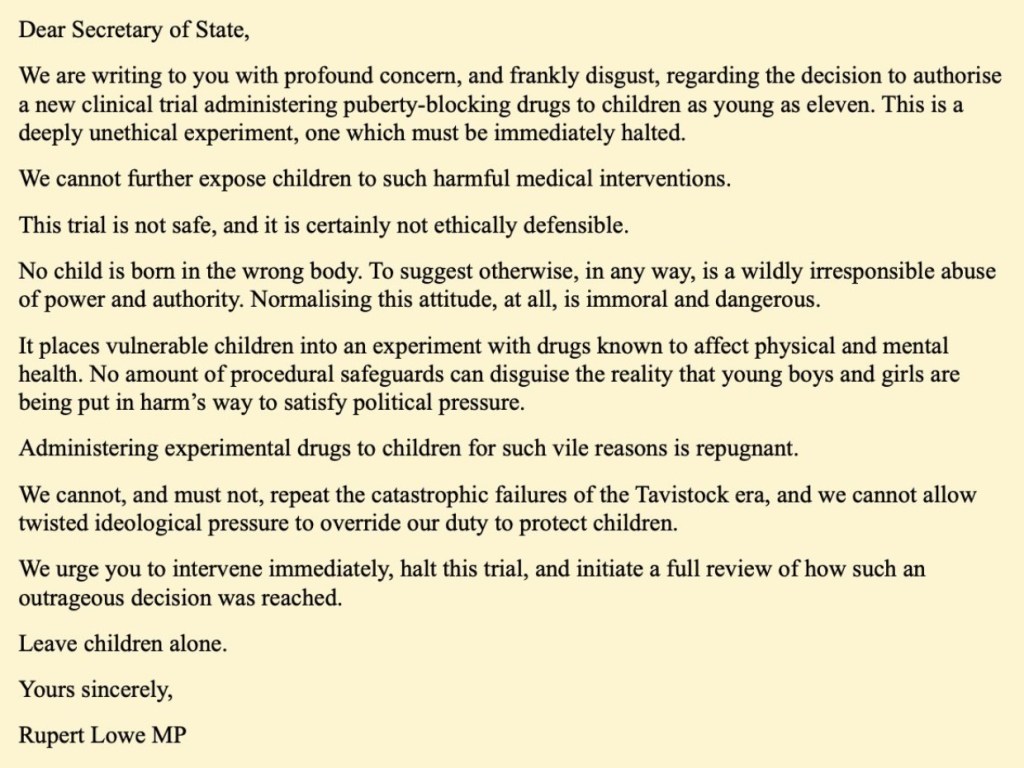
  • Letter from MP Rupert Lowe to Wes Streeting:

    I have just invited all MPs to sign this letter urgently calling on the Secretary of State for Health to immediately halt a new trial administering dangerous puberty-blocking drugs to young children.

    We cannot allow experimental drugs to be given to confused young boys and girls. We cannot allow twisted ideologies to harm children. This trial must be shut down – immediately.

    If you agree, please ask your MP to sign and we will put as much pressure on in Parliament as possible.

  • Astonishingly, the Crown Prosecution Service is proposing to appeal against the dropping of charges against Hamit Coskun.

    He was the man who set fire to a copy of the Koran outside the Turkish consulate in London, and was then attacked by a Muslim man armed with a knife. He, Coskun, was found guilty of a “religiously aggravated public order offence” – in other words, blasphemy. No charges were ever brought against the man with the knife. The conviction was later overturned:

    “We live in a liberal democracy,” the judge said. “One of the precious rights that affords us is to express our own views and read, hear and consider ideas without the state intervening to stop us doing so. The price we pay for that is having to allow others to exercise the same rights, even if that upsets, offends or shocks us.”

    That’s what the CPS now objects to. David Shipley in the Spectator:

    I had hoped I would never have to write about Hamit Coskun again. After the Quran-burner won his appeal in October, it seemed that this particular battle in the free speech wars was over. Unfortunately the Crown Prosecution Service (CPS) have other ideas. On Friday evening the state prosecutor announced that it was going to appeal Coskun’s successful appeal. The language in their appeal application is particularly revealing.

    In that document the CPS describes burning a Quran as ‘an obviously provocative act’, which is ‘highly controversial’ and ‘has led to widespread international protests and condemnation, particularly from Muslim communities and governments, and has provoked numerous well-documented incidents of disorder and violence’. This is similar to the arguments they made at Hamit’s original trial. The fact that Moussa Kadri went into his home, returned with a knife and slashed at Hamit with it was held up as evidence of how provocative the Quran burning must have been. 

    He upset some Muslims, therefore he must be prosecuted.

    In an even more disturbing part of the CPS appeal application, they describe burning a Quran as ‘an act of desecration’, and are concerned that Coskun’s case ‘will undoubtedly be relied upon in future public order cases involving inflammatory acts of desecration’. Put simply, they want to be able to continue to prosecute and convict anyone whose actions violate Islamic blasphemy codes. 

    The mask is off now. In the world of the CPS, violence committed by unstable Muslims who can’t bear the sight of a book being burned is proof that those books shouldn’t be burned. Even worse, they are speaking the language of Islamic blasphemy codes, trying to introduce the idea that burning a book is an ‘act of desecration’ simply because Muslims believe it to be so. 

    What’s going on inside the CPS? There must be powerful voices within the organisation pushing for this. Prosecuting Coskun the first time was bad enough, but to then appeal against the overturning of his conviction, made on clear free speech grounds, suggests that we have a real problem here.

    What the CPS are doing is dangerous and sinister. They need to come clean on who within the organisation is so determined to create Islamic blasphemy laws in England. Those civil servants who are trying to subvert law and justice are a threat to us all. As Mr Justice Bennathan made clear at Hamit’s appeal in October ‘there is no offence of blasphemy in our law’. 

  • Of course, we have different personality traits, and some of us (male and female) are more masculine or more feminine. But this is not some kind of gendered soul which can be so at odds with our bodies as to give rise to a medical condition that demands physical body modifications.

    A masculine girl may turn against her body, but the answer is, clearly, to assert the rights of girls to be masculine and support the girl to embrace the way she is. Likewise for feminine boys.

    Cass was right to point to a lack of high-quality, or even medium-quality, evidence, but wrong to jump from that to the need for a clinical trial. Not everything unsubstantiated by evidence deserves clinical trials, especially when the risks and long-term effects are so serious.

    The recent vibe shift means that a Cass Report that was widely welcomed in early 2024 is showing its age and its significant flaws less than two years later.

    We need to question the premise. And, when we do, it is clear that “gender incongruence” is either not a medical problem at all or it is a medical problem that requires no more than a psychological response.

  • Jonathan Sumption’s article in today’s Sunday Times is the best commentary on the Hallett Covid Inquiry that I’ve yet read.

    The report has two yawning gaps. One is the inquiry’s failure to address international comparisons. The best way to discover whether lockdowns work is to compare the experience of other countries which did something else. We have a mountain of data on this subject. It consistently suggests that lockdowns make no substantial difference to outcomes. Sweden banned events of more than 50 people and offered guidance about distancing but did not lockdown its population and allowed restaurants, businesses and schools to stay open. It did better than the UK.

    Scandinavian countries with comparable conditions which locked down did better than Sweden in the earlier phase and worse in the later phase, but about the same overall. Comparisons between different states of the US which adopted different measures reveal the same pattern. It is difficult to take seriously a report which does not address this.

    The other gap is about the collateral damage caused by lockdowns: untold misery, loneliness and mental illness, rising levels of domestic violence, untreated cancers and heart disease, rocketing figures for dementia, lifelong damage to the education of many children, destruction of small businesses, millions dropped out of the workforce who have not come back. And all at staggering cost: £410 billion according to the International Monetary Fund, some 60 per cent of which was attributable not to additional health expenditure but to business support, furlough and other costs of lockdown. Hallett stresses the importance of collateral damage but then ignores it, dishing out criticisms as if the clinical issues were the only ones that mattered.

    The main problem seems to be that Hallett relies almost entirely on the evidence of the government’s advisers. They were contemptuous of outside experts who rocked the boat by proposing different approaches. This is the worst possible kind of groupthink. Yet the inquiry uncritically adopts their line. Experts do not like being contradicted and understandably seek to justify the advice they gave at the time. But rather more is expected of an inquiry chairman who is supposed to be taking an independent view of these matters.

    A good example is her headline-grabbing figure of 23,000 lives, which modelling has “established” would have been saved if Britain had been locked down a week earlier in March 2020. This figure is derived from Professor Neil Ferguson’s models, with their unrealistic assumption that, unless compelled by law, people would take no steps for their own protection. Yet hard data show that they were doing so well before the first lockdown was ordered. Hallett herself points out that models are hypothetical thought experiments (“scenarios”), and warns against treating them as predictions, but she then does exactly that….

    The Covid inquiry is an extremely slow and expensive way of reaching some highly questionable conclusions. It is based on a remarkably limited range of material, much of it lacking in objectivity. Some of its arguments are logically incoherent. And it is riddled with solemn warnings against methodological errors and omissions which the author then proceeds to commit herself.

    This is the second “module” of the inquiry. At £200 million and with another eight modules to go, one is bound to question whether the public is getting value for money.

    More to come? Oh boy.

  • Hadley Freeman visits Newnham College Cambridge:

    When The Times broke the news last week that the Equality and Human Rights Commission submitted its guidance three months ago that single-sex spaces should be protected, and not breached by those of the opposite sex no matter no matter how they “identify”, and Labour has done sod all about implementing the guidance, two truths were confirmed. First, gender ideology is anti-gravity nonsense that only the desperate, the deluded and the double-dealing grifters still believe. And, second, too many alleged grown-ups in the room are still, unforgivably, too scared to say so.

    Several such grown-ups can be found at Newnham College, Cambridge, co-founded in 1871 by Millicent Fawcett, who believed women must have access to education. Gender ideology, by contrast, believes so firmly in stereotypes — femininity means woman, masculinity means man — that its flag is pink and blue. Despite calling itself a women’s college, Newnham includes several men who identify as women among its students. The principal, Alison Rose, has defended the “trans inclusive” policy by arguing that Newnham was never, actually, single sex, because students’ boyfriends can stay over, an argument that manages to be even dumber than gender ideology.

    Dumbness seems to be a feature now of our academic leaders. Well, perhaps not dumbness so much as cowardice. They didn’t get where they are today by speaking out against the latest fads.

    It’s unsurprising that academia is the last garrison defending gender ideology, because that’s where the whole nonsense emerged, on “queer theory” courses taught by theoreticians like Judith Butler. While, in the wider world, the days of women being cancelled for stating scientific facts are ending, in universities they are still the norm. But I met three Cambridge students who are fighting to change that.

    Maeve Halligan, 22, Serena Worley, 21, and Thea Sewell, 20, launched the Cambridge University Society of Women (CUSW) to advocate for women’s rights and single-sex spaces. When they posted their mission statement last month, other students were outraged. “You’re preaching vile hate … I’m JCR president of Homerton and Homerton JCR supports trans rights,” was a typical reply. There were scathing comments about the women’s appearances, particularly against Sewell and Worley, who are gay. “These people think they’re progressive but they always reveal their misogyny,” says Halligan.

    The abuse is relentless.

    The bullying is so bad that Sewell will only go through town if Worley or Halligan is with her, and the three form a tightknit support group.

    The cruelty of gender activism is a feature, not a bug. The cause is so nonsensical, it can only survive in a climate of fear. CUSW held its first meeting last week and 15 young women attended but Halligan had to put black cloth over the windows to keep out jeering bullies. “Plus we have to deal with the arrogance of academia: professors don’t want to admit they were wrong,” says Halligan.

    A professor told her: “As academics, we’ve been waiting for students to start a group like this.” And why didn’t the professors start their own women’s group? Because, allegedly, the university wouldn’t let them, out of fear it didn’t reflect the view of the students. This is what happens when universities see their students not as young people who need educating but paying customers.