• From Tom Parfitt in the Times:

    A death in Moscow last week seemed to mark the end of an era.

    State media first reported the news: an 80-year-old woman, the granddaughter of the Soviet commissar of foreign affairs Maxim Litvinov, had been found lifeless below the windows of her flat in the south of the Russian capital. She had left a suicide note.

    With a jolt, I realised this must be Nina Litvinova, the daughter of an elderly couple I befriended in the early 2000s because they lived in the apartment above mine, opposite Gorky Park.

    Nina’s parents, my former neighbours in Moscow, were Mikhail, a mathematician and origami enthusiast who was the son of Maxim Litvinov, and his wife Flora, a physiologist.

    I never met her but Nina, known affectionately to relatives as Ninochka, lived across the way from us on 3rd Frunzenskaya Street. She was a marine biologist known for her quiet but passionate support of political prisoners….

    The first reaction to her death on Tuesday was a ripple of shock and grief that passed through émigré circles and the smattering of oppositionists still inside Russia. The banned human rights group Memorial said she was “the personification of modest but unbending courage and nobility”.

    Then came anger. Nina’s cousin Masha Slonim, the Russian-British former BBC journalist who lives in Devon, wrote on Facebook that she had learnt the content of the suicide note that Nina had left before ending her life.

    “I love you all, and think about you,” Nina had told her family, “but I must leave; to live has become intolerable ever since Putin attacked Ukraine and began killing innocent people, while thousands here are constantly being put in prison, where they suffer and die for being, as I am, against the war and the murders … I tried to help them, but my strength has ended and night and day I am tormented by my powerlessness. I am ashamed, but I have given up. Please forgive me.”

    Masha Slonim made a bald conclusion. “Putin killed her,” she wrote.

    A reminder that while we obsess about Labour in-fighting, others live – and die – in an altogether grimmer world.
  • Jonathan Sacerdoti in the Spectator:

    Perhaps the strangest thing about the Unite the Kingdom rally was just how unremarkable it felt. There were no mass chants calling for the death of particular groups, no calls for the eradication of foreign countries, and no flags of terrorist groups or tyrannical theocracies waved in the crowd. Nobody cited scripture to urge the slaughter of another people, nobody waved terrorist symbols, and nobody I saw during the entire day covered their face.

    We live in such peculiar times that this is what set the march apart from the dozens of others which have descended on the streets of London over the last couple of years, totally unchallenged – even protected – by the police and our government. Yet this outlier was the first march Keir Starmer decided to speak out against since taking office as Prime Minister, threatening police action and the full force of the law against those involved, and pulling out all the stops to block foreign speakers from entering the country at the last minute. Of all the political protests we’ve witnessed since Labour won the general election – and we’ve witnessed many – this was the one he chose to obstruct repeatedly. This was the hill he chose to die on.

    And just in case anyone had forgotten what the other type of march looks like, they handily held one just around the corner so we could compare and contrast. The far-left omnicause supporters took to the streets waving their PLO and Iranian flags – the ones representing the Islamic Republic regime, not the sun-and-lion version indicating solidarity with the Iranian people. Some were even sporting Al-Qassam Brigades red triangles, a symbol made popular by the terrorists when marking out targets for death in videos.,,,

    Much of the traditional media coverage referred to these two marches as the ‘far-right’ march and the ‘pro-Palestine’ march, representing another imbalance in how the marches were treated. The left-wing march was afforded the courtesy of being described as it wished to be, but not one single person I met on the other one would have identified with the ‘far-right’ description. Both descriptions are questionable, because any march truly supportive of Palestinian Arabs would surely call for the end of Hamas and other terrorist groups’ stranglehold over their lives, and any far-right rally worth its salt would forbid the presence of black people, Jews or migrants of any type rather than proudly welcoming them and featuring them on stage.

    When Keir Starmer declared Tommy Robinson’s march ‘a reminder of what we’re up against in the battle of our values’, many taking part would have agreed with him wholeheartedly. But though he predicted those on it would be ‘peddling hatred and division, plain and simple’, I saw nothing of the sort. Far from ‘hate speech’, I heard plenty of love speech – love for nation, for unity, for freedom. That political and social outlook might not be to everyone’s taste, but after constant and unchallenged ‘globalise the intifada’ and ‘from the river to the sea’ mobs paraded through our cities and past synagogues, it seemed utterly disingenuous of Starmer suddenly to declare that he ‘will act decisively against hatred’ and ‘use the full force of the law when that hatred manifests as violence’ just when his leadership of his own party and the country itself is at its weakest. Perhaps it’s a coincidence that the UTK march openly challenges Labour’s positions and actions in government, and that its most popular spontaneous chant was, once again, ‘Keir Starmer’s a wanker’. No, there’s no way that’s what inspired him to act tough all of a sudden….

    The real test for any government is whether it can apply the same standard to dissent it dislikes as to dissent it finds convenient. On Saturday, that standard looked painfully absent: one set of demonstrators treated as a threat to the nation’s moral order, warned against and subjected to live facial-recognition policing, while the other was granted the softer language of protest even after years of intimidation, disruption and open extremism. If Starmer wanted to talk about ‘the battle of our values’, he might have begun by explaining why patriotism alarms him more than the politics of revolutionary violence. Now it seems it may have dealt him the final blow in his slow motion downfall.

    As Sacerdoti notes, it’s not just Starmer. The press were quite happy to describe the Unite the Kingdom rally as “far right”, after years of playing down the incitements to violence and naked antisemitism paraded on our steets almost every weekend since October 2023.

  • The Nova exhibition is finally coming to London:

    This week an immersive exhibition commemorating the festival opens in London. It is titled 06:29AM — The Moment Music Stood Still, referring to the time the music stopped as terrorists unleashed their carnage on more than 3,000 young people from around the world who had gathered on a holiday weekend to dance. 

    Recreating the site in the aftermath of the atrocity in vivid detail, the exhibition features actual staging, scorched vehicles, bullet-riddled structures and tents, as well as thousands of personal items discarded in the chaos….

    Drawing on 430 filmed interviews with survivors and witnesses, more than 10,000 photographs and videos filmed by attackers, and official records and material from attack sites, the 300-page report concluded that rapes, sexual assault and sexual torture were intended “to maximize pain and suffering”. Witnesses quoted in the report describe hearing and seeing violent gang rapes at the Nova festival.

    At the exhibition, there is a picture wall commemorating those killed that day, phone footage filmed by witnesses and in-person testimonies from survivors, returned hostages and bereaved families…..

    The exhibition has already been to ten cities worldwide including Tel Aviv, Berlin, New York and Los Angeles, and drawn more than 600,000 visitors. At the LA exhibition, 21-year-old Stanford University student Taryn Thomas, who had led Pro-Palestinian rallies on campus after October 7, experienced an awakening. She was one of a group of 40 non-Jewish students invited to visit by the organisers.

    In a speech last year, which went viral on Instagram, Thomas said: “After October 7, social media flattened a century of history into two opposing hashtags. Students supporting the Palestinian cause became a litmus test for activists like myself. In my progressive circles, my questions about the slaughtered civilians and hostages were met with whataboutisms and slogans such as ‘resistance is justified when Palestine is occupied’.

    “[Inside] I was confronted with the truth no social media post had captured. October 7 wasn’t a headline, it was a human catastrophe. The victims weren’t just numbers, they were people my age, dancing one moment, fleeing for their lives the next. In that moment, I stepped out of political dogma and into human grief and empathy.”

    So this needs to be seen. But they don’t tell you where:

    Nova Exhibition London opens at an east London venue on May 20; www.novaexhibition.com

    At an East London venue?? Apparently the exact details of the venue can’t be published in advance “for security reasons”.

    And now:

    The main sign of the Nova Music Festival Exhibition in London has been removed at the request of London police following concerns over the potential for antisemitism and terrorism. The festival organizers confirmed this to The Jerusalem Post on Sunday.

    Whatever this says about London, and the Met, it’s not good.

  • It’s just history…

    The problem isn’t the definition. It’s that the people who deploy it loudest apply it to exactly one set of migrations and pretend the others never happened..

    The Bantu expansion swept across half of Africa, absorbing or displacing the peoples who lived there first. No one calls Bantu-speakers settlers. The Turks arrived in Anatolia in the 11th century and replaced Greeks and Armenians whose roots there ran thousands of years deeper. No one demands they go back to Central Asia. Slavs pushed into lands held by earlier Europeans. Arabs spread from a single peninsula across North Africa and the Levant, Arabizing populations that had been there since antiquity. Anglo-Saxons displaced Britons. Han Chinese absorbed countless earlier peoples across what is now southern and western China.

    None of these get the colonizer label. Each one is treated as just “history.” The label only activates for a narrow, politically chosen set. Almost always Europeans, and almost always Jews returning to the one place on earth where their indigeneity is older than the word itself.

    And…

  • Excellent thread here.

    2/ Israel’s Declaration of Independence explicitly called on Arab inhabitants to remain and become equal citizens. The Arab response explicitly called for genocide zbd expulsion of Jews. So it’s important to note one side is evidenced to have preferred peace from the outset.

    3/ And importantly: around 150,000 Arabs DID remain inside Israel after the war.

    Today their descendants make up around 20% of Israeli citizens.

    That matters historically, because many 20th century ethnic conflicts ended in near-total expulsions.

    4/ None of this means the refugee crisis was invented.

    Large scale displacement happened.

    Some Palestinians fled combat zones. Some fled out of fear after massacres like Deir Yassin.
    Some were expelled directly by Israeli forces. Some expected to return after the war ended.

    […]

    9/ It is also rarely acknowledged that every area captured by Arab forces in 1948 became effectively Jew-free. Jews were expelled from East Jerusalem’s Old City and the West Bank under Jordanian control.

    10/ Ancient synagogues were destroyed, Jews were barred from accessing the Western Wall for 19 years, and Jewish communities such as Gush Etzion were destroyed or evacuated after massacres and siege. Gaza’s tiny Jewish community also disappeared entirely.

    11/ While smaller in scale than the Palestinian refugee crisis, the principle was starkly different from Israel itself: Arab-controlled territory became entirely closed to Jews whilst the Arabs in Israel were made equal citizens and thrived.

    12/ Jews were also ethnically cleansed from almost every Arab-controlled part of the Middle East after 1948. Around 850,000 Jews lived across Iraq, Egypt, Libya, Syria, Yemen and elsewhere before Israel’s creation; today, almost none remain.

    13/ This often involved explicit anti-Jewish laws: citizenship revocation, asset seizures, employment bans, surveillance, imprisonment, pogroms, and expulsions targeted specifically at Jews. Ancient communities that had existed for over 2,000 years vanished within a generation.

    14/ Framing morphed into “Palestinians = refugees, Israelis = colonial oppressors.”

    In reality, the modern Middle East produced TWO huge refugee crises:

    Palestinian Arabs displaced from Israel, and
    Jews expelled or driven from Arab countries.

    15/ And here is a major historical difference:

    Israel and other countries absorbed Jewish refugees and gave them citizenship.

    Arab states did NOT absorb Palestinian refugees fully.

    Palestinians and all their descendants were uniquely positioned by the UN as eternal refugees.

    16/ Compare this to other 20th century partitions.

    India/Pakistan:
    10–15 million displaced,
    perhaps 1–2 million dead.

    Greco-Turkish exchange:
    1.5 million Greeks expelled,
    500,000 Muslims displaced.

    17/ Post-WWII Eastern Europe:
    12+ million Germans expelled.

    The 20th century was full of brutal ethnic partitions and forced migrations. It’s been a very, very common thing as part of war or partition.

    18/ So why did the Palestinian issue endure while others largely settled?

    Reason 1: The conflict never ended.

    There was no equivalent of a final peace treaty psychologically accepted by both sides. Palestinians STILL expect to destroy Israel.

    19/ Reason 2: The refugees stayed geographically close and the area contains Jerusalem and disputed holy sites.

    That creates a very different emotional dynamic from populations scattered across continents.

    20/ Reason 3:UNRWA created a unique hereditary refugee system.

    Palestinian refugee status passed to descendants indefinitely.

    No other refugee population in history has been handled the same way.

    21/ Reason 4: Arab attitudes.

    They mostly didn’t accept Palestinians as equal citizens, and the broader Arab-Israeli conflict turned into a symbol central to regional identity and ideology.

    Muslims triumph over Jews has become an ideological / religious must. An obsession.

    […]

    24/ What makes the “Nakba” unique is only that it was never allowed to resolve. Arab states reject Israel’s legitimacy because it’s Jewish. International bodies such as UNRWA helped entrench a system where the conflict remained permanently alive rather than settled.

  • In reporting on the Employment Tribunal ruling against the NHS the other day on allowing men into women’s facilities, I wondered if the fact the claimant was Muslim had got the verdict over the line. “It’s not just Muslim women who object to men in women’s spaces”.

    Legal feminist clarifies.

    The claimant is a Muslim woman with PTSD from sexual abuse. She complained that NHSE’s policy of letting men use women’s facilities was indirect discrimination related to three protected characteristics sex, disability (her PTSD) and religion or belief (her Muslim faith).

    She won on indirect discrimination related to sex: the policy did put women at a particular disadvantage compared to men, and NHSE couldn’t justify it.

    She lost on indirect discrimination related to disability and religion or belief.

    This means that anyone rolling their eyes and saying “why are Muslim women entitled to more privacy than any other woman?” or “so we have to disclose past abuse for the most basic privacy?” is missing the point. That’s exactly what this judgment doesn’t say.

    The claimant in this case happens to be a Muslim, and to have a history of sexual abuse. But she didn’t win because of those characteristics.

    She won because she’s a woman, and letting people use “single-sex” facilities on the basis of gender identity not sex puts the whole class of women at a particular disadvantage compared to men.

    This is not “case law,” because ETs don’t make law. But it’s an indication of the level of risk run by organisations that continue to operate these policies.

    C didn’t win because of anything unusual about her case. She won because she’s a woman whose employer’s policy meant she couldn’t trust the sign on the door.

  • Hadley Freeman, in the context of the Southampton football-spying saga, recalls her own experience:

    It was about twenty years ago and I wasn’t an intern but a fashion assistant at The Guardian, which probably is the journalism equivalent of being a performance analyst intern at Southampton FC. Back then, the tabloids had a running stunt of planting fake bombs around the royal family to expose how bad their security was. So the then features editor of The Guardian, Ian Katz, decided it would be a laugh if I planted a fake bomb in the offices of The Sun to expose how bad their security was. He built me a fake bomb out of a block of Blu Tack stuck onto the back of what I can only describe as a Chairman Mao alarm clock and dispatched me to The Sun’s offices. (Katz, you may or may not be amazed to learn after hearing about this wheeze, went on to become the head of Channel 4.)

    Alas, either The Sun had better security than the royals or I was more inept than any tabloid reporter (let’s go with both), because I couldn’t even get past the front gates. So I came back, put the fake bomb on my desk and returned to my usual job of stocktaking in the fashion closet. But when I emerged about ten minutes later, no one was in the office. Literally no one. I happened to look out the window and there were all of my colleagues, standing on the pavement. While I was in the fashion closet, someone from the obituaries desk heard the Chairman Mao clock ticking and called the bomb squad. So, on the plus side, I did plant a fake bomb in a newspaper office. On the down side, it was my office.

  • I posted yesterday on NYC mayor Mamdani’s celebration of Nakba Day. Here’s more, from Hen Massig:

    Yesterday, Mayor Zohran Mamdani posted a Nakba Day video from his official mayoral account. It features an interview with a New York resident named Inea Bushnaq, described as a Nakba survivor, who recounts fleeing her home because, in her words, “the Zionists were coming into Jerusalem.”

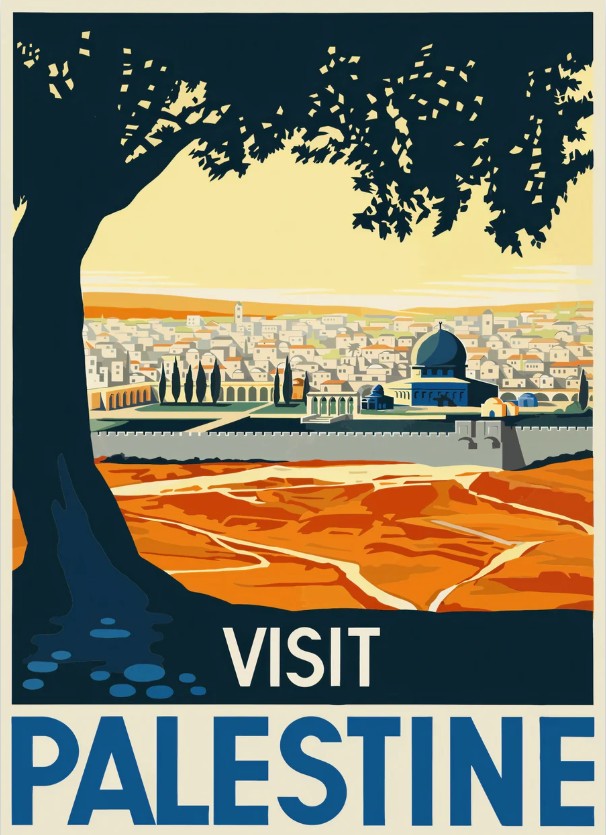
    The first frame of the video features one of the most recognizable images in this entire conflict. A warm Mediterranean sun rising over the Old City. The Dome of the Rock at the center. The words “Visit Palestine” written across the bottom.

    I recognized it immediately. I don’t think Mamdani knows its history. I wish he did. Because that history quietly dismantles the story he was trying to tell.

    The poster was designed by Franz Krausz, an Austrian-born Jewish graphic designer who emigrated to Palestine in 1934, fleeing the Nazis.

    The commission came in 1936 from the Tourist Development Association of Palestine, whose explicit goal was to encourage Jews to immigrate. At the time, the term “Palestine” carried no particular political connotation. It was simply the name for the land under British Mandate control.

    When asked to create an image that would invite his people to join the burgeoning Jewish community there, Krausz made a choice worth sitting with. Rather than emphasizing overtly Jewish symbols, he centered the image on the Dome of the Rock, one of Islam’s most sacred sites. A Jewish refugee commissioned by a Zionist organization, envisioning the future of his people’s homeland, put a mosque at the center of the frame. That was the image he chose. That was the invitation he extended.

    Krausz went on to become one of the founding figures of the advertising and graphic design industry in what would become Israel, and died in Tel Aviv in 1998.

    After Israel’s founding in 1948, most Israeli Jews stopped referring to the land as Palestine, and the poster faded from memory for decades.

    At the height of the Oslo peace process in the 1990s, a Tel Aviv graphic designer and activist named David Tartakover reprinted Krausz’s image, describing it as a gesture of hope for coexistence. He went back to Krausz personally and got his permission. An Israeli peace activist, in the middle of a fragile moment of possibility, chose a Jewish refugee’s Zionist tourism poster as his symbol of a shared future. That is what the image meant when it reappeared in the world.

    What it means when Mamdani uses it is something else entirely. Most people who share it today assume it is evidence of a sovereign Palestinian state that existed before Israel “erased” it. What it actually documents is that a Jewish man fleeing Nazi Europe was asked to picture his people’s future in that land, and the future he pictured had a mosque in it.

    In other words, Mamdani is selling a lie.

    Also, that Inea Bushnaq, interviewed as a Nakba survivor who had to flee from the rampaging Zionists…that’s a Bosnian name. Her family fled to the area in the dying days of the Ottoman Empire. Another European settler….

  • Interview here.

  • Camilla Long in today’s Sunday Times on that report – Hamas’s sexual terrorism is laid bare and still the world looks away:

    To read any one of the 298 pages of the Civil Commission’s report, published last week, on the rapes carried out by Hamas on October 7 is to be plunged back into hell. There is not only the graphic horror of it — the maimings, the torture, the shocking sexual violence — but the knowledge that, in the days, months and years after it happened, many people pretended it hadn’t.

    There were no outcries, no populist movements. Few feminists spoke about what had happened to Jewish women, even though sexual terrorism was, as the report now shows, central to Hamas’s plan.

    UN Women waited months to concede, in a tweet, there may have been some “gender-based violence”. In this country feminists warned against being “Islamophobic” and “racist”. In 2024 the Jewish-American writer Phyllis Chesler was amazed to note a “shameful, even unbearable, silence” among her feminist colleagues, while watching feminists, lesbians, queers and gays flocking to the streets and “marching for Hamas”.

    Reading the report now, I share her horror: how was this even possible?

    Because Jews. But also because Palestine and Hamas have been set up as the great progressive cause of the moment, and such brutality can be hard to justify – though, god knows, many tried. Also, because it’s almost impossible to believe that anyone could behave with such mindless sadistic violence – though, tragically, history gives us enough examples.

    In every paragraph there are descriptions of women being stripped, raped and then killed. Sometimes, after they are killed, they are raped again.

    They are mutilated: one witness at the Nova music festival said she saw Hamas fighters cut off a woman’s breast while they molested her. They threw it in the dirt and then played with it. She was then shot in the head while still being gang-raped.

    Kibbutz Be’eri, three miles from the border, was found littered with dead women, often tied up, often naked. One victim had “knives, scalpels, a hammer, an axe, screwdrivers, tools, tools from the household” embedded in her body. “The body was completely mutilated.” Then there were the women who lay dead, blood surrounding their genitals. At a military base female soldiers were “shot in the crotch, intimate parts, vagina”. And when all that was over, and these criminals still hadn’t had enough, they would destroy the women’s faces.

    Yes, they hate Jews. They really really hate Jews. It’s what they’re taught, from infancy – mostly, disgracefully, in UNRWA schools. Also, I think, we need to remember that these young men were fired up, not only by Jew hatred, but also by drugs – captagon, most likely, the nasty amphetamine-style drug that bank-rolled Assad’s Syria, and possibly cocaine too. This isn’t normal human behaviour.