I posted yesterday on NYC mayor Mamdani’s celebration of Nakba Day. Here’s more, from Hen Massig:
Yesterday, Mayor Zohran Mamdani posted a Nakba Day video from his official mayoral account. It features an interview with a New York resident named Inea Bushnaq, described as a Nakba survivor, who recounts fleeing her home because, in her words, “the Zionists were coming into Jerusalem.”
The first frame of the video features one of the most recognizable images in this entire conflict. A warm Mediterranean sun rising over the Old City. The Dome of the Rock at the center. The words “Visit Palestine” written across the bottom.
I recognized it immediately. I don’t think Mamdani knows its history. I wish he did. Because that history quietly dismantles the story he was trying to tell.
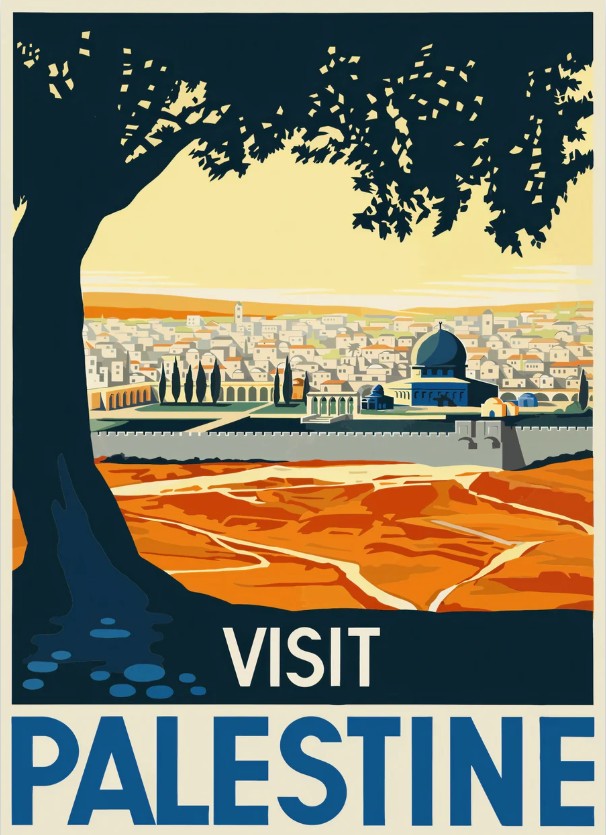
The poster was designed by Franz Krausz, an Austrian-born Jewish graphic designer who emigrated to Palestine in 1934, fleeing the Nazis.
The commission came in 1936 from the Tourist Development Association of Palestine, whose explicit goal was to encourage Jews to immigrate. At the time, the term “Palestine” carried no particular political connotation. It was simply the name for the land under British Mandate control.
When asked to create an image that would invite his people to join the burgeoning Jewish community there, Krausz made a choice worth sitting with. Rather than emphasizing overtly Jewish symbols, he centered the image on the Dome of the Rock, one of Islam’s most sacred sites. A Jewish refugee commissioned by a Zionist organization, envisioning the future of his people’s homeland, put a mosque at the center of the frame. That was the image he chose. That was the invitation he extended.
Krausz went on to become one of the founding figures of the advertising and graphic design industry in what would become Israel, and died in Tel Aviv in 1998.
After Israel’s founding in 1948, most Israeli Jews stopped referring to the land as Palestine, and the poster faded from memory for decades.
At the height of the Oslo peace process in the 1990s, a Tel Aviv graphic designer and activist named David Tartakover reprinted Krausz’s image, describing it as a gesture of hope for coexistence. He went back to Krausz personally and got his permission. An Israeli peace activist, in the middle of a fragile moment of possibility, chose a Jewish refugee’s Zionist tourism poster as his symbol of a shared future. That is what the image meant when it reappeared in the world.
What it means when Mamdani uses it is something else entirely. Most people who share it today assume it is evidence of a sovereign Palestinian state that existed before Israel “erased” it. What it actually documents is that a Jewish man fleeing Nazi Europe was asked to picture his people’s future in that land, and the future he pictured had a mosque in it.
In other words, Mamdani is selling a lie.
Also, that Inea Bushnaq, interviewed as a Nakba survivor who had to flee from the rampaging Zionists…that’s a Bosnian name. Her family fled to the area in the dying days of the Ottoman Empire. Another European settler….
 Mick Hartley
Leave a comment