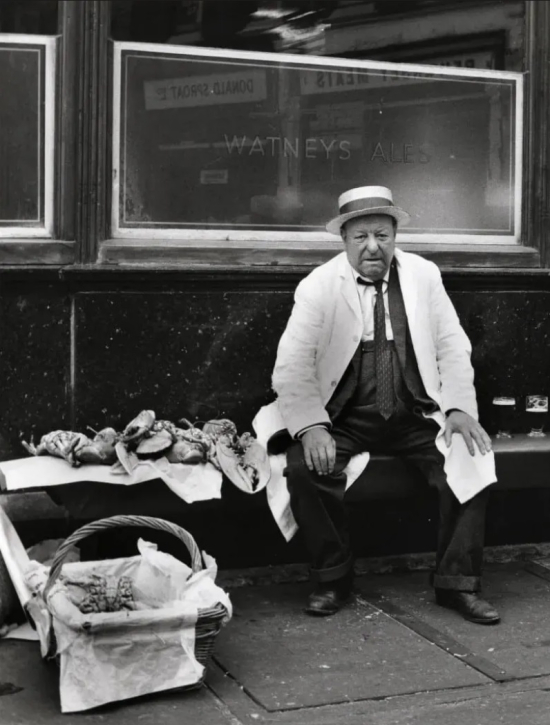
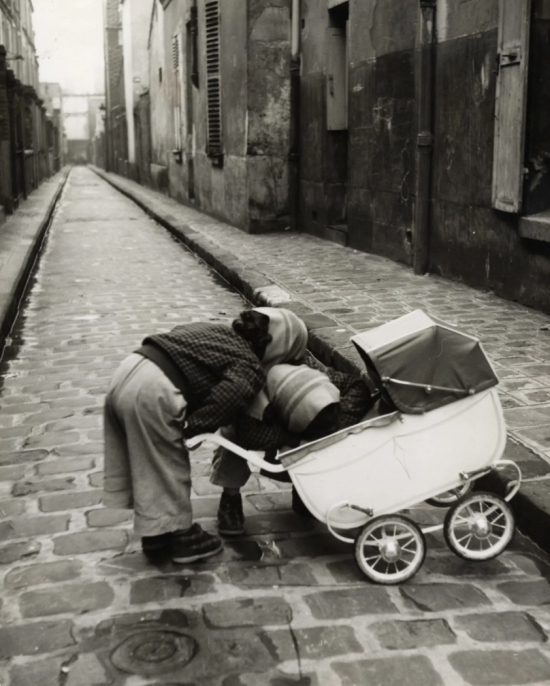
• Dorothy Bohm – "one of the doyennes of British photography" – has an exhibition in the Print Room downstairs at the Photographers' Gallery.

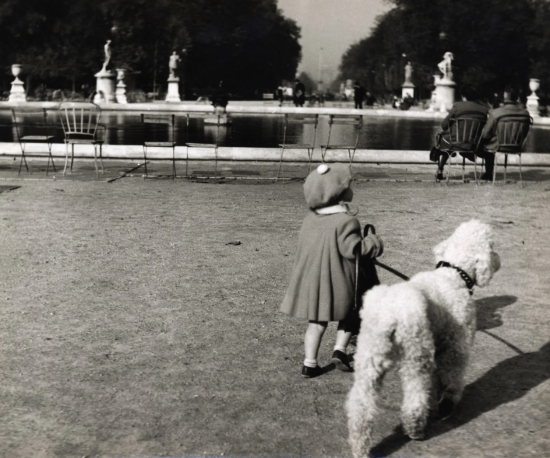
    "I have spent my lifetime taking photographs. The photograph fulfils my deep need to stop things from disappearing. It makes transience less painful and retains some of the special magic, which I have looked for and found. I have tried to create order out of chaos, to find stability in flux and beauty in the most unlikely places.”

    Bohm1
    Villa des Tulipes, 18th arrondissement, 1953

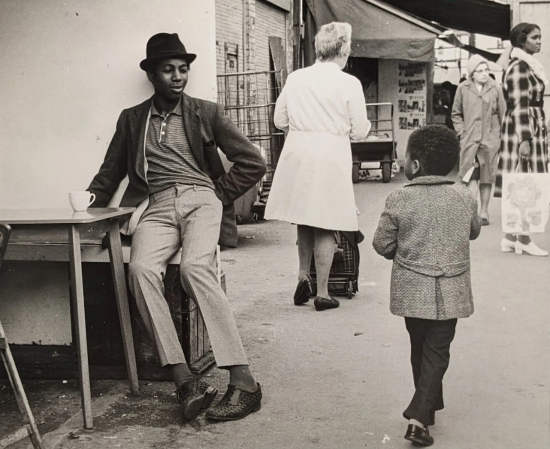
    Bohm2<
    Shepherd's Bush Market, London, 1970s

    Bohm5
    Paris, 1950

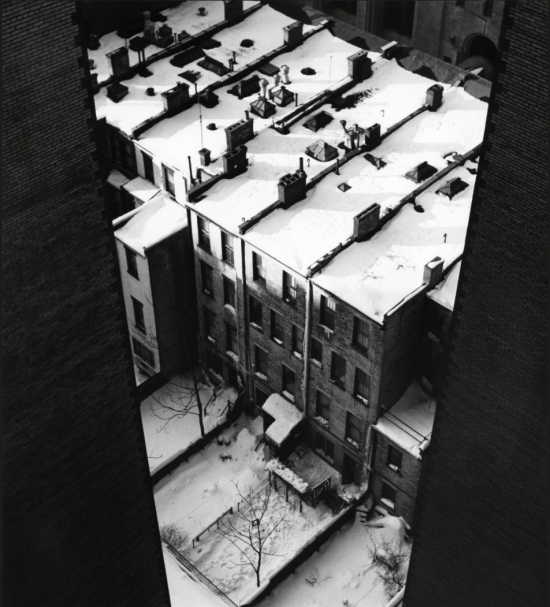
    Bohm6
    New York, 1952

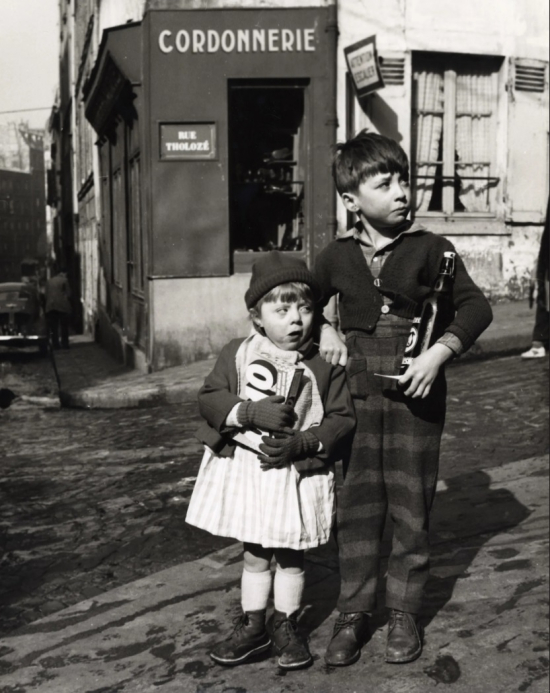
    Bohm3
    Rue Tholozé, Paris, 1954

    Bohm7
    New York, 1953

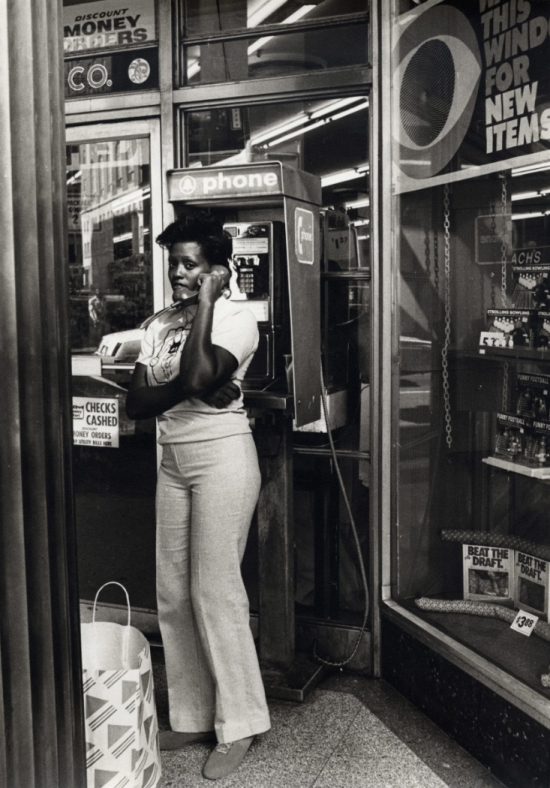
    Bohm8
    New York, 1970s

    Bohm9
    Mount Street, Mayfair, 1960s

    Bohm10
    Jardin des Tuileries, Paris, 1953

    Bohm11
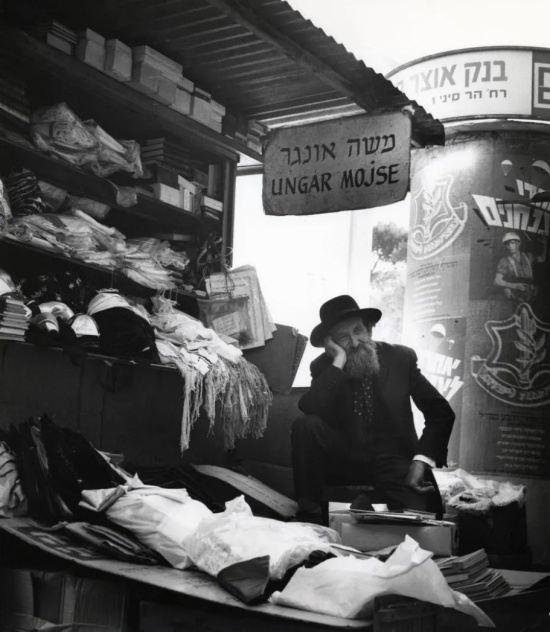
    Israel, 1970

    Bohm12
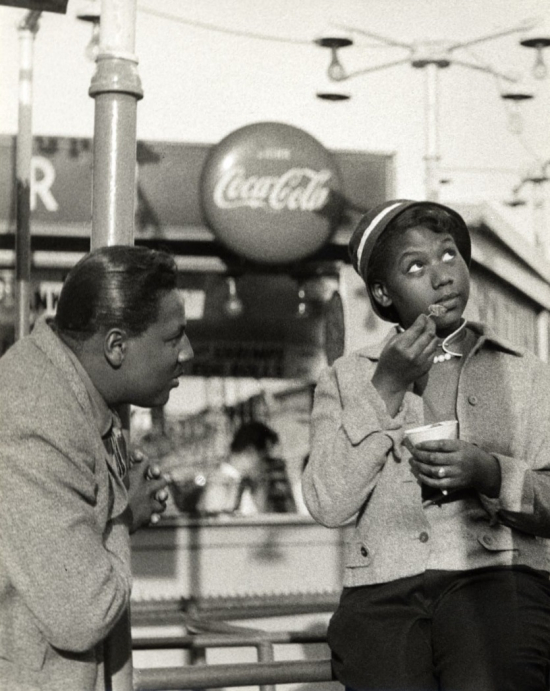
    Coney Island, New York, 1952

    Bohm13
    Cannon Street Station, London, 1960s

    Bohm14
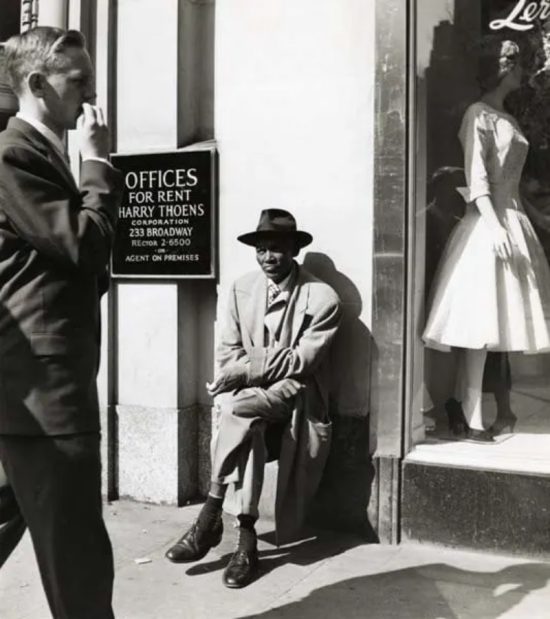
    Broadway, New York, 1956

    Bohm15
    Billingsgate, London, 1960s

    Bohm16
    Approach to the Castle, Lisbon, 1963
    [Photos © Dorothy Bohm Archive]

  • https://platform.twitter.com/widgets.js

    Full text:

    In 1941, the Nazis incited The Farhud, a massacre against the Jews of Baghdad. Hundreds of Iraqi Jews were murdered in this extension of the Holocaust

    The Farhud and Kristallnacht are so similar – violent massacres against Jews incited by Nazis that sparked the expulsion and mass murder of Jews from their countries. They really should be taught together.

    My own grandmother, Hela, lived through the Farhud. She finds it difficult to speak about that time, but she has shared her story with me.Though, she always prefers to speak about Iraq before the Farhud, the place she loved so dearly.

    On the first day of the Farhud, my grandmother was at a cafe I knew well, she often told me about the lovely little cafe she loved to go to. On June 1st, 1941 she was there like always.

    Suddenly she hears screaming. She turns her head and sees an irate man screaming “Kill the Jews” in front of a woman with eight children, one merely a baby.

    To my grandmother’s horror, he begins shooting. One-by-one he shoots the little children as their mother screams. He saves her for last.

    The cafe owner grabs my grandmother and hides her in the backroom until my great-grandfather came to fetch her. They went to a neighbor’s house, a kind Muslim family who were equally horrified by the frenzy of hate.

    All night there was screaming and crying. Glass shattering. My grandmother could not sleep.

    The next day she watched in horror as a disabled Jewish teen was brutally raped. She watched as the man finished and then broke a glass bottle so he could rape her with that too.

    My grandmother did not speak for the rest of that day, she could only weep inconsolably.

    My grandmother adored Iraq and the streets she grew up in, the neighbors they were friends with. But she was not safe in Iraq after the Farhud, nor was any other Jew.

    This is my history and the history of most of the Jews living in Israel today. A majority of us are the descendants of Jews who were violently expelled from the Middle East and North Africa.

    I will not “go back” to Poland, nor will I advocate for the destruction of Israel, the one place my grandmother felt safe after she had to witness such horrors.

    They were in Iraq a long time, the Jews

    The history of the Jews in Iraq is documented from the time of the Babylonian captivity c. 586 BCE. Iraqi Jews constitute one of the world's oldest and most historically significant Jewish communities.

    Over 1000 years before Arabs arrived in Palestine.

    During the 19th century, the influence of the Jewish families of Aleppo of the previous century faded as Baghdad emerged as a strong Jewish and economic center in its own right. The Jewish population had grown so rapidly that by 1884, there were 30,000 Jews in Baghdad and by 1900, 50,000, comprising over a quarter of the city's total population. Large-scale Jewish immigration from Kurdistan to Baghdad continued throughout this period. By the mid-19th century, the religious infrastructure of Baghdad grew to include a large yeshiva which trained up to sixty rabbis at time. Religious scholarship flourished in Baghdad, which produced great rabbis, such as Joseph Hayyim ben Eliahu Mazal-Tov, known as the Ben Ish Chai (1834–1909) or Rabbi Abdallah Somekh (1813–1889).

    Then the Farhud, in 1941 – the beginning of the end. And after…

    Hoping to stem the flow of assets from the country, in March 1950 Iraq passed a law of one-year duration allowing Jews to emigrate on condition of relinquishing their Iraqi citizenship. They were motivated, according to Ian Black, by "economic considerations, chief of which was that almost all the property of departing Jews reverted to the state treasury" and also that "Jews were seen as a restive and potentially troublesome minority that the country was best rid of." Iraqi politicians candidly admitted that they wanted to expel their Jewish population for reasons of their own….

    From the start of the emigration law in March 1950 until the end of the year, 60,000 Jews registered to leave Iraq. In addition to continuing arrests and the dismissal of Jews from their jobs, this exodus was encouraged by a series of bombings starting in April 1950 that resulted in a number of injuries and a few deaths. Two months before the expiration of the law, by which time about 85,000 Jews had registered, another bomb at the Masuda Shemtov synagogue killed 3 or 5 Jews and injured many others. Iraqi Prime Minister Nuri al-Said was determined to drive the Jews out of his country as quickly as possible, and on August 21, 1950, he threatened to revoke the license of the company transporting the Jewish exodus if it did not fulfill its daily quota of 500 Jews.

    And now:

    In 2021 the Jewish population in Iraq number was fewer than five. In 2022 the number of living Jews in Iraq had shrunk to three.
  • Jack Omer-Jackaman, in a long read at Fathom, on the obscene jubilation of the anti-Zionst left at the October 7th pogrom:

    Every radical generation has its Kronstadt, said the American sociologist Daniel Bell – has, in other words, that revelatory moment when, at least for some, the intellectual evasions and moral contortions of the party line become both unavoidable and untenable. Bell was old enough that his Kronstadt was Kronstadt. For others, the Moscow Trials, Molotov-Ribbentrop, Hungary, Czechoslovakia, Poland etc. etc. did the trick. Plenty more refused to acknowledge a Kronstadt moment and went to their graves refusing to concede that there was so much as a flaw, let alone evil, in the great liberation.

    My own Kronstadt – from an era when the Soviet god that failed had been replaced with a new deity in the form of decolonisation – was less an event than an idea, or rather the exposure of a dogma posing as an idea. I remember it with crystal clarity: the moment I read Judith Butler’s demand that we understand ‘Hamas/Hezbollah as social movements that are progressive, that are on the left, that are part of a global left.’

    I knew two things at that moment. First, that decolonisation and the campaigns for global justice had not themselves been delegitimised by such insanity, any more than the horrors of the Soviet Union had delegitimised socialism. Second, that while, like Jean Améry, I would be always of the left, I could henceforth play no part in any left that agreed with Butler, and that the rest of my life would in some way be spent engaged in an acrimonious dialogue with it.

    Any more I have to give, from here on out will, in large part, be devoted to ensuring that the ‘this is what liberation looks like’ response to 7 October becomes this generation’s Kronstadt. […]

    The road to this squalid reaction to 7 October has been a long one, with many a disastrous turn leading the far left into ever more dangerous and bankrupt territory. It is what happens when dogma becomes more fashionable than critical thought; when radicalism trumps reason; when the antidote to Orientalism is taken to be Occidentalism; when the counter to cultural imperialism is moral relativism; when it is ‘better to be wrong with Sartre than right with Aron’; when Foucault decides, for us all, that Iranian women and Iranian democrats can go to hell – the Ayatollah is, after all, just too damned exciting.

    Yes, the present swamp was fed by myriad fetid tributaries. So too does it inevitably become more and more contaminated. Generations raised on blather masquerading as profundity and on nihilism masquerading as radical chic. This next generation has far exceeded Butler in both irrationality and the explicitness of its contempt for Israeli life.

  • Oh ffs. Woman, 70, in court over husband's death. It's a man:

    A woman has appeared in court charged with the murder of her husband, who was found dead at their home in East Sussex.

    Emergency services were called to a property in Lavender Street, Brighton, at about 19:30 BST on 27 May.

    Joanna Rowland-Stuart, 70, was charged arrested and charged with killing Andrew Rowland-Stuart, also 70, who was pronounced dead at the scene.

    Ms Rowland-Stuart appeared before magistrates in Crawley on Friday. She has been remanded in custody ahead of a hearing at Lewes Crown Court on 3 June.

    https://platform.twitter.com/widgets.js

  • Joan Smith at UnHerd:

    An intolerant movement has found a new target: literary festivals. Last night, in a development that should worry everyone who values open debate, the Edinburgh International Book Festival (EIBF) followed the example of the Hay Festival by suspending links with one of its sponsors, the investment company Baillie Gifford.

    Both festivals have been hit by authors withdrawing and fears of disruption, prompted by a little-known group calling themselves “Fossil Free Books”. In recent weeks, they sent an email to writers, calling on them to protest about Hay’s sponsorship deal with Baillie Gifford or withdraw from appearing. The activists accuse the company of investing in the petrochemical industry and criticise its links with companies that operate in Israel.

    In reality, Baillie Gifford’s investment in fossil fuels is 2%, well below the industry average, while their involvement in Israel consists of investing in companies such as Amazon and Airbnb, which millions of consumers use without qualm everyday. Predictably, the flight from Hay was led not by authors, but the singer Charlotte Church, the Labour MP Dawn Butler and the Labour peer Shami Chakrabarti. But around 600 authors signed an open letter, leading to events being cancelled and tickets having to be refunded. In Edinburgh, similar pressure was being exerted….

    In an over-heated atmosphere, where prominent people live in terror of saying or doing the wrong thing, activists have enormous influence. During the Labour leadership campaign in 2020, a previously unknown organisation calling itself the Labour Campaign for Trans Rights demanded that the candidates sign a series of pledges, including one to expel “transphobic” members of the party. Most did, including Lisa Nandy, Rebecca Long-Bailey and current deputy leader, Angela Rayner.

    The speed with which well-known people give in to the demands of self-appointed moral arbiters is astonishing. Some appear to have lost any capacity for critical thinking, responding like Pavlov’s dogs to a series of cues: trans rights, fossil fuels, Israel. Writers, of all people, should know better. This is not moral clarity, but its exact opposite.

    But, encouragingly, there has been a backlash:

    Dozens of Scotland’s top writers have criticised the ”perverse” and “deeply retrograde” impact of protests over the sponsorship of Edinburgh International Book Festival. Close to 70 celebrated authors, including Val McDermid, Liz Lochead, Jackie Kay, Chris Brookmyre, Andrew O’Hagan and Alexander McCall Smith, have signed an open letter raising concerns about the campaign and the future of the festival.

    Writers, that is, who you've heard of, unlike the signatories of that open letter – Michael Rosen plus a load of numpties.

    In the open letter, sent exclusively to The Scotsman, the writers said they were “profoundly concerned” about the fate of the UK’s book festivals and other cultural events, and the “likely consequences” of calls for boycotts related to festival sponsorship by Baillie Gifford.

    It said: “In particular we are deeply concerned about the future of the Edinburgh International Book Festival (EIBF). As citizens, we are absolutely right to keep up the pressure for fossil fuel divestment. We also call for an immediate ceasefire in Gaza and for the release of hostages.

    “However, a strategy of protest which results in EIBF being left without a principal sponsor will jeopardise its future: this would be a Pyrrhic victory, and merely deprive writers and activists of platform and influence.”

  • An opinion piece in the BMJ from Glasgow GP Margaret McCartney – Medical institutions must treat the Cass review as a significant event and act upon it:

    The conclusions of the Cass review should not be surprising to anyone who has watched the promotion of medical interventions as necessary or curative in young people with gender dysphoria. As Cass states, there is a “lack of evidence” on the long term impact of hormonal prescriptions in young people, for example. Work now begins on how to design better, more evidence based, holistic services. The conclusion that services “must operate to the same standards as other services seeing children and young people with complex presentations and/or additional risk factors” is astonishing, in that it needed to be said. We need, says the report “a different approach to healthcare, more closely aligned with usual NHS clinical practice.”2 In other words, this suggests that the approach the NHS has taken with respect to gender dysphoria has been at odds with the usual, evidence based approach taken elsewhere. This should be deeply discomfiting. As the dust settles, and we reflect on the report’s conclusions, we should ask why this has happened.

    There are multiple potential explanations. One is alluded to clearly by Cass: “the toxicity of the debate is exceptional,” she writes. Indeed. I know many senior medics who were concerned about the lack of evidence for interventions, but felt their reputation and job would be under threat if they spoke up. Anonymous personal attacks online is one thing; personal abuse from senior medics for raising clinical concerns is quite another. When considered in the context of whistleblowing more broadly, medicine clearly has an ongoing problem.

    But when it comes to large, well funded, professional medical organisations, there is even less excuse. The job of medical institutions is in large part to remember the mistakes of history. These organisations should respond with care, consider evidence, uncertainty, and the recurrent tendency of well meaning medicine to do harm with good intentions. Popularity should be resisted over the need for evidence and caution. This requires strong leadership. Shutting down, or trying to shut down debate about serious clinical uncertainties—as has happened—is unacceptable.

    This has not been helped by the multiple lobby groups, welcomed by many institutions to influence their policy making in this area. The same rules that we would normally use to guard relationships with any other pressure group—be it promoters of disease “awareness campaigns” or party politicians looking for support—seem to have dissolved against social pressure to achieve a compliance badge on a website.

    The other explanation for what has happened that I think pertinent is this. Doctors, quite rightly, have been afraid to make the same mistakes as medicine did when homosexuality was treated as an illness in the 1950s. Then, electric shocks, desensitisation, hormones, and psychotherapy were attempted to be used to “treat” homosexuality—shamefully. What medicine did then was to intervene—ineffectively and harmfully—in something that was not a disease and should not have come under a medical purview. As Cass states, for most young people experiencing gender dysphoria, it is temporary; it is often associated with neurodiversity; it mainly resolves over time, and medical intervention does not benefit the majority. There is a comparison, but it is in favour of medicine backing off from prescriptions and surgery, and understanding why a phenomenon might be happening, why it is being seen in a medical context, and what is the best and least harmful way to respond to such expressed and profound distress.

    An interesting comparison. In both cases – homosexuality and gender dysphoria – doctors felt obliged, in line with the social mores of the times, to intervene medically. This was shameful on both occasions. For homosexuality no intervention was required: just a change in the social mores. Gender dysphoria, on the other hand, was an extremely rare complaint until very recently. It's a social contagion, driven by the gender industry. Whatever the answers may be, they shouldn't involve immediate prescription of puberty blockers followed by hormone replacement therapy. At least, thanks to Cass, that much is now clear.

  • https://platform.twitter.com/widgets.js

    [And again: "Dear university students in the US, my advice to you is to become familiar with the Quran."]

    Further proof, if proof were needed: at the People's Conference for Palestine on May 26 in Detroit (post yesterday): North Korea "has never once recognized the Zionist tumor that goes by the name of Israel." "PFLP founder George Habash received training in Pyongyang".

    With Iran and North Korea on your side, all that's needed now is an endorsement from Putin. Case closed.

  • She had it coming.

    https://platform.twitter.com/widgets.js

    From Manchester Evening News – Grandad who strangled wife before going to Costa jailed for six years.

  • Darren Johnsom seems to have been one of the rare Green Party members who wasn't deranged – so they threw him out. The party, he believes, has been taken over by trans ideology: their dismissal of the Cass Report was the final straw.

    He writes about it in the Telegraph:

    In the Scottish Parliament Green MSPs now stand completely isolated on the Cass findings. Their co-leader, Patrick Harvie, was reluctant to even accept the report as a valid scientific document.

    In London, Zoë Garbett, the Green mayoral candidate last month (who now sits as a London Assembly Member after her predecessor resigned her seat just days after getting elected) joined Harvie in attempting to undermine the findings. Apparently without even a pause for reflection over the monstrous way vulnerable young people had been let down by the NHS, she put out an upbeat and bouncy but completely nonsensical video dismissing the Cass Review as “really worrying” and saying that while “it’s widely recognised there are problems with trans healthcare, this review does not speak to the heart of those.”

    This casual dismissal of such a landmark report was absolutely gut-wrenching for me. I had twice stood as the Green Party’s candidate for mayor of London and spent 16 years representing the Greens as a London assembly member. Throughout that time, children’s health featured high on my list of priorities, whether it was pushing for tough measures on air pollution or fighting for better homes for families living in overcrowded conditions. How dare leading Greens be so dismissive of a well-researched, scientific review tackling a shameful medical scandal.

    I reacted with fury. “Vote Green if you want to completely ignore medical evidence and see more children pumped full of harmful drugs.” I wrote on X (formerly Twitter) in response to that awful, glib video from Garbett.

    I knew at the time it would put my 37-year membership of the party in jeopardy. Numerous women in the party have already been suspended or expelled but I was not going to sit back and stay silent while leading members of the Green Party went out of their way to rubbish the Cass Review. The Green Party has also accused me, erroneously, of endorsing the Labour candidate in Brighton Pavilion. I have not, although I will admit to calling some of my erstwhile colleagues “science-denying loons”. Well, if the cap fits.

    I am beyond despair that the political party I’ve been a member of for decades, that has always said “trust the science” when it comes to climate change or air and river pollution, is apparently putting ideology before science when it comes to pushing untested medical treatments for children.

    By suspending me this week, the Green Party perhaps hopes it can bully me into silence in the run-up to the general election. They will not succeed. Whether they decide to lift the “temporary suspension” they have slapped on me or expel me on a more permanent basis, I will not stop speaking out on this grotesque medical scandal that has harmed many vulnerable young people and harmed the credibility of the political movement I’ve spent most of my life fighting for.

  • Yet another deranged Green Party candidate. From the JC:

    A Green Party parliamentary candidate suggested that the Israeli government may have paid Hamas to commit the October 7 attack so they could build a canal through Gaza….

    Joe Belcher, who is standing in the West Midlands seat of Aldridge-Brownhills, questioned on X/Twitter last November why Palestinian terror leaders would have “sold their people down the river” by attacking Israel.

    "Why would Hamas commanders order Oct 7 to then have their territory destroyed and their people killed or displaced from Gaza?” he asked.

    "For money? If so, who offered them this money? The Israel government?”

    Belcher continued: “It's certainly convenient now that Israel can attempt to justify wiping out Palestinians from Gaza and to claim Gaza as Israel.

    “Why would they do that? To claim rights over the oil and gas reserves in Gazan waters and to clear the way to create the Ben Gurion Canal through Gaza?”

    Ah yes – the Ben Gurion canal. I wrote this in December:

    The Ben Gurion Canal was a project conceived in the US in the early 1960s and quickly abandoned, involving the construction of a rival to the Suez Canal, from the Mediterranean at Gaza through to the Gulf of Aqaba at the top of the Red Sea. The level of hare-brained crackpottery involved can be seen from the suggestion that the colossal amount of excavation work required would be facilitated by the use of over 500 nuclear explosions. But – this being Israel, and this being Gaza – the story is loved by conspiracy theorists. The blocking of the Suez Canal in 2021 was seen by some as deliberate, and part of a plot by the West to support this alternative Israeli canal. And now, of course, it's cited as the real reason for Israel's attack on Gaza. Money, hidden Jewish power, shady deals – what more could you want?

    Jonas Hessenauer explored this in Fathom, and explained the current popularity of this particular conspiracy theory, in the UK at least:

    ‘Israel and the United States want the giant amounts of gas in Gaza, and to create a rival to China’s New Silk Road’, said the British-Syrian ‘journalist’ Richard Medhurst in a video that he published on X (formerly known as Twitter) on 27 October, and which has since been viewed over 1.6 million times. In the same clip, he relativises the Holocaust and demonises Israel, when he calls the Gaza Strip a ‘concentration camp run by the Israelis’. Medhurst also claims that the UK, the US, and Israel were responsible for the explosion in the port of Beirut (2020) as well as for blowing up the Nord-Stream-pipelines (2022). He expresses himself openly antisemitic, anti-American, and conspiracist in other videos too.

    And a Green Pary candidate lapped it all up. Who would have guessed?