
• For, shall we say, a less nuanced view than Freedland's, here's Douglas Murray in the Spectator:

    If you follow most of the British media, you may well think that the past year involves the following events: Israel attacked Hamas, Israel invaded Lebanon, Israel bombed Yemen. Oh and someone left a bomb in a room in Tehran that killed the peaceful Palestinian leader Ismail Haniyeh.

    Of course all this is an absolute inversion of the truth. Hamas invaded Israel, so Israel attacked Hamas. Hezbollah has spent the past year sending thousands of rockets into Israel, so Israel has responded by destroying Hezbollah. The Houthis in Yemen – now so beloved of demonstrators in the UK – sent missiles and drones hundreds of miles to attack Israel, so Israel bombed the Houthis’ arms stores in Yemen. And Hamas leader Haniyeh, who was born under Egyptian rule and died in Tehran, never brought the Palestinian people anything but misery.

    On 7 October last year Israel was surprised by a brigade-sized invasion of terrorists into its territory. These terrorists raped, murdered and burned their way as far inside Israel as they could get. How this intelligence and military failure was possible is something that Israelis still have to work out. But the first answer is because they face a fanatical, ideological opponent which wants to destroy them. Hezbollah joined in the action on 8 October. All these attacks were funded and orchestrated by the Revolutionary Islamic government in Iran, which as I write this is sending hundreds of ballistic missiles at Israel from Iran – strikes that have so far proved a failure.

    Hamas still holds a hundred Israelis hostage inside Gaza, but the Israeli government has managed to bring half the hostages home already. For many people in the first days of the war, it seemed impossible that even one hostage would be able to come back to their families alive. So this is no mean feat in itself. Aside from saving the hostages, the other most important thing for Israel has been to strike and destroy the proxy armies of Iran who wish to make the whole of Israel unlivable for Jews.

    All this time the governments in Britain and America have given the Israelis advice which mercifully they did not listen to. Earlier this year, Kamala Harris warned that the IDF shouldn’t go into Hamas’s Gaza stronghold in Rafah. As she wisely said: ‘I’ve studied the maps.’ Fortunately the Israelis did not listen to Kamala’s beginners’ guide to Rafah. They went into the Hamas stronghold, continued to search for the hostages, continued to kill Hamas’s leadership and continued to destroy the rocket and other ammunition stores that Hamas has built up for 18 years.

    Next came the complete destruction of Hezbollah, which has the blood of hundreds of Americans and other nationals on its hands, as well as that of Israelis. Not to mention the fact that this foreign army of Iran has immiserated Lebanon for 40 years. The Christians of that country have dwindled to a minority as these Shiite fundamentalists have taken a once thriving country and turned it into yet another ayatollah-dominated hellhole.

    Then, in a series of attacks which historians are already studying, everything went kaboom for Hezbollah. First thousands of its operatives were targeted all over Lebanon and Syria. Having decided that phones were not a safe means of communication, the terrorists had recently reverted to pagers, but someone managed to get into the supply chain, put a small amount of explosive in every Hezbollah device and then blew the balls off the people who were hoping to destroy their neighbours. Then Hezbollah’s walkie-talkies also suddenly detonated. Much of Hezbollah’s leadership – including those involved in the killing of 241 American marines in their barracks in Beirut in 1983 – met up in person to discuss all this, during which they too were killed in a strike.

    The British and American governments among others had told the Israelis that there should be no escalation. But fortunately they weren’t listened to. The Israeli Prime Minister Benjamin Netanyahu had gone to New York to address the various despots and kleptocrats on First Avenue; so the ultimate leader of Hezbollah, Hassan Nasrallah, thought that this would be a safe moment to get together with the few remaining members of his organisation. Before going on stage in New York and observing the traditional walkout of ‘diplomats’, Netanyahu ordered the final strike. While he was up there, Hassan Nasrallah went to meet his maker.

    By this point, there is nobody left in Hezbollah. They’re all gone. All of the leadership, every one of their commanders, while their lower-level operatives are trying to get their testicles reattached in the hospitals of Beirut. It’ll be wall-to-wall wreath-laying for the Hamas and Hezbollah fanboys.

    But there it is. The wisdom of the international community is that ceasefires are always desirable, that negotiated settlements are always to be desired, and that violence is never the answer. As so often, these wise international voices have no idea what they are talking about.

    Israel’s enemies have spent the past year trying to destroy it, as they have so many times before. But it is they who have gone to the dust, with the regime in Tehran the only thing that is, for the time being, still standing. Absent that terror regime, and not just Israel but the whole of the Middle East has a bright future. Sometimes you need war to make peace. Sometimes there is a price to pay for trying to finish the work of Adolf Hitler. Who knew?

    That "finish the work of Adolf Hitler" is more than a cheap jibe. The links between Nazism and antisemitism in the Islamic Middle East have been well established by historians like Matthias Küntzel. See here, for instance.
  • A brave piece in, yes, the Guardian, from Jonathan Freedland:

    Here’s what I mean about those two different views of Israel. There’s the Israel you see on the news: the mighty bully, wildly lashing out at its neighbours, that, not content with turning much of Gaza into rubble, has now rolled its tanks into Lebanon – apparently for no better reason than because it can. This Israel is the one indicted by the world’s courts, where it is accused of the most heinous crimes. This Israel has, for a year, brought out millions in mass demonstrations in the major cities of Europe, the US and beyond, a scale of protest unseen for two decades, politicising a generation that has decided that opposition to Israel is the great issue of our age.

    And then there’s the Israel you glimpse in the testimony of the men, women and very young children who survived a massacre whose anniversary comes on Monday – telling how they huddled, alone and undefended, in bathrooms and kids’ bedrooms, for long, terrified hours as Hamas men surrounded their homes, firing bullets through doors and hurling grenades through windows, before eventually setting house after house ablaze, yelping in delight at what they themselves called a “slaughter”. This Israel is the one still yearning for the hostages seized that day, scores of whom remain in captivity in Gaza. This Israel is the one whose north has been pounded by Hezbollah rockets for 12 months straight, forcing about 65,000 Israeli civilians from their homes.

    These are the two Israels, and they have next to nothing in common: the Israel that is seen by much of the world, and the Israel that sees itself.

    Take the upcoming anniversary. For many outside Israel, 7 October will mark one year since the start of a brutal war whose prime victims have been the innocents of Gaza, their deaths counted in the tens of thousands. Inside Israel, 7 October is the anniversary of the bleakest day in Jewish history since the Holocaust, when nearly 1200 people, most of them civilians, were massacred, many of them raped, tortured and burned alive.

    Or take the last two weeks. For many outside Israel, the bloodshed of the last fortnight is confirmation that Israel is the country that most threatens the Middle East, an aggressive power that, whatever comes next with Iran, had already widened its war to take in Lebanon, with strikes on Yemen too. Inside Israel, the last two weeks are understood as the country at last hitting back against the proxies of the regime that constitutes the true danger to the Middle East – namely, Iran and its theocratic rulers. For years, Iran has encircled Israel with a “ring of fire” that includes the three Hs: Hamas, the Houthis in Yemen and, most well-armed of the three, Hezbollah, wielding an enormous arsenal and the power of a state within a state. These actors and Iran are not, incidentally, simply in the business of ending the injustice of Israel’s post-1967 occupation: their stated goal is to end Israel itself.

    For many outside Israel, last week’s killing of Hezbollah’s leader, Hassan Nasrallah, was a reckless act of Israeli escalation, bound to push the Middle East into all-out war and equally bound to cause great loss of life. To Israelis, it was an act of self-defence, finally taking out the commander of an army that had been firing on northern Israel for an entire year – a fusillade that began on 8 October in an act of self-proclaimed solidarity with Hamas and which never stopped – rendering the towns and villages of that area uninhabitable. Israelis ask which country in the world would tolerate such a bombardment and leave untouched the man giving the orders, especially when that man once hailed the convenience of Jews being gathered in one place, Israel, because it meant not “having to go to the ends of the world” to find them. While they’re at it, Israelis like to remind their critics of Nasrallah’s role at the right hand of Bashar al-Assad, when Hezbollah assisted the Syrian dictator as he set about the murder of more than 600,000 of his own people.

    Or take the war that has caused so much pain for all of the last year. What the world sees in Gaza is a benighted strip of land that Israel has crushed, heedless of the consequences for civilian life. What Israelis see is a cruel Hamas enemy that revealed its true face on 7 October and which has embedded itself inside and beneath the streets and homes of Gaza, using the entire population as a human shield, so that when innocents die there, it is Hamas who should bear the blame.

    You can keep on like this, each example exposing the gulf that separates Israel from a swath of world opinion. But all this only points to the deeper difference. To most outsiders, Israel is a regional superpower, backed by a global superpower. It is strong and secure. But that is not how it looks from the inside. Israelis see their society as small – the size of New Jersey – besieged and vulnerable….

    There are two things to say about this yawning gap between how the world sees Israel and how Israelis see themselves. The first is that there is one group that is exposed daily to both perspectives and often finds itself caught in the middle. I am thinking of diaspora Jews, who see what Israel does, and how it looks, from the outside – and yet know, from friends and family, how it feels on the inside.

    Well yes, and there also many of us, not Jews, who can see why Israel feels compelled, finally, to confront its enemies. After October the 7th the status quo, surrounded by Iranian proxy armies bent on the its annihilation, and the total extermination of the Jews, was no longer an option. Though of course it has been diaspora Jews who've suffered most, given the extraordinary surge in antisemitism across the western world over the past year – not helped, it has to be said, by newspapers like the Guardian.

    The second is that if there is to be any hope at all of ending the terrible bitterness that fills that part of the world and radiates far beyond it, then those who stand on opposite ends of the yawning gap have to try, if only for a moment, to see how things look from the other side. Israelis need to think hard about the impact their actions, so eminently justified in their own eyes, have on all those around them. And the rest of the world could do with putting themselves in Israelis’ shoes every now and again, to imagine what it would be like to be surrounded by enemies who dream of your death and who, just one year ago, tried their damnedest to make those dreams come true.

    Who still dream of your death, and who are still trying their damnedest to make those dreams come true.

  • https://platform.twitter.com/widgets.js

    Full text:

    The difference between Israel’s overall goal and the Jihadists overall goal is that Israel seeks to eliminate the terrorists trying to kill them, and the Jihadists goal is to kill the Jews (or at least destroy the Jewish state and subject the Jewish people to submission under their oppressive, supremacist, ultra-nationalist, fascist rule).

    The lack of universal moral clarity on this is not just astounding, but with regard to those who call themselves academics, experts, journalists, politicians, commentators, professors, and the like, it’s honestly embarrassing.

    It’s one thing to be against war, violence, and death, which is a natural impulse to all feeling humans, but it’s quite another to reverse the cause and effect of these regional wars. It isn’t hiding, it’s in plain sight.

    It makes one wonder whether the jihadi-inspired brain rot has so deeply and irreparably pervaded our collective consciousness that they actually aren’t aware of their moral obfuscation, or worse, they know exactly what they’re doing and they’re doing it on purpose.

    Either way, our zeitgeist is marked by a duration of sweeping dishonesty, and untruth only sets us down an ever more dangerous path.

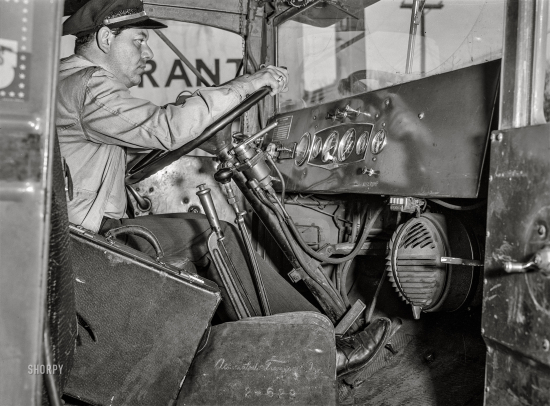
  • John Vachon, March 1943. "Bob Daugherty, a driver for the Associated Transport Company, at the wheel of a Brown truck on U.S. Highway Route 29 near Culpeper, Virginia."

    image from www.shorpy.com
    [Photo: Shorpy/John Vachon for the Office of War Information]

  • Off for a couple of days. Back Friday.

  • Hugo Rifkind at Jewish News – We expected sympathy to vanish but not this constant hate:

    I certainly remember knowing what was about to happen. I think everybody did. The day after, I was at the Cheltenham Festival on a panel and I said it out loud: that the wave of global sympathy Israel was at that point receiving would last, precisely, only until Israel retaliated. And then, such would be the scale and nature of that retaliation, it would disappear. This wasn’t a particularly insightful thought. Everybody knew it. I did, and you did, and Hamas did, and Benjamin Netanyahu did. It’s what always happens.

    Did I, though, expect that within days, posters of Israeli hostages would be being torn down, in every western city? No. That was new, and the experience of being a Diaspora Jew in lands where that occurs is new, too. And did I expect, when that experience began to change, how few people would care?

    Indeed, how many people would make a point of not caring? Again, no. I can remember, going back really not so far, how earnestly I tried to explain to people, for example, what that Hamas phrase – “from the river to the sea” – meant to most Jews. Honestly and truly, naively and stupidly, I really did think this might make them think twice about saying it. Instead, the opposite happened. It made them all love saying it even more.

    It’s at this point in a column, I know, that I should set out my stall. Make a declaration about my Zionism, my feelings about the Netanyahu government, my condemnation of Hamas, my despair about the slaughter of the inhabitants of Gaza, my preferred technicalities of some theoretical solution for peace in the Middle East. I’ve been asked about all of that quite a lot over the last year though, and I think I’ve perfected my response.

    Ready? It is “fuck off”.

    It doesn’t matter what I think. Even I don’t much care what I think. I can’t solve this. Why must I pretend I can?

    That’s the main thing that feels new. For a Jew to be expected to have all the answers, and to exhibit absolute moral perfection, before he or she is allowed to say anything at all.

    Linked to this is the low-level, constant, burning sense that quite a lot of people now hate me….

    It has become impossible, over this past year, to be irrelevantly Jewish. Impossible not to feel it, and be seen as it, by friends and foes, whatever you do, whatever you say, whatever the circumstances, whatever you’d otherwise prefer. Is it worse than being in Gaza? Of course not. Neither is it worse than being in Israel.

    Ask yourself, though, why I feel compelled to say that, when I’m here in Crouch End. I do, though, don’t I? Somehow, our society has decided that I have lost the right not to just be.

    And no, I did not expect that, at all.

    To be honest there wasn't even that much sympathy straight after October 7th, before any Israeli retaliation. Already many were taking the line – just as with the US after 9/11 – that Israel, the Jews, had it coming. Even, for some on the left, that this was something to be celebrated: the oppressed at last rising up against the colonisers.

  • After Siam Goorich on the "simpering terrorist sympathisers", here's Brendan O'Neill at Spiked:

    We are now in the truly surreal situation where privileged Westerners seem distressed over the death of Nasrallah while Muslims in Lebanon, Syria and Iran are dancing in celebration over it. Moneyed genderfluid kids on the manicured lawns of Columbia in NYC might be experiencing pangs of grief, or at least worry, following the killing of Nasrallah. But feminists in Iran, anti-Hezbollah activists in Lebanon and the families of the Syrians Hezbollah helped to butcher when it sided with Assad in the Syrian Civil War are elated. Surely, nothing better captures the moral disarray of the woke of the West than their bitter tears for an Islamist extremist whose Jew hatred, misogyny, homophobia and rank authoritarianism made him the enemy of every Muslim in the Middle East who longs for the thing these pampered Westerners enjoy: liberty.

    The Nasrallah angst of our opinion-forming classes is incredibly telling. It speaks to the staggering double standard by which Israel is judged. One wonders if it is historical ignorance or just brazen hypocrisy that means the puffed-up activist class of the US and UK can rail against Israel’s ‘unprecedented’ toppling of a terrorist mastermind even though their own nations have done likewise for decades. From Osama bin Laden to Abu Bakr al-Baghdadi, many terrorists have met a grim, just end in recent years. And I don’t recall spittle-flecked rage about it. I don’t remember self-righteous wails of ‘What now?!’. That Israel is pilloried for doing things we do, that killing terrorists suddenly becomes a war crime when Jews do it, is proof of the bigotry that lurks barely beneath the surface of ‘anti-Zionism’.

  • https://platform.twitter.com/widgets.js

    "standard exterminationist antisemitic abuse about "Chosen People", "holocaust" in Lebanon etc all without challenge. Profoundly and appallingly offensive."

  • This is just awful. From Anna Moore at the Guardian:

    October marks the 10th anniversary of the murder of Claire Throssell’s two sons, Jack and Paul, by their father. He had lured them to the attic with sweets and a new train set, then barricaded the house and started 14 fires. He’d locked all the doors, secured the patio doors with a heavy bike lock and used chairs and mattresses as extra barriers to slow down firefighters.

    Jack and Paul, aged 12 and nine, hadn’t wanted to visit their father, Darren Sykes. He had previously hit both them and their mum. He’d made them eat until they were sick. He used to call them “mummy’s boys”. Paul had explained all this to a worker at Cafcass (Children and Family Court Advisory and Support Service) in a formal interview. Throssell had said in an evidence statement that, when angry, Sykes was capable of hurting or killing the boys, that he had told her he intended to take his own life and that he could understand fathers killing their children. Still, contact was awarded to him.

    Ten years on – or, in her own words, “10 years into my life sentence” – Throssell cannot believe how little has been learned. “I’ve had sleepless nights knowing that the judge who made the contact order was still on the bench and the Cafcass worker who interviewed Paul has never been held accountable,” she says.

    “I don’t live now, I exist,” she continues, “and the only reason I exist is to make a difference. There are days I wake up disappointed I’m alive, but then I remember that I made a vow to get my children’s voices heard. We need a true overhaul of the family courts – and if I can’t get that, why am I still here?”  […]

    Paul was interviewed by a Cafcass officer for the section 7 report and described life with his dad, listing the many reasons he didn’t want to see him. The Cafcass officer then met with Sykes. The serious case review following the boys’ deaths found that Sykes became “agitated and uncomfortable” in that meeting and barred the door to prevent the officer leaving – her notes stated that she wanted extra support when with him in future. “If that Cafcass officer couldn’t handle seeing him alone, how the hell did she think a nine- and 12-year-old would? She had the power to overrule the contact order there and then,” says Throssell. “But she didn’t.” CCTV images have shown that, on leaving that meeting, Sykes went out and bought five cans of petrol. Two days later, during the next contact visit, he killed his sons and himself.

    Violent controlling men being appeased; women's concerns ignored. Again and again and again.

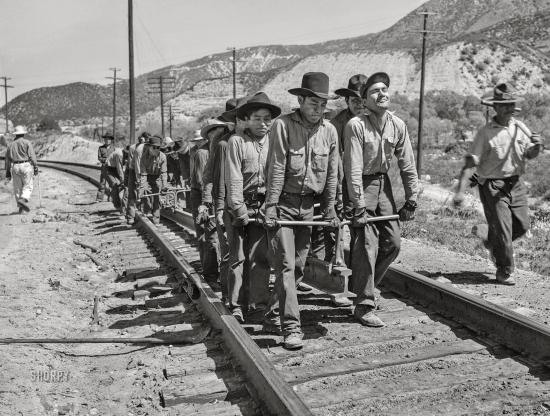
  • Jack Delano, March 1943. "Cajon, California. Indian section gang working on the Atchison, Topeka and Santa Fe Railroad track."

    image from www.shorpy.com
    [Photo: Shorpy/Jack Delano, Office of War Information]