• Vote now for your BBC Women's Footballer of the Year:

    Voting for the BBC Women's Footballer of the Year 2024 is open.

    Fans from across the world can vote for their favourite from the five-player shortlist of Barbra Banda, Aitana Bonmati, Naomi Girma, Caroline Graham Hansen, Sophia Smith.

    The award was first given out in 2015, making this its 10th year.

    How exciting!

    One problem though:

    https://platform.twitter.com/widgets.js

    Full text:

    Barbra Banda, the Zambian footballer who previously failed a ‘gender eligibility test’ at the Women’s Africa Cup of Nations, is among the nominees for BBC Female Footballer of the Year 2024.

    In 2022, Banda was barred from competing in Wafcon, after failing a ‘gender’ verification test the day before the start of tournament.

    @BBCSport reported that Banda had been taking medication to ‘reduce her levels of testosterone, which are naturally overly high.’

    If testosterone levels in a female athlete are ‘overly high’, there are three possible explanations:

    ~ the female is male;
    ~ the female is taking performance enhancing drugs;
    ~ the female is seriously ill (and would be very unlikely to be performing in elite sport).

    Being barred from the most prestigious tournament in Africa has been no barrier to a glittering career in the women’s game for Banda. Although a contract with Real Madrid was withdrawn after Banda’s ban, the player went on to represent Zambia at the 2023 Women’s World Cup in Australia and at the Tokyo and Paris Olympic Games. FIFA and the International Olympic Committee have no requirement for female athletes to prove their sex is actually female. Banda, a former professional in women’s boxing, currently plays for the USA-based team Orlando Pride.

    Yet again, women’s sport is being brought into disrepute (and women footballers put at risk of serious injury) by weak governing bodies that refuse to stand up for fairness and safety for females. If female footballers fail ‘gender eligibility’ this raises inevitable questions over their sex.

    @FIFAcom and @iocmedia could resolve the matter at once by introducing sex verification tests to confirm if all the players on the pitch are indeed female. At the moment, we just don’t know.

  • As I reported last week, North Korea is not only supplying arms to Russia for its Ukraine war: it's sending soldiers too. Not, however, without problems:

    A group of North Korean soldiers recently deployed to support Russia deserted near the border close to Bryansk, Russia, a senior Ukrainian military official said on Oct. 15. The troops are believed to be part of a contingent sent by North Korea to assist Russia under a growing alliance between the two nations. The desertion is seen as further evidence of the military cooperation outlined in a North Korea-Russia agreement signed in June, which includes provisions for mutual military support.

    The Ukrainian official told The Chosun Ilbo that intelligence reports indicated 18 North Korean soldiers deserted approximately 7 kilometers northwest of the Ukraine-Russia border, between Bryansk and Kursk. “Russian forces are currently tracking the deserters,” the official said. “The soldiers have not been apprehended yet, and local Russian military units are reportedly attempting to hide the incident from higher command.” The exact military unit these soldiers belong to and their reason for desertion remain unclear.

    If confirmed, the incident would be further proof that Russia, in addition to receiving artillery shells and missiles from North Korea, is now receiving direct military support. On Oct. 9, South Korean Defense Minister Kim Yong-hyun said during a National Assembly audit that there is a strong possibility North Korea could send regular troops to the Ukrainian front under its agreement with Russia. Ukrainian President Volodymyr Zelensky also stated in a video address on Oct. 13 that the North Korea-Russia alliance is strengthening, with North Korea providing both weapons and personnel to Russia.

    Ukrainian media outlets Liga.net and Kyiv Post reported that North Korea has already sent about 10,000 soldiers and personnel to Russia. Approximately 3,000 of these North Korean troops have reportedly been integrated into Russia’s 11th Air Assault Brigade, which is currently reorganizing near the Ukraine-Russia border, and are undergoing joint training with the brigade’s Buryat battalion. These troops may soon be deployed to the Kursk region.

    Given the appalling conditions under which North Korean workers live in Russia – little better than slave labourers – it's safe to assume that the conditions for soldiers will be equally grim, with all wages going straight to Pyongyang. At least the workers can expect to live through their ordeal: the wretched soldiers have no such guarantee. Why should they sacrifice themselves in the name of some demented quasi-fascist Russian historical fantasy about the non-existence of a separate country called Ukraine? May there be many more such desertions.

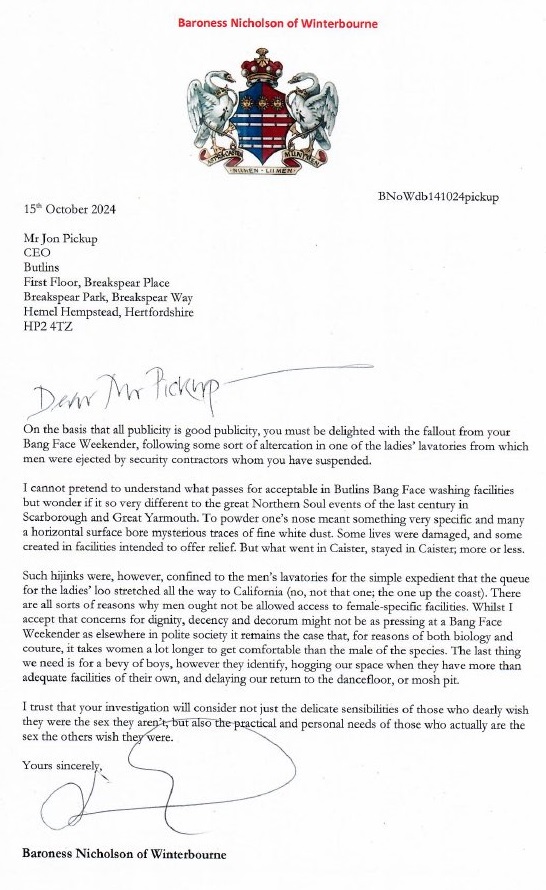
  • The Butlins story, if you didn't know, is that two security guards at a "Bang Face" event last week at the Skegness site removed some trans women from the Ladies toilets  – only to be suspended by the management:

    The incident allegedly started when a security guard followed a person into the women’s toilets and told them to leave because they were a man.

    In a statement, Butlin’s Skegness said: “As an inclusive business we were very concerned to hear about this incident.

    “Much to our disappointment, our third-party security contractor did not follow our processes despite being thoroughly briefed.

    “Once we were made aware they were immediately removed from duty for not handling the situation in line with our processes.

    “We are in direct contact with those involved and are reviewing how we work with contractors.”

    Oh dear: the headaches of being an "inclusive business".

    Well, Baroness Nicolson has written a letter – and she writes very good letters.

    GZ8-_p4XUAASS6s

  • After Iran's rocket attack on Israel a couple of weeks back, a “lethal, precise, and surprising” response was promised by Israel's defence minister. But so far…nothing. The general assumption is that this is due to US concerns – in particular, warnings that Iran's nuclear installations or oil production facilities must on no account be targeted. Still, America has sent over batteries of its THAAD (Terminal High Altitude Area Defence) interceptors, with US crews, as a (welcome) gesture of support. So – what's going on?

    Historian Benny Morris, writing in Quillette, suggests that this is all part of a political dance between Biden and Netanyahu while the US president has his eyes very much on the upcoming election. If Israel launches a serious attack on Iran before the election, senior Democrats worry that this will harm their election chances, drawing the US into a war they don't want. After the election though, it may be a different story….

    Hence, if Israel launches its retaliatory operation against Iran before the US elections, Israel must take American sensibilities into account. Israel may adopt a two-step strategy: hit some non-oil and non-nuclear Iranian sites in the coming days and, after Iran retaliates as it has promised it would, hit the oil and nuclear sites after 5 November. After that date, the US will have a new president-elect, and the fear that Israel’s actions could hurt Kamala Harris’s chances of being elected will no longer pertain. Indeed, both Israel and Biden might view the two and a half months after 5 November [before the inauguration of the new president] as a golden window of opportunity in which to destroy the Iranian nuclear project at last—something that Israel appears to believe it is incapable of doing without major American assistance.

    In other words, it is possible that while Israel has been putting up a show of delaying the retaliation against Iran for immediate, pragmatic reasons, in fact it is simply waiting until after 5 November, at which point it can go after whichever targets it believes are crucial to victory and to saving the country from eventual nuclear destruction by Iran, without fear of arousing Biden’s anger. Iran is said to be only a year or two away from producing nuclear bombs and has already accumulated large amounts of enriched uranium needed for nuclear weaponry. The thinking among some Israelis is that following 5 November, Biden  may be more amenable to joining in an Israeli assault on Iran’s critical facilities and nuclear installations or at least might condone such an attack.

    An optimistic view, perhaps? We'll see.

  • Up on Hampstead Heath this morning:

    IMG_2529s

    IMG_2515s

    IMG_2523s

    IMG_2525s

    IMG_2524s

    IMG_2526s

    IMG_2530s

    IMG_2547s

  • In my Sunday post on cousin marriages I assumed that the main reason for the practice being banned across Scandinavia was because of the increased risk of genetic defects. According to this piece from Swedish MP Fredrik Karrholm in the Spectator, there's more to it:

    The reason for the move is the same in all the Nordic countries; within certain large immigrant communities, the practice of cousin marriage remains common. In parts of the Middle East and North Africa, up to half of all marriages are between relatives. Pakistan, which has a significant immigrant population in the UK, has one of the highest prevalence of cousin marriages in the world.

    The Swedish minister of justice, Gunnar Strömmer, correctly argues that a ban could help combat marriages entered into under pressure or coercion. Cousin marriages are frequently arranged or forced. In some cases, refusing to go through with the marriage can result in violence or even so-called honour killings. By banning cousin marriages, the Swedish government aims to break the cycle of coercion and control rooted in these practices.

    On top of the social issues tied to cousin marriages, the associated health risks are well documented. Studies have shown that children from cousin marriages have a significantly higher rate of congenital conditions, such as heart defects and developmental disabilities.

    Despite cousin marriage being a well-known issue, for too long any debate on this subject has been shamefully sidelined. Addressing cousin marriage and its implications has been a sensitive subject here, and avoided in mainstream political discourse. Notably, the people to first and most clearly raise concerns about it come from immigrant backgrounds themselves. Former Swedish MP Hanif Bali, who was born in Iran, was one of the earliest voices to speak out against cousin marriage, and he has advocated for legislative change.

    The criminal gangs, which have become such a problem now in Sweden, are often based on clan loyalties which derive from the institution of marriages arranged within a family. A ban on these marriages, it's hoped, may help to break those loyalties and thus weaken the power of the gangs.

    Joseph Henrich, professor of human evolutionary biology at Harvard University, has found that cousin marriage doesn’t just affect family dynamics – it reshapes societies. His research shows that as cousin marriages declined in Europe, individualism grew. The western church’s crackdown on such unions laid the groundwork for liberal democracy by weakening tight family networks that thrived on loyalty. Instead, societies in the West nurtured values like cooperation with outsiders, trust in institutions, and civic responsibility.

    In Sweden this is particularly relevant. Many criminal networks in Sweden are based on or benefit from tight-knit, clan-based loyalties. These families, bonded through marriage and blood, can undermine the state from within. By banning cousin marriage, the Swedish government can strike at the heart of this system, loosening the grip of clans and reducing their ability to operate above the law.

    In the fight against organised crime this cultural shift could prove decisive. Not only could a ban on cousin marriage weaken organised crime, but it will also help preserve our open, fair, and law-abiding society.

    In the end, this isn’t just about marriage; it’s about the foundations of democracy and the rule of law as we know it.

  • https://platform.twitter.com/widgets.js

    Full text [the X thread has images too, which I haven't copied here. Or, better, see the thread reader]:

    1. Until 1912, Turks made up 35% of the population of Selanik (Thessaloniki, Greece), having arrived in 1456. Following Greece’s annexation, 50,000 Turks, including Atatürk’s mother, fled. No Turks remain in Thessaloniki today.

    2. Until 1923, Greeks made up 33% of the population of Constantinople (Istanbul). Despite arriving 1,600 years before the Turks, persecution and pogroms from 1923 through 1964 drove out 100K Greeks. There are only 2,000 Greeks left in Istanbul today.

    3. Until 1947, Hindus made up 47% of the population of Karachi (Pakistan). Predating the arrival of Muslims by 1,000 years, they were forcibly moved as part of the Partition of India. Hindus make up only 2-4% of Karachi’s population today.

    4. Until 1939, Germans made up 95% of the population of Danzig (Gdańsk, Poland) when it was annexed by the Nazis. Following WWII, 350K Germans were expelled from the historic Prussian city after its incorporation into Poland. There are no Germans left today.

    5. Until 1939, Germans were also 95% of the population of Königsberg (Kaliningrad, Russia). After WWII, 300K Germans were expelled as the Soviets “repopulated” it. Less than 1% of Kaliningrad's population is German today.

    6. Until 1941, Poles made up 63% of the population of Lwów (then Poland), where they had lived there since the 14th century. The Soviets expelled 200K Poles between 1944-46 due to shifting borders after WWII. There are fewer than 2,000 Poles in Lviv, Ukraine today.

    7. Until 1941, Jews made up 30% of Baghdad’s population, having arrived there 1,000 years before the Arabs. Persecution, starting with the 1941 Farhud pogrom, led to their rapid expulsion and exodus. There are no Jews left in Baghdad.

    8. Until 1947, Sikhs made up 20% of the city of Lahore, where they had lived for centuries. Following the Partition of India, nearly all of Lahore's 100,000 Sikhs fled communal violence or were forcibly displaced to India. Today, there are no Sikhs left in Lahore, Pakistan.

    9. Until 1948, Jews were 30% of the population of Tripoli, Libya. They arrived in Tripoli before the Romans and Arabs more than 2,300 years ago. Persecution under Italian fascists and then Arab nationalists forced them to flee. There are no more Jews in Tripoli.

    10. Until 1974, Greek Cypriots made up 80% of the population of northern Cyprus. Following Turkey’s invasion, 200K Greek Cypriots fled the violence or were expelled, while 50K Turkish Cypriots were displaced from the south. Today, Greeks make up less than 1% of northern Cyprus’

    Not only are the Palestinians the only descendants of refugees still embracing violence in pursuit of their claims: they're the only refugees serviced by their very own UN organisation, UNRWA, employing some 30,000 people, which looks after the day-to-day business in Gaza such as education (teaching Jew hatred) while the supposed government, Hamas, gets on with the business of building tunnels and arming themselves for the fight against Israel.

  • Esther Bubley, September 1943. "Columbus, Ohio. An old model bus, of the type which would ordinarily have been scrapped but is now being rebuilt because of the shortage of buses, parked in Columbus."

    image from www.shorpy.com
    [Photo: Shorpy/Esther Bubley for the Office of War Information]

  • Roz Adams, the women who was subjected to a "heresy hunt" at the Edinburgh Rape Crisis Centre for suggesting that a rape victim should know the sex of her counsellor, has finally won her case. From the Telegraph:

    A woman who was hounded out of a scandal-hit “trans-inclusive” rape crisis centre run by a biological male is to receive £35,000 in compensation.

    Roz Adams, who was a support worker at the Edinburgh Rape Crisis Centre (ERCC), is to receive the “substantial” figure for injury to feelings in a “stark recognition of the gravity of harassment” she suffered for her gender critical beliefs, her lawyer said.

    An employment tribunal has previously found that Mridul Wadhwa, a male who identifies as female and was chief executive of the centre, had presided over a “heresy hunt” against Ms Adams because of a suspicion she was transphobic.

    Ms Adams had been subjected to a “Kafkaesque” disciplinary process after questioning how to respond to female survivors who asked about the sex of another employee who said they were non-binary and adopted a typically male name.

    While the sum of £35,000 has been agreed between the parties, Ms Adams is also calling on the tribunal to make a series of recommendations after claiming that support services overseen by Rape Crisis Scotland (RCS) are still failing women.

    A remedy hearing heard on Monday that despite Sandy Brindley, the chief executive of RCS, claiming that work was underway on a shared definition of women across its network in October 2023, the wording was yet to emerge.

    The continuing presence of Sandy Brindley as head of RCS, despite her long-term support for the disgraced Mridul Wadhwa, is an issue yet to be resolved.

    Ms Brindley, who had previously backed Ms Wadhwa as an “amazing sister” and a “warrior for women’s rights”, has resisted widespread calls to resign from her own post.

    Ms Adams claimed that deliberately “muddy” language and policies around the issue meant that women seeking help could not make an “informed choice” about accessing services.

    “I don’t know how any organisation can claim to have women only spaces or services while not defining what a woman is or what female means,” Ms Adams said.

    “A survivor can’t give informed consent if they don’t know what they’re giving informed consent to.

    “Rape Crisis Scotland were fully aware they [ERCC] weren’t following women only spaces. Sandy Brindley, the chief executive of Rape Crisis Scotland, also won’t define women.

    “It’s pretty shocking to me, and at the heart of where the issues lie… centring survivors and informed consent. It beggars belief.”…

    She said the centre remained “celebratory” of its gender self-ID policy.

    She claimed that there had been a “begrudging” acceptance that gender critical beliefs were legally protected but not that they were valid or based on a desire to protect vulnerable women.

    She contrasted her treatment with that of Ms Wadhwa, who was allowed to take leave and then step down, potentially with a payoff, despite presiding over a major scandal.

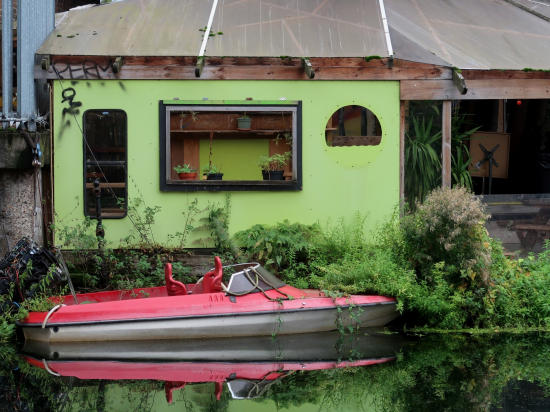
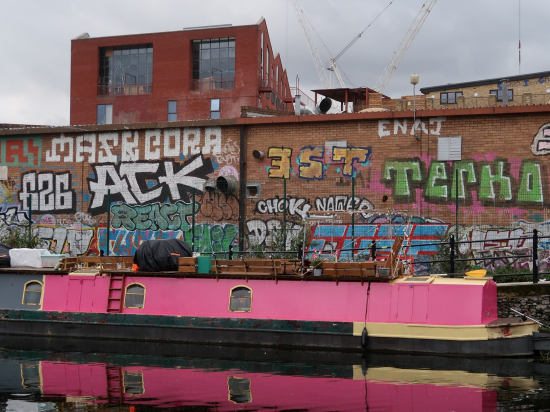
  • On the Lea at Hackney Wick:

    IMG_2502s

    IMG_2503s

    IMG_2506s