A crack in the edifice? Leor Sapir in City Journal – The American Society of Plastic Surgeons becomes the first major medical association to challenge the consensus of medical groups over “gender-affirming care” for minors.
The main justification for “gender-affirming care” for minors in the United States has been that “all major U.S. medical associations” support it. Critics of this supposed consensus have argued that it is not grounded in high-quality research or decades of honest and robust deliberation among clinicians with different viewpoints and experiences. Instead, it is the result of a small number of ideologically driven doctor-association members in LGBT-focused committees, who exploit their colleagues' trust. Physicians presenting different viewpoints are silenced or kept away from decision-making circles, ensuring the appearance of unanimity.
As the U.K.’s Cass Review pointed out, the World Professional Association for Transgender Health (WPATH) and the U.S. Endocrine Society were especially important in forging this consensus, and they did so by citing each other’s statements, rather than conducting a scientific appraisal of the evidence. The “circularity” of this approach, says Cass in her report to England’s National Health Service, “may explain why there has been an apparent consensus on key areas of practice despite the evidence being poor.”
Well yes, that might explain it. You scratch my back…
Perhaps because it has never really depended on evidence, this doctor-group consensus has shown remarkable resilience in the face of major system shocks, including several whistleblowers, revelations from court documents that WPATH manipulated scientific evidence reviews, the Cass Review, a bipartisan commitment in the U.K. to roll back pediatric medical transition, and a growing international call for a developmentally informed approach that prioritizes psychotherapy over hormones and surgeries.
But the U.S. consensus now appears to have its first big fracture. In July, the American Society of Plastic Surgeons, a major medical association representing 11,000 members and over 90 percent of the field in the U.S. and Canada, told me that it “has not endorsed any organization’s practice recommendations for the treatment of adolescents with gender dysphoria.” ASPS acknowledged that there is “considerable uncertainty as to the long-term efficacy for the use of chest and genital surgical interventions” and that “the existing evidence base is viewed as low quality/low certainty.”
The treatment of "gender dysphoric" teens in the US has become a conveyor belt, starting with the ideologically-captured mental health professionals, and driven by a fear of going against the consensus…and, of course, by the money. Plastic surgeons are the last in line, to try and make acceptable – to prettify – the butchery that constitutes the essence of "gender-affirming care".
How they process the unfortunate children:
Gender clinics across the country have adopted letter-of-support and letter-of-medical-necessity templates to ensure that adolescents seeking surgery get approval, with few hiccups. The message these templates implicitly send to therapists, who are the first and arguably most important gatekeepers, is that gender surgery for minors is a standard procedure rather than an extreme departure requiring strong evidence.
The gender clinic at Seattle Children’s Hospital is an example of a major clinic that offers mental-health professionals a template to use for writing letters of support for surgery. The template contains language designed to bypass any concern that the candidate fits the profile of “rapid onset gender dysphoria” (ROGD), the most common adolescent presentation and the one that prompted the course reversal in Europe. The template effectively instructs the referring therapist to attest that the ROGD presentation is really just a teen who has always known he or she was transgender but only disclosed that information to his or her parents during adolescence. This common anti-ROGD refrain is based on highly dubious research.
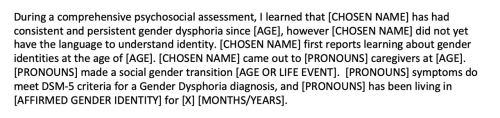
The author of this template appears to be Caitlin Thornbrugh, a creative writing instructor in the Department of English at Northeastern University who received the university’s “LGBTQA Resource Center Gratitude Award” in 2021.
Perfect. Rather than medical professionals making the decisions on clinical grounds, we have academics from the English department setting the tone – fuelled no doubt by their Judith Butler readings.
And the plastic surgeons may just have had enough:
[Sheila] Nazarian, the Beverly Hills surgeon, told me that surgeons in her professional network who perform gender surgeries typically defer to mental-health professionals and endocrinologists to determine for them whether minors should receive procedures like double mastectomy. That approach, she believes, is misguided, and reduces surgeons to mechanics.
“We are not highly trained technicians,” Nazarian told me. “We are physicians with responsibility for the health and well-being of our patients. We can get input from other clinicians, but ultimately the responsibility for determining medical readiness lies with us. That means that we have to examine all the data and studies available to us. Furthermore, you can’t help people by ignoring the reasons they want to go under the knife. With every patient, I exercise discretion as a professional and determine whether the procedure they are seeking is in their ultimate best interest.” The idea that surgeons should defer heavily to the prior assessments of clinicians struck Nazarian as wrong. “You can’t outsource your professional judgement to other clinicians. It’s your responsibility as the last in a chain of treatment to ensure you are doing what is best for the patient now and in the long term.”
 Mick Hartley
Leave a comment