David Walsh in today's Sunday Times has been reading Doriane Coleman’s new book On Sex and Gender — A Commonsense Approach, with her discussion of the old East European tradition of doping female athletes.
Coleman had some experience of the difficulties. On a July afternoon in Munich in 1983, she competed in an international 800m race. Lined up against her was the 32-year-old Jarmila Kratochvilova. Long before they reached the 400m mark, the bell had tolled for every other runner in the race, including Coleman, who eventually finished third.
By then the Czech athlete was disappearing into the distance. Her winning time, 1min 53.28sec, was a world record. Forty-one years on, Kratochvilova’s record still stands. Some athletics people believe it will endure for decades to come. It is the oldest record in her sport. Coleman’s memory of the race? “We knew it was two races in one race. All of us started with the same dream but it was only available to half the competitors. The rest of us had to change our goals from medals and titles to personal bests. The anti-doping culture wasn’t robust back then. You’d be asked, ‘Are you OK to be tested?’ We assumed others were doping.”
Evidence has shown the Czech authorities ran a doping programme and Kratochvilova’s name shows up in a list of athletes pre-tested before competing internationally, which was standard practice in countries that systematically doped.
And includes this image of Kratochvilova in action:
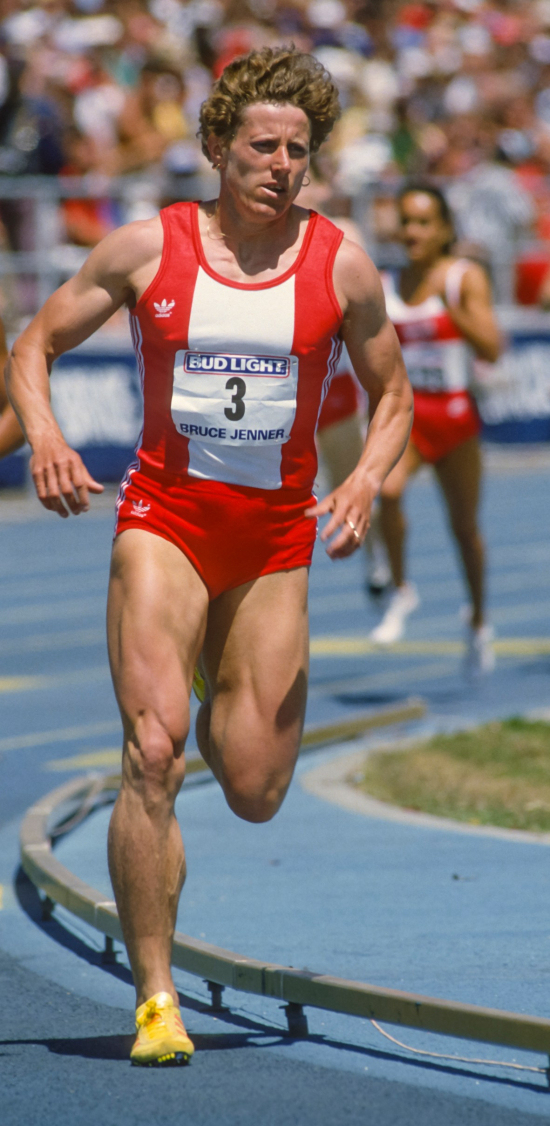
[David Maddison/Getty]
Yes, there's clearly something, well…not quite right about her physique. But I'm intrigued by that "Bruce Jenner" on her chest. It's a stock photo, and that's definitely Kratochvilova. Is it just serendipity that she's wearring the name of Caitlyn nee Bruce, former athlete and perhaps America's most famous trans woman?
Walsh gets on to the new guidelines produced by the International Olympic Committee (covered by me here):
Last week the International Olympic Committee (IOC) issued its latest guidelines on how journalists, broadcasters and national federations should portray and refer to male, female, transgender and DSD athletes. First, though, the IOC wants us to understand that “women, like men, are not a homogeneous group, nor are they solely defined by their gender identity. Indeed, women are as different from each other as they are from men.” Really!
An annex has been provided “to promote a more accurate, responsible, respectful, and inclusive coverage and communication” of any transgender athletes and athletes “with sex variations” who will be competing in the female competition category in Paris.
The IOC also asks us not to refer to DSD athletes as “biological males” but simply as women. This is the IOC’s thought police gone mad. While respect for gender identity is important, this guidance makes no sense. Not only are they conflating sex and gender, they ignore the scientific facts, set out by the Court of Arbitration for Sport in the Caster Semenya case, that from puberty onwards DSD athletes produce testosterone levels in the male range (7.7 to 29.4 nmol/L) rather than the much lower female range (0.06 to 1.68 nmol/L) because they have male chromosomes and male gonads (testes, not ovaries).
Those testosterone levels give them clear physiological advantages, including bigger and stronger bones and muscles and higher levels of haemoglobin in the blood that significantly affect sports performance. Hence the need for separate male and female competition categories. This is also why World Athletics says that for purposes of sports competition it is biological sex, not gender identity, that counts, and why for the purpose of competition, it treats DSD athletes as biological males.
Failing to acknowledge biological realities, which is what the IOC is doing with its guidelines, is dishonest and dangerous. There is a section in the guidance on what the IOC calls “problematic language”. They tell us we are never to say “born male”, “born female”, “biologically male”, “biologically female” “genetically male”, “genetically female”, “male-to-female” and “female-to-male”. Someone at the IOC has lost their senses.
Like a practised politician, the IOC hasn’t taken a position on the participation of transgender and DSD athletes in its Games. That’s for individual federations to determine, it says. Why get involved in what is divisive when you can simply issue guidelines promoting diversity and inclusivity? Instead of guidelines, it should just try to keep women’s sport strictly for women.
Yes – though I don't agree that "respect for gender identity is important", when claims for its reality and its significance are a major part of the problem. Gender expression, perhaps…
 Mick Hartley
Leave a comment