Arthur Siegel, February 1942. "Detroit, Michigan. Looking towards downtown from the slum area in the early morning. These are conditions under which families lived before moving to the Sojourner Truth housing project."
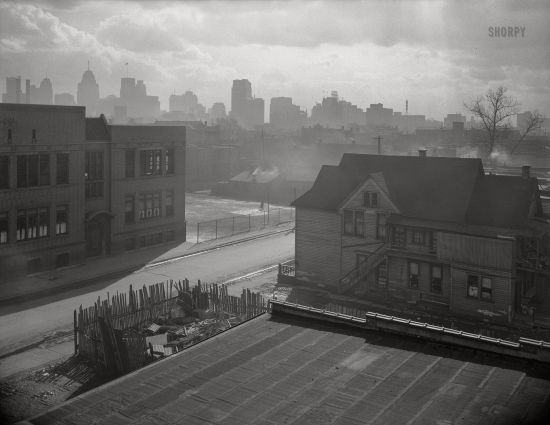
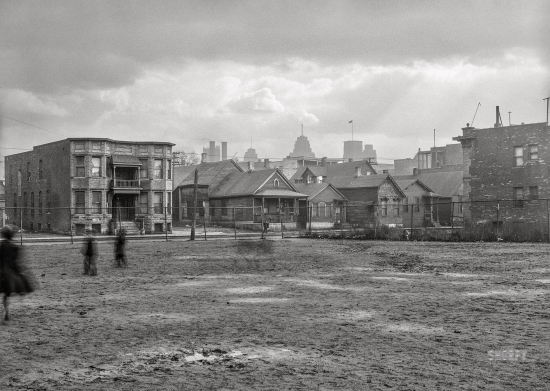
{Photos: Shorpy/Arthur Siegel for Life magazine]
Named after the abolitionist and activist for African-American civil rights, the Sojourner Truth project didn't quite go according to plan:
As a strikingly controversial project in 1941, Sojourner Truth Project set precedents for Detroit housing project policy through the next decade. Created by the Detroit Housing Commission (DHC) and United States Housing Authority (USHA), the proposed 200 units would alleviate housing shortages caused by the wartime climate of World War II. However, the project was met with extreme backlash from white residents and middle-class black homeowners in Conant Gardens. Violence erupted in 1942 when black families moved into the project housing. More than a thousand black supporters and white opponents crowded streets culminating in violent displays later characterized as the Sojourner Truth riot….
The continual pressure from opposing sides influenced the federal government to switch positions on the racial profile of those occupying the project three times. Original proposals of black occupancy resulted in the Federal Housing Administration's (FHA) refusal to insure mortgage loans for the Seven Mile-Fenelon because of its proximity to the public housing. The racist FHA policy instilled in white residents fears that black residence would directly result in their inability to finance new construction on vacant lots or personal improvement projects.
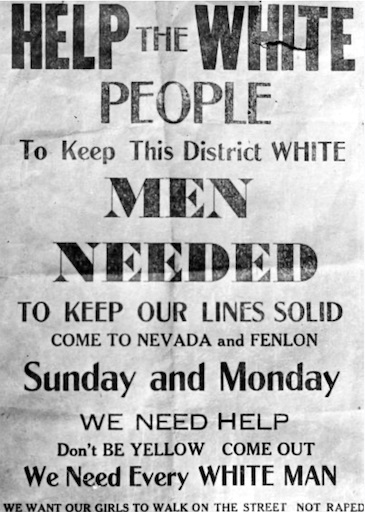
Bending to white pressure, in January 1941, the DHC designated the Sojourner Truth as a project of white occupancy. After a subsequent eruption of two week long protests, city officials promised the project to black war workers. However, this resulted in opposing picketing and protesting by white residents of Seven Mile-Fenelon who demanded "Rights to Protect, Restrict and Improve [their] Neighborhood." Black families moved into the newly constructed housing on February 28, 1942.
On February 28, 1942, as the first black families moved into their houses, black supporters and white opponents flooded the streets by the thousands. Passionate protest turned to visceral violence as 40 people were injured, 220 arrested, and 109 held for trial—all but three were black. White segregationists utilized this violent eruption as an established precedent to detrimentally affect Detroit's public housing for decades. Influenced by the riot, DHC established a viciously oppressive mandate for racial segregation in all public housing projects. Utilizing the language of the National Associate of Real Estate Boards, city officials vowed that their projects would "not change the racial pattern of a neighborhood". White community groups maliciously utilized threats of a repetition of Sojourner Truth riots as ammunition to shoot down political support of public housing. City officials strongly wanted to avoid bloodshed and therefore surrendered to their elitist demands.
 Mick Hartley
Leave a comment