Fergal Keane has an important article at the BBC on the international order set up after WW2, and its failure in the light of what's happening in Ukraine:
We are not in the middle of a new world war, or a Holocaust, but the lessons for the world of that terrible conflict – and the promises made in its aftermath – have a relevance we cannot ignore today.
It was a reality framed in scathing terms by the Ukrainian President Volodymyr Zelensky when he addressed the Security Council of the United Nations this week. He reminded his audience that the UN had been established in 1945 to guarantee peace after the horrors of World War Two.
Listing allegations of war crimes by Russian troops in Ukraine – summary killings, torture, rape – he called for the council to order a war crimes investigation.
"Are you ready to close the UN?" he asked. "Do you think that the time of international law is gone? If your answer is no, then you need to act immediately."
The threat to the peace of Europe is greater now than at any time since the end of the Cold War in 1989. For nearly a month, I watched families flee westward from Lviv in trains, cars and buses as Russia waged war on their homeland. I listened to survivors from the besieged port of Mariupol talk of a hell on earth with bodies lying in the streets and the cityscape they knew, of shops, restaurants, the Hurov Park with its spectacular fountains, reduced to rubble….
In the far western corner of Ukraine, Lviv is a city to remind us of the worst of mankind, but also of what can be done to protect us from the consequences of aggression.
Walk five minutes west from the ruins of the synagogue and you reach a squat two-storey building that was the cradle of the world's most important human rights legislation – the very principles under which President Putin and his armies might yet face judgement.
The law faculty of the University of Lviv was the alma mater of Raphael Lemkin who invented the word genocide to describe the attempt to exterminate "in whole or in part" a national, religious or racial group. Aghast at the Nazi Holocaust Lemkin coined the term in 1944 and, four years later, succeeded in having the UN define genocide as a crime under international law.
His fellow alumnus, Hersch Lauterpacht, was instrumental in bringing about the legal concept of crimes against humanity which was first used to prosecute Nazi leaders at the Nuremberg trials in 1945-46.
Both men were Jewish and studied in Lviv in the early decades of the 20th Century. Lviv was called Lemberg then and was a city of the Austro-Hungarian Empire, home to a cosmopolitan mix of Poles, Ukrainians, Russians and other nationalities from across the empire.
World War One destroyed Austria-Hungary and ushered in an age of instability as Poles, Ukrainians, the Soviet Union and Nazi Germany fought for control of the city. The majority of the remaining Jewish population was wiped out in the Holocaust, among them the relatives of Lemkin and Lauterpacht.
At the end of World War Two, Lviv came under the rule of the Soviet Union, where it remained until the fall of communism and the creation of an independent Ukraine in 1991.
Although they differed in important respects – Lemkin argued in favour of group protections, Lauterpacht focused on individual rights – their legacies were enshrined in the 1945 UN Charter, which promised to "save succeeding generations from the scourge of war which, twice in our lifetimes, has brought untold sorrow to mankind, and to reaffirm faith in fundamental human rights, in the dignity and worth of the human person…"
Now, Lviv finds itself once more at the centre of a great historical trauma.
I think of that phrase – "the dignity and worth of the human person" – after watching people fight to board trains in the early days of the evacuation of Ukraine. I remember it when I see the images of executed civilians in Bucha, and I wonder what has happened to the dream of the lawyers from Lviv?
We are living in an age where millions are displaced by war. I have seen them jumping from smugglers' boats into the shallows on a Greek beach, shouting with joy that "God is Great". In the Democratic Republic of Congo, Myanmar and Yemen, I have heard civilian victims describe cruel military campaigns.
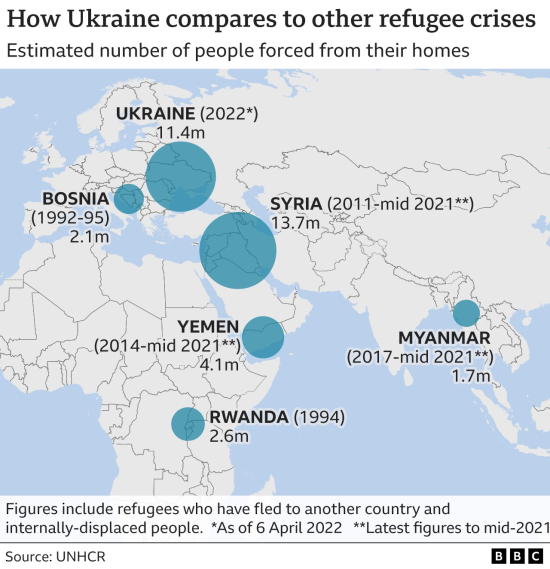
According to the most recent UN statistics – gathered before the Russian invasion of Ukraine – 84 million people are now forcibly displaced worldwide. The figures reflect an international order in crisis with the UN unable to prevent the murder and abuse of civilians in many regions of the world….
It's a long piece, but worth reading in full.
The story of Lviv and its role in the origins of the terms "genocide" and "crimes against humanity" is covered in Philippe Sands' book East West Street.
And here's the accompanying refugee map:
 Mick Hartley
Leave a comment