We heard earlier in the week how Russian forces burned down a museum in Ivankiv, a city northwest of the capital Kyiv, that was home to dozens of works by the Ukrainian folk artist Maria Prymachenko. The museum seems to have been specially targeted, in a clear demonstration of Putin's determination to destroy Ukrainian culture and remove any trace of an artistic legacy separate from Russia.
The Ivankiv Historical and Local History Museum, located northwest of the capital city Kyiv was burnt to the ground, along with 25 works by Prymachenko, according to the Kyiv Independent.
Vlada Litovchenko, director of the Vyshhorod Historical and Cultural Reserve, confirmed the “irreparable loss.”…
The self-taught artist was born in 1909 in the region and was buried there when she died in 1997. Her colorful folk art paintings were widely exhibited in the country and appeared on the country’s stamps during the 1970s. She was honored with the 1966 Taras Shevchenko National Prize of Ukraine. UNESCO declared that 2009 was the year of Maria Prymachenko.
Since the Russian forces destroyed the museum during the ongoing war, Ukraine has called for UNESCO to strip Russia of its membership in the organization.
Well maybe not all of her works were lost. In the Times today:
The clash is as stark as it is symbolic. On the one side are the massed ranks of Russia with their mud-coloured military weaponry. On the other are bright folkloric pictures in a small Ukrainian museum.
One week ago, early on Saturday morning, Russian forces attacked Ivankiv, a town 30 miles south of Chernobyl and 50 miles northwest of Kyiv. Shortly afterwards videos on Twitter showed the small, squat Ivankiv Historical and Local History Museum ablaze. It was a significant target — the museum’s collection included 25 works by Maria Prymachenko, one of Ukraine’s most celebrated folk artists, whose brightly coloured paintings enchanted Picasso and Chagall and featured on postage stamps. In 2009 Likhachev Boulevard in Kyiv was renamed Maria Prymachenko Boulevard; her image has decorated the Ukrainian five hryvnia coin.
The fire appeared to be a deliberate attack on Ukrainian culture, says Anastasiia Prymachenko, 26, the great-granddaughter of the artist, and director of the Maria Prymachenko Family Foundation. She is sheltering in Lviv with her 52-year-old father, Ivan, Maria’s grandson, who fled Ivankiv on the eve of the attack.
“The museum was the first building in Ivankiv that the Russians destroyed,” she says, speaking in Spanish over the phone from Lviv. “I think it is because they want to destroy our Ukrainian culture — the museum is the only thing we have there, with lots of artefacts showing Ukrainian and Ivankiv culture.”
On Monday, Ukraine’s Ministry of Foreign Affairs posted a statement on Twitter, alongside Prymachenko’s 1977 work, Two-Headed Chicken, saying that “about 25 works by outstanding Ukrainian artist Maria Prymachenko were burned. She created world-famous masterpieces. Her special gift and talent captivated Pablo Picasso.”
Maria Prymachenko spent her entire life in the village of Bolotnya, outside Ivankiv. Now the people of Ivankiv have come to her rescue, in yet another emblem of the courage and resistance of the Ukrainian people. When he saw the museum burning, a friend of Anastasiia, who does not wish to be named, ran into the building and saved as many of the artworks as he could.
“He was on the street. When he saw the smoke from the museum he ran, broke the museum window and went into the fire,” she says. “He couldn’t take everything out but he knew the most famous paintings were by Prymachenko. Since he only had a few minutes, he just took these paintings, and a few other works of art.”
Anastasiia thinks that about ten poster-sized paintings were saved from the burning building, but does not know which. Two highly decorated plates were lost in the blaze and the fate of the remaining works is unknown. The saved artworks were taken into hiding by locals and are now scattered across Ivankiv. “We don’t know exactly how many were saved or where they are but we know the people of the town have them.”
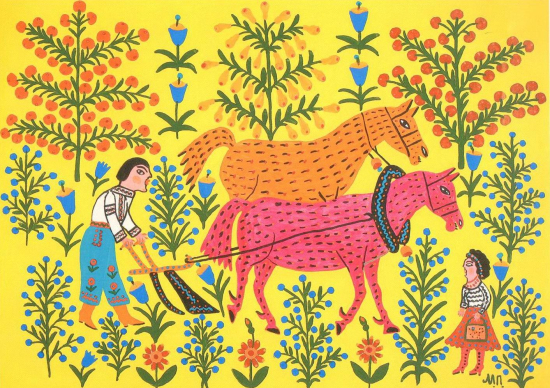
My Beloved Plows the Field
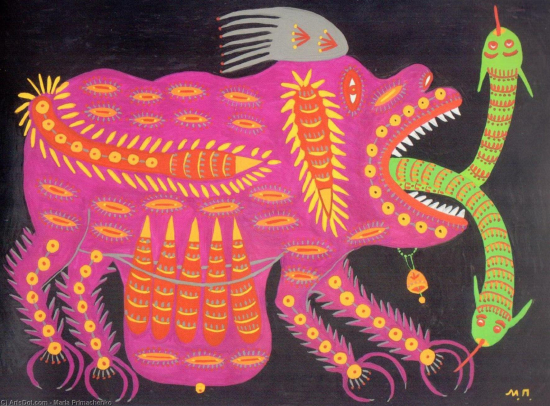
May That Nuclear War be Cursed!
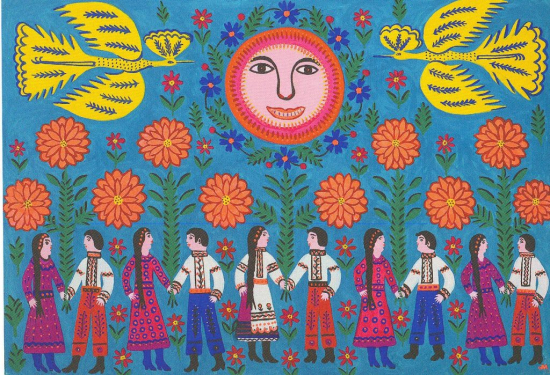
Our Army, Our Protectors
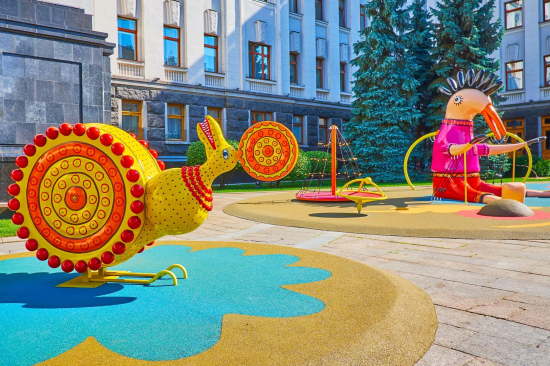
A playground decorated with Maria Prymachenko’s characters [ALAMY]
Fortunately the majority of Maria Prymachenko's art is elsewhere, with the largest collection, about 650 pieces, in the National Museum of Ukrainian Folk Decorative Art in Kyiv. Or perhaps not so fortunately, given Putin's plans for Kyiv.
“There are many of Maria’s paintings in the non-protected areas of Ukraine and I am very scared that they will attack more museums,” Anastasiia says. “We need to protect them because if they erase our culture and Maria’s art, that will be very sad. I don’t know how to save them — I don’t know what to do. This is my whole job, my life, all of my family’s art. We try to protect it but when they start killing people we don’t have time. We just hope everything will be OK.”
Update: see more of Maria Prymachenko's art here.
 Mick Hartley
Leave a comment