Apparently the Maori, in conspicuous contrast to the New Zealand government, view the Jews of Israel as an inspiration. Here, for instance, the flags of Maori, New Zealand, Israel, and the United Tribes are displayed during a ceremony of apology, called a ‘whakapāha,’ held in 2018 to express regret for New Zealand’s actions in standing against Israel at the United Nations, and to seek forgiveness.
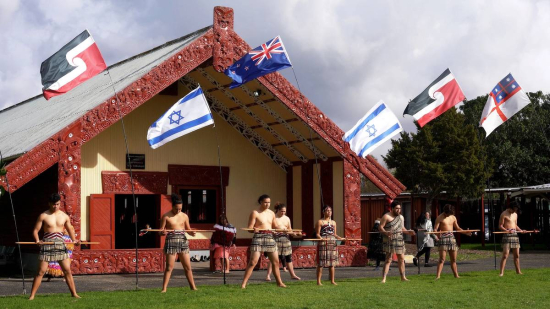
[Photo © Perry Trotter]
Sheree Trotter, a Maori herself and co-founder of the Holocaust and Antisemitism Foundation, makes the case in Tablet that what links the Jews and the Maori is the concept of indigeneity. Israel nowadays is often portrayed as a product of "settler colonialism", with European Jews coming in to replace the Arabs, but of course the Jews are the indigenous occupants of the land of Israel: the Arabs arrived there in the great post-Mohammed Arabic conquests in the 7th century. It's a point that Israel would do well to emphasise more, in the face of Arab claims to be the rightful owners of the land.
The development of a distinct language, culture, and belief system within a particular land prior to colonization is a defining feature of indigeneity, one shared by Māori and Jews. Many definitions of indigeneity include the characteristic of “nondominant groups of society.” Some scholars have asserted that this provision was a later addition, aimed squarely at preventing Jews from claiming indigenous status. The notion that a people suddenly loses indigenous status by virtue of having achieved their long sought self-determination undermines the very concept of indigeneity. Fiji, for example, gained its independence in 1970, but this did not mean that indigenous Fijians thereby lost indigenous status. While the other aspects of indigeneity are intrinsic to identity as a people, the requirement to be nondominant in society is an external, political, and social feature that is subject to change. An aspiration (in this case self-determination) does not render a people nonindigenous by the attainment of its goal.
So, in regard to Israel, why does this matter? Because a colonialist narrative has taken hold in the popular imagination, by which Jews are seen as foreign colonizers who have displaced the indigenous Palestinian population. The colonialist narrative had its genesis in academia and has filtered down to politics and media. It has been promoted by historians of settler colonialism, Palestinian academics, politicians, and anti-Israel activists. Israel is portrayed as the archetypal intruder. The Palestinian American academic Rashid Khalidi has said, “the modern history of Palestine can best be understood in these terms: as a colonial war waged against the indigenous population, by a variety of parties, to force them to relinquish their homeland to another people against their will.”
The wording may vary, but Khalidi’s view is widely held. In 2016, for example, the Palestinian National Authority attempted to sue the British government over the Balfour Declaration, for supporting the idea of establishing a Jewish homeland in what was then Ottoman Palestine. Palestinian Foreign Minister Riyad-al Maliki stated that “hundreds of thousands of Jews were moved from Europe and elsewhere to Palestine at the expense of our Palestinian people whose parents and grandparents had lived for thousands of years on the soil of their homeland.” This narrative has been strengthened mostly through long and frequent repetition, the most basic of classic propaganda techniques.
But maintaining the claim that Israel is the acme of a settler colonial state is false, and comes at great cost to our understanding of history. It is a politically motivated and highly selective rendering of the past, a distortion rather than a truthful account.
The Israeli historian Benny Morris, while deftly rebutting Khalidi’s aforementioned thesis, has pointed out that the commonly understood notion that colonialism involves an imperial power gaining control over another country and “settling it with its sons” simply does not apply to the Zionist venture. “By any objective standard, Zionism fails to fit this definition,” he argues. “Zionism was a movement of desperate, idealistic Jews from Eastern and Central Europe bent on immigrating to a country that had once been populated and ruled by Jews, not ‘another’ country, and regaining sovereignty over it.”
Harvard historian Derek Penslar also challenges the colonialist narrative, pointing out that the Jews returned to their ancient homeland “not for its strategic value, natural resources, or productive capabilities but rather because of what Jews believed to be historic, religious, and cultural ties to the area known to them as the Land of Israel. Zionism was based in concepts of return, restoration, and re-inscription.”
I would argue that settler colonialism has long been the wrong framework to use for understanding Israel’s history. A better one is the growing field of indigenous studies.
Some scholars of indigenous studies have seen the importance of fighting for the recognition of Jewish indigeneity as a means to address “territorial disputes between Arabs and Jews, the protection of both Jewish and Arab rights, and the rights of indigenous peoples everywhere.” Dr. Nan Greer, former adjunct professor at the University of Redlands, has argued that the indigenous rights of the Jewish people should be enshrined in law. She points out the importance of an indigenous people’s connection to a distinct location rather than a broad, generalized region, “such as Arab-Muslim groups claiming lands in multiple nation-states throughout the Middle East.” […]
As much as some academics, politicians, and activists think that the Jews of Israel are colonizers, in reality, indigeneity helps connect the Jewish people to the experience of other indigenous peoples. It provides a counterweight to the false narrative that Jews are foreigners in their homeland, where their distinctive language, traditions, and religion developed. Strong connection to the land and ancestors has been maintained over millennia, and is further confirmed by archeological, literary, and genetic evidence. Embracing indigenous identity at least as much as the identity conferred by historical suffering and persecution in European and Arab lands could be an important tool in resolving various disputes, including perhaps over land ownership.
From Mount Zion to Mount Tarawera, the connection between indigenous peoples and their land is one that endures and remains central to individual and corporate identity. You cannot deny Jews their indigenous rights and identity without undermining the arguments for the rights of indigenous peoples everywhere.
The portrayal of Israel as a "settler colonialist" country is meanwhile firmly rebutted by Alan Johnson in Fathom. Well worth a read.


 Mick Hartley
Leave a reply to Mick H Cancel reply