We have enough trouble already with statues of past heroes now deemed to be racist swine. Imagine if this one had gone up.
Washington, D.C. "U.S.J. Dunbar, 6/27/23." The sculptor Ulric Stonewall Jackson Dunbar and a model of the proposed "Mammy" monument:
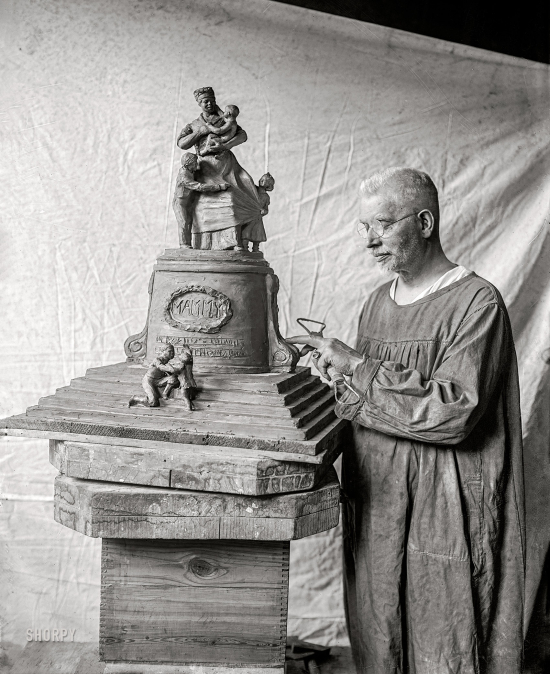
[Photo: Shorpy/National Photo Co.]
A proposed memorial to be located in Washington DC that would have honored mammys – black slave women who looked after the master's white children in the antebellum South, and became a racist stereotype perhaps best known now in Al Jolson's Mammy, or the Hattie McDaniel character in Gone With The Wind. The proposer was Congressman Charles Manly Stedman from North Carolina, in 1923.
But, luckily, it never got made:
As a Southern Congressman stated in support of the monument: "The traveler, as he passes by, will recall that epoch of southern civilization" when "fidelity and loyalty" prevailed. "No class of any race of people held in bondage could be found anywhere who lived more free from care or distress."
Today, it seems incredible that Congress sanctioned a monument to so-called Faithful Slaves — just blocks from the Lincoln Memorial, which had been dedicated only months earlier. But the monument to the Great Emancipator masked the nation's retreat from the "new birth of freedom" Lincoln had called for at Gettysburg, three score and ten years before. By 1923, Jim Crow laws, rampant lynching, and economic peonage had effectively reenslaved blacks in the South. Blacks who migrated north during and after World War One were greeted by the worst race riots in the nation's history. In the capital, Virginia-born President Woodrow Wilson had recently segregated federal facilities and screened Birth of a Nation at the White House. The overtly racist movie exalted the Ku Klux Klan, which peaked at two million members in the 1920s and won control of mayors' office and state legislatures across the land.
"We have this image of the 1920s as the Jazz Age, the birth of the modern, a world of skyscrapers and flappers," says David Blight, a Yale historian and leading scholar of race in the late 19th and early 20th century. "But white supremacy had few better moments in our history."
The early 1900s were also the heyday of Old South nostalgia. Popular songs and bestselling novels depicted antebellum Dixie as a genteel land of benevolent "planters" and happy "servants." Central to this idyll was the figure of Mammy, who in popular imagination resembled Uncle Tom's wife, Aunt Chloe, a cheerful, plump slave in a checked kerchief. White performers blackened their faces to tell stories and sing spirituals in the style "of the old time 'house darkey.'"…
Similarly, there is more folklore than fact underlying the stereotype of matronly slaves nursing young whites. "I went in search of the mammy and couldn't find her," says historian Catherine Clinton, whose books include Tara Revisited and Plantation Mistress. "Most slaves who looked after white children were very young." In other words, more like Prissy in Gone With the Wind than Mammy.
Or even younger. Harriet Tubman, for instance, was seven when she began caring for a baby and was whipped if the infant cried. Ex-slaves interviewed by the WPA in the 1930s also told of nursing babies as girls themselves, while the older black women of mammy lore looked after slave children whose mothers labored in the fields. These interviews also cast a harsh light on the supposedly privileged status of "house" slaves. One former slave recalled a "Mammy" being lashed "till de blood runned out"; another described a rape by the slaveowner's sons. "I can tell you that a white man laid a nigger gal whenever he wanted," said an ex-slave from Georgia who "went into the house as a waiting and nurse girl" between the ages of nine and twelve.
These and other routine cruelties didn't figure in the moonlight-and-magnolia romance that seized white imagination in the late 19th and early 20th centuries. Nor was the Mammy craze of that era confined to literature, song, and marketing. It was fostered by groups such as the United Daughters of the Confederacy (UDC), which sought to recast the "Lost Cause" as a noble defense of a Southern utopia. If slaves had been loyal, well treated, and content, it followed that emancipation and Reconstruction were calamitous — just as portrayed in Birth of a Nation. The ladies of the UDC honored aged blacks as "faithful Confederates" and even ghost-wrote testimonials such as "What Mammy Thinks of Freedom," in which an ex-slave says, "w'en I gits ter hebben, Lord, I hope I'll find its slabery."
And then there were the lynchings, which claimed some 2,500 lives between 1890 and 1920:
The Senate, just weeks before approving the Mammy monument, had allowed a Southern filibuster to defeat an anti-lynching bill. (One Southern Senator called it "a bill to encourage rape" by blacks, while another contrasted this menace with the "unspeakable love that every southern man feels for the old black nurse who took care of him in childhood.") The proximity of the lynching and Mammy debates prompted the Chicago Defender to publish a cartoon titled "Mockery," in which a Southerner presents plans for the mammy statue to the dangling body of a lynching victim. The Baltimore Afro-American offered its own vision of the planned monument: a frowning Mammy perched atop a wash tub instead of a pedestal, her empty hand extended above the inscription: "In Grateful Memory to One We Never Paid a Cent of Wages During a Lifetime of Service."
Blacks also bristled at the stereotype of benignly affectionate relations between masters and hefty, aging mammies, who seemed never to have families of their own. A truer monument, one paper suggested, would be a statue to a "White Daddy," sexually assaulting a young black woman as a mammy looks helplessly on.
Plans for the actual UDC monument stoked still greater outrage.
One sculptor's model showed an Aunt Jemima-like figure holding a white child as two other children clung to her dress. These were "pickaninnies," the artist explained, "trying to have their mother pay attention to them instead of devoting all her time to the white children." Another sculptor proposed a seated Mammy with an infant at her breast, set within a columned fountain. The monument's backers favored this design and said it would be titled "The Fountain of Truth." According to the Washington Post, the monument was to be erected on Massachusetts Avenue, near an equestrian statue of the Union general, Philip Sheridan.
But the monument bill had to pass a House committee before it could be enacted. And blacks not only fulminated against the statue; they organized protests. Petitions and letters poured into the offices of politicians and newspapers, including one presented by two thousand black women to Vice President Calvin Coolidge and the Speaker of the House. The women's auxiliary of the main Union veterans' organization, the Grand Army of the Republic, also condemned the monument as a "sickly sentimental proposition," and suggested the money would be better spent on "bettering conditions of the mammy's children."
Three months after the introduction of the monument bill in the Senate, Congress adjourned without having taken any further action. "Because of the controversy and resistance, it's ultimately allowed to die," says Micki McElya. And so, the Mammy statue quietly joined the ranks of monuments in the capital that were never built, including a towering "Mother's Memorial" and a plan for the Washington Monument that depicted the first president in a carriage atop thirty columns. The spot where Mammy was to have stood is now occupied by a statue of Tomas Garrigue Masaryk, a "champion of liberty" in Czechoslovakia.

 Mick Hartley
Leave a comment