The Deutsche Börse Photography Prize has been described as Europe's "most prestigious" annual photography award. So, with the latest 2018 exhibition newly opened at the Photographers Gallery, what can we learn about the state of photography today?
Well, nothing good, I'm afraid. The shortlist of four artists "showcases diverse and innovative photographic practices, which recognise and celebrate the many developments within the medium, while also challenging its boundaries.". Challenging boundaries, alas, is nearly always a warning sign.
Take Swiss artist Batia Suter, for instance. Here's what you read when you enter her gallery:
The ongoing themes of Batia Suter's artistic practice are the iconographic transformation of images and the conditions by which they become charged with new associative values. Her intuitive creative process situates printed figures in new contexts to provoke sudden reactions and exercise the many potentials of the image. Featuring hundreds of photographs, her imposing Parallel Encyclopedia #2 is a sequence of visual dialogues that reappropriate images of the natural world, objects and scientific analysis, as well as different periods, cultures, people and places.
Here Suter presents a sensitive composition of large reproductions sourced from over 1000 publications spanning from non-fiction, textbooks, historical volumes, to advertisements and magazines. The collected image material is methodically combined, edited and repurposed into different chapters which seamlessly intertwine. Images of drawings, paintings, objects, charts, scientific diagrams, other photographs and illustrations are juxtaposed to provide new poetic visual narratives, surprising affinities and alternative categorisations within our collective knowledge.
Got that?
No surprise that such a project made it to the shortlist. The fact that this has no graspable meaning matters not at all provided the right buzzwords are included – - iconographic transformation…reappropriate….repurposed….visual narratives. In that respect it's a curator's dream. As an added bonus, the artist here is herself in effect a curator, searching out and compiling images that others have created, for her own purposes. Of course the kind of people who curate these exhibitions are going to go for this stuff, by someone who speaks the same language they do. The images here – mostly, as I recall, blurred reproductions from biological textbooks – are very much of secondary importance to the text. The next logical move will be to do away with images and photography altogether. Maybe next year.
Elsewhere Mathieu Asselin’s project Monsanto: A Photographic Investigation provides a "searing indictment" of global biotechnology corporation Monsanto. Again the original photography is minimal – at least there's some this time – but the main image, covering one wall, is of a blown-up press photo of the chairmen of Monsanto and Bayer shaking hands, looking like everyone's idea of evil greedy capitalist bastards. Plus a screen offering live updates of Monsanto’s share price. Monsanto are no doubt a deserving target, but this is all about the text plastered all over, with the images a poor second.
Refusal, from Rafal Milach, looks at post-Soviet countries such as Belarus, Georgia and Azerbaijan, and the ruins of their totalitarian fantasies. Which could be excellent, and there is indeed one rather fine shot, of an unfinished viewing tower in Anaklia, Georgia, on the shore of the Black Sea, commissioned by the then President of Georgia, Mikheil Saakashvili, in 2012, before he fled the country:
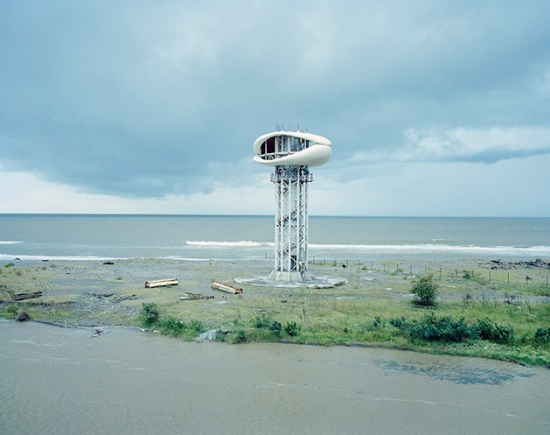
[Photo: Rafal Milach]
More photos like that would have been very welcome, and would have made for a fine display, but unfortunately the rest is all a bit pointless.
Finally, Luke Willis Thompson’s project autoportrait is a film of Diamond Reynolds, a woman who found tragic fame in July 2016, after she saw her boyfriend shot dead by a Minnesota police officer during a traffic stop, and the footage she filmed went viral. Here she appears on film, largely motionless, with no sound but the whirr of the 35mm projector. At least this is a primarily visual project, in contrast to the others, even if it's film rather than still photography. And it's very striking. Unfortunately I kept coming back to the ridiculous false eyelashes she was wearing – but maybe that's just me.
Depressing.


 Mick Hartley
Leave a comment