I have mixed feelings about the Andreas Gursky exhibition at the new Hayward Gallery. The images are often spectacular, and yet I can't help feeling that he's not worth the accolades heaped on him – as the most famous photographer in the world today, and one who's single-handedly elevated photography to an art form, worthy of the same critical scrutiny as any other work of art.
Much of the critical acclaim, I can't help thinking, relies on the fact that his work is open to the same language that saturates art discourse. Indeed he uses the language himself. When people feature in his images – which isn't often – he doesn't just have people in his images: rather, he's "exploring the relationship of humans to their environment". He claims that "documentary styles are no match for the complexity of the world", that "reality can only be shown by constructing it", that "montage and manipulation bring us closer to the truth". And as montage and manipulation are his speciality, he's claiming that somehow, where other photographers fail with their simple snap-and-go technique, his work shows us "the truth".
This is the language of a modern artist trying to sell their work. It's the kind of stuff that curators love: the stuff that you read again and again as you peer down to read the lengthy notes attached to each art work in any number of modern exhibitions, to explain why this particular image is so important, and why it challenges your preconceptions, and why it questions our understanding of reality and life and death and all things in between.
In other words, Gursky talks the talk. His pictures invite art historical exegesis by critics, curators, art historians. Reviews of the exhibition are, unanimously, full of praise. The reviewers know just what to write about: they belong to the same milieu, after all. It reinforces the familiar stale line that, somehow, we need experts to interpret the world for us. We can't just be shown the wonder and the beauty of the world in case, foolishly, we draw the wrong conclusions.
It's worth emphasising the key point here: that he's completely the opposite of a Cartier-Bresson, whose philosophy of capturing the decisive moment has influenced generations of street photographers. Gursky constructs and manipulates and builds his pictures, just like…..well, just like works of art. There's no decisive moment for him because that's not the kind of photography he's interested in. He doesn't like the messy business of real life and so – like fellow German photographer Thomas Ruff – he concentrates on the surface, making it as technically perfect, but somehow soulless, as possible.
Take for instance his 1993 image Paris, Montp0arnasse:
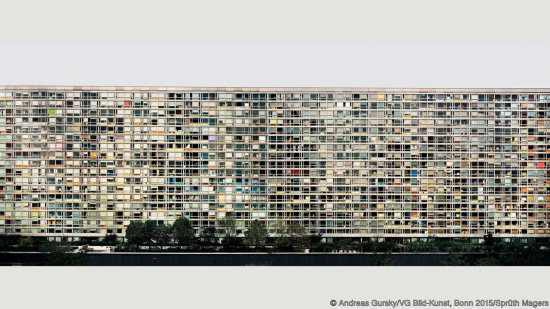
It's a huge photograph, meticulously printed, with – Gursky's trademark – everything in focus. And, by composing it from different images, he's managed to flatten it out, so that it looks, as it really is, a perfect rectangle. A normal photo from just one perspective would inevitably have distortions and foreshortenings, depending on the point of view. Our vision takes account of this, so when we look at the building in real life, or when we look at the building in a normal photo, we edit out those distortions and see the building as a regular shape. Except here Gursky's done the work for us.
From the catalogue:
One of the effects of bringing multiple images together to form a single work is that it results in an odd, suspended and bodiless perspective – as viewers we feel we are everywhere and nowhere at once. This diffuse and disembodied viewpoint creates a sense of dislocation that makes even familiar scenes strange.
Except I don't think it does, really. It's impressive because it's such a huge image, but it's a bit bloodless. It's glossy and it's perfect – like advertising.
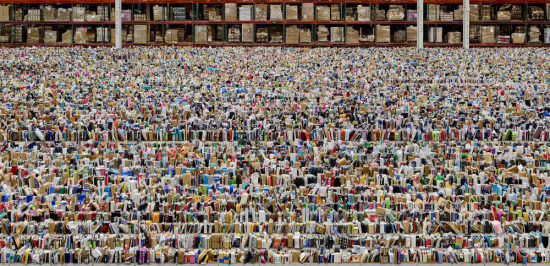
There are some compelling images, but they're barely worth reproducing here because it's the sheer scale and detail, as you see them in the exhibition. that gives them their power.
Amazon 2016, for instance, of an Amazon warehouse in Phoenix:
Or 99 Cent Store:
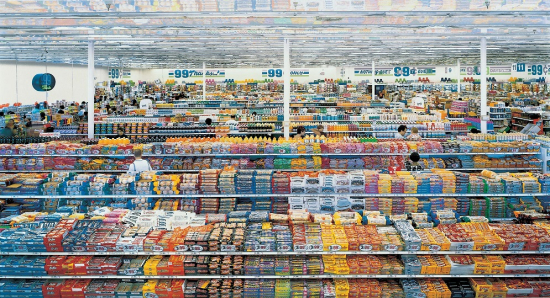
They're impressive exercises in image construction, but, for me, not much more.
Then there are the images from North Korea's Arirang Festival – that exercise in de-indivualisation and totalitarian mass control on a huge scale, from the regime with the worst record on human rights on the planet. It's somehow not surprising that Gursky was drawn to this grotesque spectacle. He's said that he's not interested in the individual, and here he gets a chance to prove it.
Pyongyang VI:
This makes me uneasy. It's not an image I like on any level. Of course a visit to Pyongyang doesn't mean that Gursky approves of the North Korean regime, but still…
You can read about his 2007 trip, The Axis of Evil: Traveling to North Korea with Andreas Gursky, here.
“I never claim the picture is a depiction of reality,” says Gursky. “It’s always a combination of invention and reality, an interpretation of reality. The impressions in your head get mixed up after one and a half hours of Arirang. A picture is not good because its subject is good, but because something has been made discernible, something that gives the picture direction. But I never give up the link to the documentary aspect of it.” What happens when North Korea’s stage direction collides with Andreas Gursky’s? Maybe the product of two negative integers is positive this time around, resulting in the most authentic depiction that can be made of North Korean reality today.
Hmm. He's so caught up in his self-regarding philosophy that he doesn't see what's right in front of him. Does he think his great skill and vision is sufficient to neutralise the stench of fascist spectacle on show here? The resulting pictures are, I'm sure, images that Gursky's North Korean minders would have been very happy with. Read the piece in full to see how they went out of their way to help the great man capture the full Arirang spectacle. And Gursky clearly considers these images to be successful. There are two Pyongyang pictures in what's billed as a retrospective show.
Are we in Leni Riefenstahl territory? Maybe that's too strong. But it does leave, for me, a bad taste in the mouth.
 Mick Hartley
Leave a comment