A time traveller from fifty years ago, on hearing of last week's World Hijab Day, would surely assume, given its level of support by the great and the good in the west, that it must be a united protest led by feminists against such an obvious and outrageous symbol of women's oppression. Five decades on from the heady days of Betty Friedan and other feminist pioneers, what else would they think but that the struggle continues? Women round the globe, to mark World Hijab Day, would be tearing off such degrading tokens of male subjection and shaking their hair free, chanting "Modesty, no! Freedom, yes! Rid the world of hijabs!" before breaking into a rousing chorus of "We Shall Overcome".
Time's arrow, however, isn't always straight.
In Iran, though, the struggle does continue. Largely unsupported and ignored by their western sisters, courageous women like Narges Hosseini fight on:
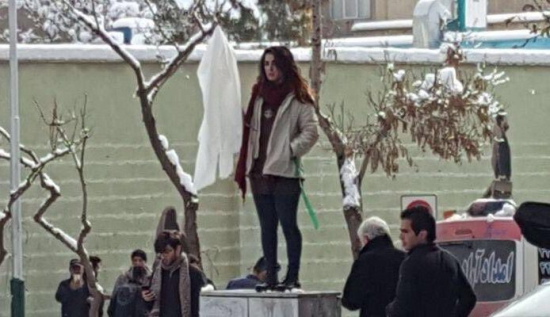
Narges Hosseini, who was arrested for protesting Iran’s compulsory hijab, refused to appear in court to face charges punishable by up to 10 years, including “encouraging immorality or prostitution.”
“Ms. Hosseini did not even appear in court to express remorse for her action. She said she objects to the forced hijab and considers it her legal right to express her protest,” Hosseini’s lawyer, Nasrin Sotoudeh, told the Center for Human Rights in Iran (CHRI) on February 5, 2018.
Hosseini, 32, has been in detention since January 29, 2018. She was unable to pay the $135,000 USD bail set by the judge presiding over her case.
She was arrested on January 29, 2018, for posting a photo on social media of herself standing on a bench holding her white headscarf like a flag on Tehran’s Revolution’s Street.
All women in Iran are required to cover their hair and bodies in public.
Vida Movahed was the first woman to be arrested after she did the same thing in late December 2017 in Tehran. The act of removing your headscarf in public and waving it like a flag has become a symbol for the “Girls of Revolution Street” movement, which advocates choice over compulsion for women’s clothing.
“Ms. Hosseini is being held in difficult circumstances in Gharchak Prison [south of Tehran] but she is not prepared to say she is sorry,” Sotoudeh, a prominent human rights lawyer, told CHRI. “She believes she’s innocent.”
Hosseini is facing the charges of, “openly committing a harām [sinful] act” and “violating public prudency” under Article 638 and “encouraging immorality or prostitution” under Article 639….
Hosseini’s lawyer also rejected a senior judicial official’s claim that her client is a drug addict.
On February 4, Judiciary Spokesman Gholam-Hossein Mohseni-Ejei told the semi-official Iranian Students News Agency (ISNA) that some of the hijab protesters “have been taking industrial drugs and participating in an organized plot hatched abroad.”
“Despite the Judiciary Spokesman’s false claim, Narges Hosseini has never consumed drugs in her life,” Sotoudeh told CHRI.
Iranian officials also accused two protesters who died in detention of being drug addicts. Some detainees in Evin Prison were also told by their interrogators to admit to being drug addicts to speed up their release, according to Sotoudeh.
Since late January 2018, at least 29 people have been arrested in cities throughout Iran, including Tehran, Mashhad, Isfahan and Rasht, for joining the “Girls of Revolution Street” movement and posting photos of themselves on social media with their hair uncovered.
They're going to need all their courage. In Iran, protest against the regime is not to be undertaken lightly:
A Friday prayer leader in Tehran has called for the death penalty to be issued to citizens who participated in the weeklong protests that erupted across Iran in December 2017.
“In our theology, the ruling against those who pour into the streets in opposition to a just Islamic ruler, cause fires or kill people… is death,” said Ayatollah Ahmad Khatami during a sermon on February 2, 2018.
Khatami is a member of the chairing committee of the Assembly of Experts, the constitutional body that select’s the country’s ruler.

 Mick Hartley
Leave a comment