As I posted a couple of days back about the new search for Tasmanian tigers on the Australian mainland, I can't resist this story from nearby New Guinea:
After decades of fearing that the New Guinea highland wild dog had gone extinct in its native habitat, researchers have finally confirmed the existence of a healthy, viable population, hidden in one of the most remote and inhospitable regions on Earth.
According to DNA analysis, these are the most ancient and primitive canids in existence, and a recent expedition to New Guinea's remote central mountain spine has resulted in more than 100 photographs of at least 15 wild individuals, including males, females, and pups, thriving in isolation and far from human contact.
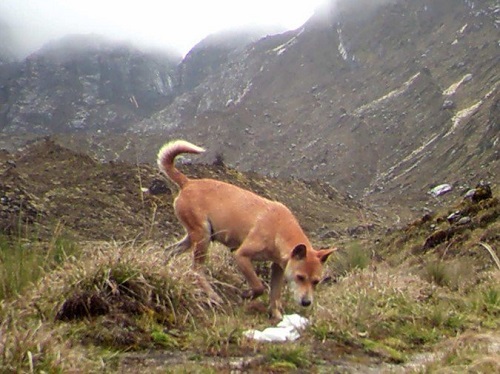
[Photo: NGHWDF]
"The discovery and confirmation of the highland wild dog for the first time in over half a century is not only exciting, but an incredible opportunity for science," says the group behind the discovery, the New Guinea Highland Wild Dog Foundation (NGHWDF).
"The 2016 Expedition was able to locate, observe, gather documentation and biological samples, and confirm through DNA testing that at least some specimens still exist and thrive in the highlands of New Guinea."…
Due to the lack of evidence of the species, it's been unclear exactly how dingoes, singing dogs, and highland wild dogs actually relate to one another, but that's a question that will hopefully soon be answered, because these animals truly are our best bet for getting a better understanding of canid evolution.
As the NGHWD explains:
"The fossil record indicates the species established itself on the island at least 6,000 years ago, believed to have arrived with human migrants. However, new evidence suggests they may have migrated independently of humans.
While the taxonomy and phylogenetic relationships with related breeds and Australian dingoes is currently controversial and under review for both New Guinea singing dogs and highland wild dogs, the scientific and historical importance of the highland wild dog remains critical to understanding canid evolution, canid and human co-evolution and migrations, and human ecology and settlement derived from the study of canids and canid evolution."
They do indeed look very much like dingoes, which are believed to have arrived in Australia – with or without humans – some 4000 years ago, or perhaps even earlier. The native thylacines found themselves out-competed, leading to their (presumed) extinction on the Australian mainland some 2000 years ago.
Dingoes interbreed with other dogs which arrived later with the Europeans – a major threat to their survival. These New Guinea highland wild dogs, living as they do in isolated pockets away from civilisation, will presumably be a pure breed free of such problems.


 Mick Hartley
Leave a comment