Why, I wonder, does Wolfgang Tillmans merit an exhibition at Tate Modern? He's a photographer, but he doesn't seem to be interested in the usual concerns of photography – capturing decisive moments, or recording the world in all its strange glory, or manufacturing timeless arresting images from the messy business of everyday life. There are very few pictures which, of themselves, capture the attention. Instead you have to read the guide to try and understand what's going on.
He's interested in the technology of making pictures, we learn. So, in the first room – the first very first image, in fact – we have Sendeschluss/End of Broadcast. Here's the man himself in a publicity shot in front of it:
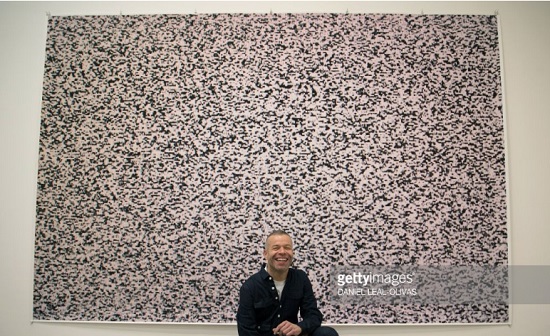
From the exhibition catalogue:
Static interference typically appears when an analogue signal is switched off. This can occur when a station's official programme finishes for the night or if a broadcast is censored. In Tillmans Sendeschluss/End of Broadcast 2014 it represents the coexistence of two different generations of technology. The chaotic analogue static was displayed on a digital television, which allowed Tillman's high-resolution digital camera to record the pattern as it really appeared, something that would not have been possible with a traditional cathode ray tube television. This work shows Tillman's interest in questioning what we believe to be true: the seemingly black-and-white image turns out to be extremely colourful when viewed very close up.
If you're thinking, hey, what a great idea, and what a fascinating image - well, you're in luck. There's plenty more where that came from. There are 14 rooms in the exhibition, and it's on till the 11th of June. There's plenty of time to engage further with this "groundbreaking" artist and his works "in an exciting variety of media – photographs, of course, but also video, digital slide projections, publications, curatorial projects and recorded music – all staged by the artist in characteristically innovative style".
If, on the other hand, the idea of using a high-resolution digital camera to picture an old analogue static interference pattern strikes you as a fatuous conceit, and the resultant image as uninteresting at best, having no relevance whatsoever to the question of "what we believe to be true", then I could be saving you the £12.50 entrance fee.
And no, it's not extremely colourful very close up. I checked.
Then there's Greifbar 29 - one of a number of similar large prints:
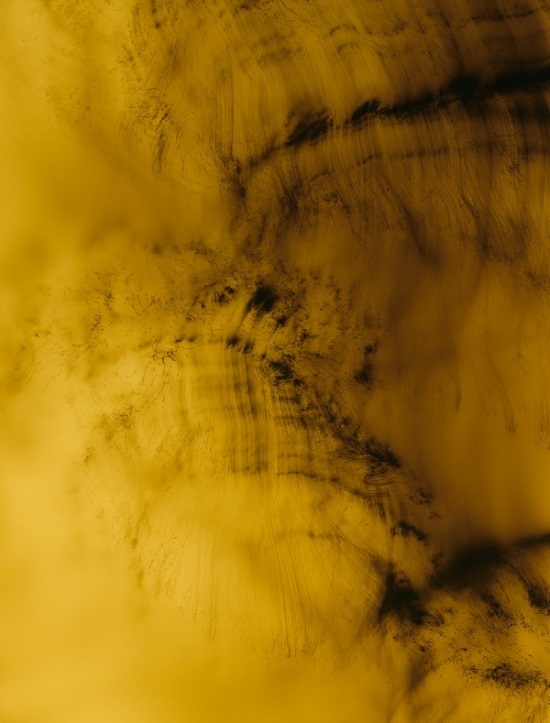
[2014 © Wolfgang Tillmans]
From the catalogue:
[T]he abstract Greifbar 2014-15 images are made without a camera. Working in the darkroom, Tillman traces light directly onto photographic paper. The vast swathes of colour are a record of the physical gestures involved in their construction, but also suggest aspects of the body such as hair, or pigmentation of the skin. This reference to the figurative is reflected in the title, which translates as "tangible".
Tillmans has observed that even though these works are made by the artist's hand, they look as though they could be "scientific" evidence of natural processes. For him, this interpretation is important, because it disassociates the works from the traditional gestural technique of painting. That the image is read as a photographic record, and not the result of the artist's brushstroke, is essential to its conceptual meaning.
Its conceptual meaning??
At some point our hero gets tired of sitting around in his studio and heads out into the world. These travel photos, to me, are distinguishable from your average tourist snapshots by their size and the quality of the printing, but by not much else. Sunset night drive, for instance:
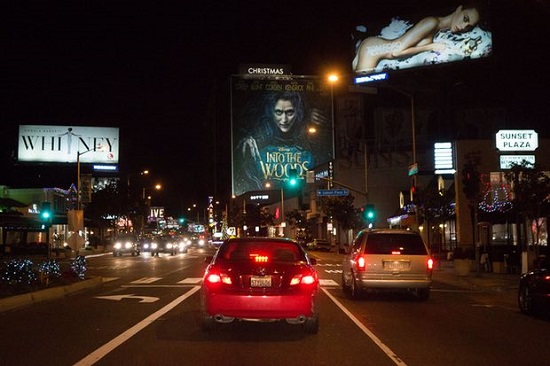
[2014. Photograph: © Wolfgang Tillmans]
A fairly hackneyed shot of Sunset Boulevard by night, you might think. Rest assured, though – Tillmans is not your average traveler:
Tillmans is interested in social life in its broadest sense, encompassing our participation in society. His photographs of individuals and groups are underpinned by his conviction that we are all vulnerable, and that our well-being depends upon knowing that we are not alone in the world….
He's also politically involved. The invasion of Iraq in 2003 was, apparently, a key moment in his political awakening:
The year 2003 is the exhibition’s point of departure, representing for Tillmans the moment the world changed, with the invasion of Iraq and anti-war demonstrations. The social and political form a rich vein throughout the artist’s work.
Or:
"I have a feeling that 2003 was a year of destiny," he tells me while we stand in the first room of the exhibition.
"There was an ongoing misunderstanding between the west and the Islamic world, and a pointless war that has repercussions to this day, with the European refugee crisis that's put the EU under threat. It was a very disheartening moment."
An ongoing misunderstanding between the west and the Islamic world? Hmm. Do you sense a profound grasp of the pre-invasion situation vis-a-vis Saddam's vicious Baathist regime, the failing UN sanctions, the genocide of the Kurds and so on? No, me neither.
He ticks all the right boxes, then. And he's very well regarded in art circles. Here's a hagiographic Guardian interview by Sean O'Hagan – "In person, Tillmans, tall and muscular, his hair close-cropped, is an imposing presence…". At the same paper art critic Adrian Searle gives a breathless five-star review to the show – though the Guardian commenters are less complimentary.
Why is he so loved by the art establishment? Well, as we've seen, his work seems to lend itself to all the familiar delights of art exegesis, finding significance in the banal, with a determination to infuse every image with the most profound meaning just because….well, just because they've been produced by Wolfgang Tillmans, who, they all agree, is a great artist.
A link at the Tate exhibition page takes us to an essay by Jeremy Millar which is something of a classic of its kind:
All photographs are of light, are made by light, although not all are about light. Not all of Tillmans’ photographs are about light either, or about it solely, but looking at a collection of them one gains a sense of its immense importance for him. It is not simply a technical necessity, or a formal device, but rather suggests a transformative process that is fundamental to photography…
Or again:
One sees throughout Tillmans’ work a longing that moves between engagement and retreat, a fascination for the crowd and all that comes from a shared experience, the ‘sensuous community’, but also those things which reveal themselves only when we find ourselves alone. These are the moments of reflection upon what has come before, an attempt, perhaps, to re-establish the sense of self that had previously been dissolved.
The man does seem to inspire this kind of adulatory verbal incontinence. Indeed the exhibition catalogue is almost one long panegyric to his brilliance:
An acute awareness of fragility endures across Tillmans's practice in all its different forms. Often this is expressed in his attentiveness to textures and surfaces….
The text and tables sculpture Time Mirrored 2017 represents Tillman's interest in connecting the time we live to a broader historical context. He always understands the Now as the history of the future. Events perceived as having happened over a vast gulf of time between us and the past, become tangible when "mathematically mirrored" and connected to more recent periods of time in our living memory.
And so, endlessly, on.
Some of the answer to my original question, then – why does he merit an exhibition at Tate Modern? – is answered in my first paragraph: you have to read the guide to try and understand what's going on. There's nothing the art world likes more than an artist whose work needs to be explained, at length. In fact you could more or less define the difference between a photographer and an artist nowadays by the fact that, with a photographer, you just look and you get it – though perhaps some brief context might be helpful, ie location, or date, or who the portrait's of. With an artist, you look and you think…umm…and you then open up the booklet to have it all explained to you by an art expert who leads you through the correct thought processes so you can gain an understanding of quite how brilliant the artist is – and of course, equally important, gain an appreciation of quite how clever and sensitive the expert is who's responsible for this clever elucidation that you're reading.
But also it just seems to have been accepted that the man is a Very Important Artist, and therefore, by definition, every thing he does must be Great Art, even if we have to struggle a bit and mutter about "conceptual meaning" and an "acute awareness of fragility" and all the rest to justify it.
For the rest of us, not inducted into the rarefied upper reaches of the art world, it is, despite the odd arresting image, an exercise in self-indulgence and pretension.

 Mick Hartley
Leave a comment