As we've heard, the North Koreans have been celebrating the birthday of Kim Jong-il, despite his death over six years ago.
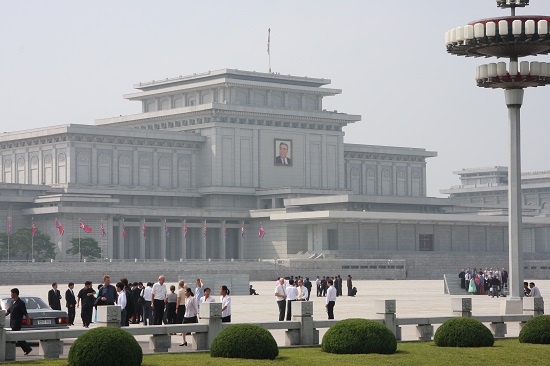
Both he and his father, Great Leader Kim Il-sung, are embalmed, Lenin-like, in the huge Kumsusan Palace of the Sun in north-east Pyongyang:
[Photo: Wikipedia/Mark Scott Johnson]
The palace was built in 1976 as the Kumsusan Assembly Hall and served as Kim Il-sung's official residence. Following the elder Kim's death in 1994, Kim Jong-il had the building renovated and transformed into his father's mausoleum. It is believed that the conversion cost at least $100 million. Some sources put the figure as high as $900 million. Inside the palace, Kim Il-sung's embalmed body lies inside a clear glass sarcophagus. His head rests on a Korean-style pillow and he is covered by the flag of the Workers' Party of Korea. Kim Jong-il is now on display in a room close to and very similar to his father's.
Kumsusan is the largest mausoleum dedicated to a Communist leader and the only one to house the remains of multiple people. It is fronted by a large square, approximately 500 metres (1,600 ft) in length. It is bordered on its northern and eastern sides by a moat.
Foreign visitors can access the palace only on Thursdays and Sundays. They must be on an official government tour. Photography, videotaping, smoking and talking are not permitted anywhere inside the palace. The palace plaza, though, is open all week, and is the venue for national rallies.
The building is accessed via an underpass adjacent to a tram stop across the road. Upon entering the building, visitors (both foreigners and North Korean tourists) are asked to check all personal belongings except their wallets in a cloak room, and are given a numbered ticket to claim their belongings when leaving. Visitors proceed along a series of long travelators. Photography is also not permitted anywhere in the palace.
Until 2015, visitors had to emerge in a long hall with two white stone statues of the Kims bathed in soft red light, this was replaced by a 3d-styled portrait of the Kims with Mount Paektu in the background, with national and party flags flanking them. Marble arched columns line the hall. Visitors are told to stop at a yellow line on the floor and, after a few moments of contemplation, beckoned into another room. Here, they are given small speaker devices that play a narration of the Korean people's grief when Kim Il-sung died. The room features bronze-like busts of people grieving. Finally, visitors go in a lift to the top floor in the white and grey marble walled building. They are filed through a dust blowing machine and enter the room with the preserved remains of Kim Il-sung and Kim Jong-il lying in state. A red rope barrier runs around the transparent crystal sarcophagi. Visitors are sent in groups of four and are told to bow at the Kim's feet, to his left, and then right side.
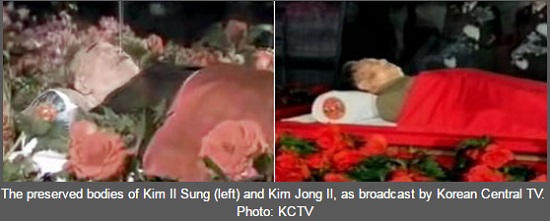
The appropriate display of emotion is required on being in the presence of the embalmed corpses.
From the Daily NK:
 Mick Hartley
Leave a comment