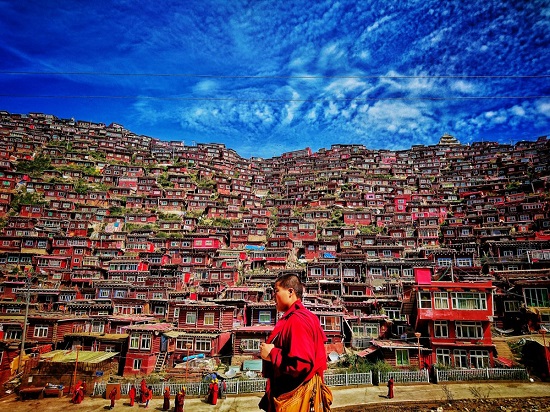
Sertar County in Sichuan, China – an entry to the Sony World Photography Competition for 2017:
[Sony World Photography Awards]
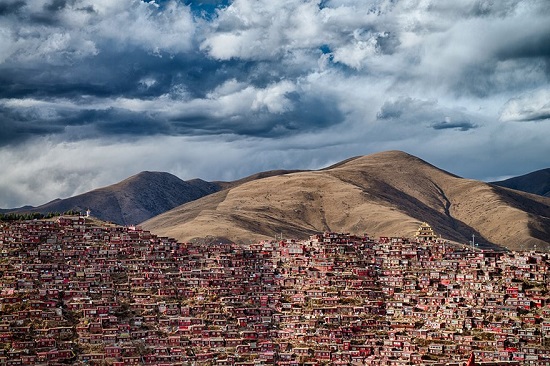
This is Larung Gar Buddhist Academy, one of the largest and most influential centres for the study of Tibetan Buddhism in the world.
A more sober photograph of Larung-Gar from this year's competition:
[Photo: Attila Balogh/Sony World Photography Awards]
Naturally the Chinese authorities are not helpful:
A large Tibetan Buddhist academy tucked in a remote valley of Sichuan province is under threat of large-scale destruction by Chinese authorities for the second time in 15 years, international human rights groups and scholars say.
Larung Gar, a picturesque settlement of red log-cabin dwellings set amid alpine hills, was founded in 1980 by a teacher named Khenpo Jigme Phutsok, a "living Buddha" who played a key role in reviving Tibetan Buddhism after the 1966-76 Cultural Revolution when religious traditions were forced underground.
Despite its remote location — the journey by car takes 20 hours over rough roads from the metropolis of Chengdu — the learning center has attracted adherents from Tibet and many other parts of China, as well as overseas.
In 2001, government officials forced thousands of monks and nuns to leave Larung Gar, sending in demolition crews to tear down their simple wooden structures. At the time, authorities at the provincial religious affairs bureau told Reuters and other media outlets that “concerns about social stability” from “central authorities” had prompted the evacuations and said that the settlement would be limited to 1,400 students.
Despite Khenpo Jigme Phutsok’s death in 2004, Larung Gar has rebounded, growing bigger than ever. In recent months, though, a notice from local officials began circulating saying that Larung Gar’s population needed to be reduced to no more than 5,000 residents by Sept. 30, 2017.
The document did not spell out a clear rationale for the downsizing, though it did cite two major government meetings during which President Xi Jinping stressed “national unity” and the necessity for religious groups to support the Communist Party and “merge their religious doctrines with Chinese culture.” Communist Party authorities have in recent years stepped up “political education” in monasteries as well as mosques.
 Mick Hartley
Leave a comment