Art imitates life:
The heartbreaking image of a dead 3-year old Syrian refugee who was drowned in the Mediterranean sea last year just got a huge artistic tribute.
Last week, Chinese artist Ai Weiwei closed his eyes and lay face down on a cold, pebbled beach imitating the lifeless body of the Syrian toddler Alan Kurdi.
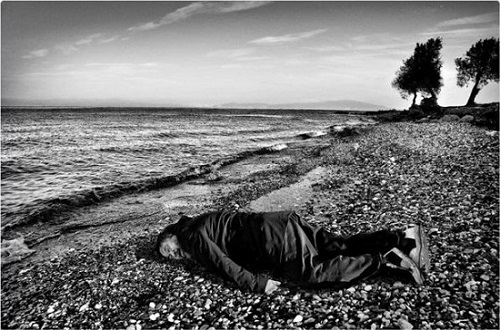
[Photo: Rohit Chawla for India Today]
That photograph of Ai captured by India Today magazine on the Greek island of Lesbos is now the toast of the India Art Fair at an exhibition called “The Artists” this weekend. The exhibition was mounted by news magazine here.
There might be some point to this if the plight of Syrian refugees was an ignored or forgotten subject in need of a spot of publicity. But it isn't: it's never very far from the headlines. The picture of Aylan Kurdi became an iconic image – perhaps the best known photograph of last year. So this just looks like a massive piece of self-indulgence by Weiwei, appropriating the suffering of others for his own ends.
Ai and his team "actively helped in staging this photograph for us," said Rohit Chawla, a photographer at India Today, who traveled to Lesbos, where Ai is currently working on an art project on refugees.
“I am sure it wasn’t very comfortable to lie down on the pebbles like that. But the soft evening light fell on his face when he lay down,” Chawla recalled.
See what suffering great artists have to endure?
A huge number of art lovers and gallery owners are now lining up in front of the black and white photograph at the art fair, organizers said.
“It is an iconic image because it is very political, human and involves an incredibly important artist like Ai Weiwei,” said Sandy Angus, co-owner of India Art Fair. “The image is haunting and represents the whole immigration crisis and the hopelessness of the people who have tried to escape their pasts for a better future.”
The photograph will run next week along with Ai’s interview in India Today.
“When I said to him, 'I will meet you at your studio,' Ai Weiwei answered, “the seashore is my studio,” said Gayatri Jayaraman, the magazine senior editor who interviewed him.
Jayaraman said Ai stood on the seashore waiting for the boats filled with refugees and assisted them as they get off. He was collecting rubber pieces of the boats for an art installation project.
“He is such a great artist, but to me he also appeared to be a Mahatma Gandhi-like figure,” Jayaraman said. “He is very warm and humble, but his very presence there in that situation as tired, cold, wet refugees arrived was colossal. And very political.”
Weiwei has attracted a great deal of sympathy – quite rightly – for the harassment he's received at the hands of the Chinese authorities, but this suggests that what we have here is another artist with a massive ego, happy to play along with the cult of the artist as hero-figure.
And no, I didn't think much of his Tate Modern Sunflower Seeds.
Update: to elaborate a little….
“It is an iconic image because it is very political, human and involves an incredibly important artist like Ai Weiwei,” said Sandy Angus, co-owner of India Art Fair. “The image is haunting and represents the whole immigration crisis and the hopelessness of the people who have tried to escape their pasts for a better future.”
The image is, palpably, not haunting. The original image – of Aylan Kurdi's body – was indeed haunting. Unbearably so. This isn't. This is an image of an overweight man lying on a pebble beach. Nor does this image "represent the whole immigration crisis". Again, if any image can be said to do that, it's the original Aylan Kurdi image.
So what's the point? What we're left with is that the image "involves an incredibly important artist like Ai Weiwei". That seems to be the point. For a certain type of mind, it seems, that fact lifts this onto a different level. What was "just" a picture of a dead boy on a beach now somehow becomes an "iconic image" because an artist – an "incredibly important artist" – has taken the place of the boy. As though, Christ-like, the artist, by his appropriation of the image, takes upon himself the suffering of the dead boy and, by extension, the suffering of all the Syrian immigrants.
Weiwei clearly cares about this issue. He's closed down his exhibition in Copenhagen, in protest at a new law that allows Danish authorities to seize valuables from asylum seekers. But this seems such an enormously self-aggrandising gesture, this lying on the beach, this symbolic taking the place of the dead boy. It just plays – as I said above – to the cultish belief in the power of the artist, by the simple fact of his divine genius, as capable of transcending the commonplace and making art out of the base clay of human suffering.
Perhaps his stay in the Greek Islands, engaging with the refugee crisis, will produce something worthwhile. I have to say I'm not holding my breath.


 Mick Hartley
Leave a comment