From the Daily NK:
In a response to North Korea’s fourth nuclear test, the international community is set to intensify sanctions. As a result, North Korean factories have been instructed to increase the proportion of materials acquired from domestic sources to be used in the production process. Pyongyang’s Taedonggang Foodstuff Factory has been instructed to undertake a “flavor revolution” of its Pyongyang Red Pepper Paste, but has not received ingredients from the state to do so, so it has been forced to turn to the donju [the money masters, or nouveau riche].
In a recent phone call with the Daily NK, an inside source from South Pyongan Province said, “After the alleged hydrogen bomb test and the expected economic sanctions to follow from countries such as the United States, the Taedonggang Foodstuff Factory gave instructions to its employees in the importance of developing self-reliance. The instructions explained that just as the hydrogen bomb test shocked the world, the production of red pepper paste would need to undergo a shocking revolution in flavor.”
The Taedonggang Foodstuff Factory has already shocked the world with its recently developed hangover-free alcohol, so nothing, clearly, is beyond them. But the stress on self-reliance may be just a touch hypocritical:
It appears as if the new flavor of the Pyongyang Red Pepper Paste is a direct imitation of the South Korean style, which is a delicious combination of sweet and tangy that has really caught on north of the border. The packaging of the product is even similar to the South Korean equivalents, so some people have gotten confused looking at the labels, unable to tell whether the product is from the North or South.
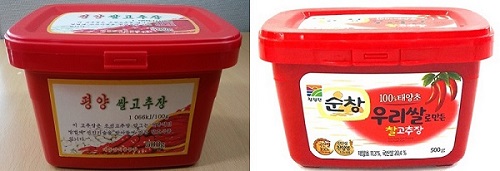
A comparison of North Korea’s Pyongyang Rice Red Pepper Paste (left) and South Korea’s SunChang Rice Red Pepper Paste (right). The northern product has copied the taste and packaging of its southern counterpart. Image: Daily NK.
It's all reminiscent of the tale of the Choco Pies a few years back. The South Korean luxury confections were given to Kaesong workers and became so popular that they were traded on the black market for several times their original price. The North retaliated by producing their own, much inferior, Choco Pies, and spreading rumours that the South Korean pies were contaminated.
It's much worse than that now, though. It's not just copying products: it's rebranding them:
Recent reports from North Korea have revealed the prevalence of the practice of repackaging Chinese-made goods in North Korean factories to make it appear as though they have been produced domestically. Kim Jong Un, frustrated over what he calls “a sickness of preferring foreign-made goods,” has ordered the state-run factories to simply repackage Chinese goods and pass them off as homegrown.
Local sources told Daily NK they see this as an attempt for the young leader to “bury his head in the sand” rather than face the fact that domestic factories lack the capacity to engage in quality manufacturing.
A source in South Pyongan Province told Daily NK on January 21st that when Chinese goods enter the country, rather than going directly to the market with their country of origin clearly marked, it is becoming a common practice to relabel them with North Korean manufacturing stickers, designs, and markings before they hit the shelves to pass them off as local merchandise.
Daily NK verified this news with an additional source in the same province as well as a source in the capital.
A short time ago it was the donju [new affluent middle class], engaged in wholesale/retail operations, who would store goods in their own warehouses before releasing them to the markets. But now the regulations have altered, giving state-run factories the exclusive right to do so. Currently, Chinese goods that pass through these factories are rebranded as homegrown products with North Korean packaging before being sold. Although the practice started in a few factories, now it is quite widespread.
During his leadership Kim Jong Un has repeatedly underscored the importance of domestic production, with the most recent iteration encouraging the nation to “escape the importation sickness” and “increase the ratio of domestic good consumption.” While a worthy idea on paper, the reality is that North Korea’s languishing state-run factories lack the technology and know-how to produce most of the goods that that are so readily imported from China.
Consequently, factories have concluded that they have no choice but to resort to the desperate measure of simply repackaging foreign-made goods in an effort to comply with the leader’s most recent prescription. The repacking scheme seeks to fuel domestic demand for North Korean goods, which are generally regarded by the public as low-quality and undesirable, by improving the public’s image of products bearing North Korean brands.
“As North Korea’s market expands, anyone selling goods is able to make a profit but the manufacturing capabilities of domestic factories are not able to meet the increased demands of consumers,” our source explained….
She then remarked dryly, “It appears that the regime is under the impression that they can claim to have domestically developed a product when all they’ve actually done is assemble or package it somehow. Lacking the resources and skills to develop the necessary technology themselves, all they can do is try to manufacture propaganda about it instead.”
Well yes, propaganda: that's something they can manufacture.


 Mick Hartley
Leave a comment