It does all seem a little precious, the whole Grayson Perry thing: transvestite potter who's developed a religion with his teddy bear Alan Measles as God. But the exhibition he's put together at the British Museum is really quite extraordinary.
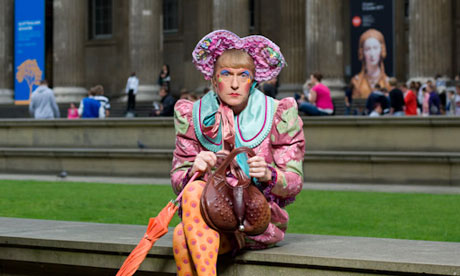
[Photo: Pal Hansen for The Observer]
A good place to start is last week's Imagine, with Alan Yentob. Perry makes an ideal subject for this kind of TV arts programme: eloquent and at ease in front of the camera. Yentob hardly needs to say a word, and even BM Director Neil MacGregor, surely a man who's used to expressing himself fluently in public, comes across as tongue-tied and awkward in comparison.
Perry's point is that he's not happy with the current art world. He's acquired a certain level of fame as an artist – he won the Turner Prize in 2003 – but the prospect of a career punctuated by the usual type of gallery exhibitions doesn't appeal. It's the whole stale post-Duchamp world of defining art as whatever happens to be in an art gallery:
"Things are given a spurious significance by being in the gallery now. It used to be you built the gallery to put significant objects in. Now you put insignificant objects into a gallery to give them significance."
So he had the idea of approaching the British Museum to see if he could curate an exhibition combining his own work with a selection of BM artefacts. The point about the BM is that, in contrast to the current art world, these objects are made by unknown craftsmen. There's no ego involved; no major name; no "spot the genius" games. They were made with a particular purpose in mind, to an end, but that end wasn't, generally, aesthetic in the sense that we now understand that term. They may have been made for religious, funerary, or ceremonial reasons, but they wouldn't have been intended as works of art as such. Whatever that, now, may mean.
I can't imagine anyone else making a success of this, but he pulls it off. Much of that is down to the quality of his contributions. The pots – what he's best known for – are good, but some of the other pieces are outstanding, and it's difficult to imagine he'd have made them outside of the context of this exhibition. His ceramic Temple Guardian is wonderful, as is the centrepiece, The Tomb of the Unknown Craftsman – an iron ship loaded with anthropological bits and pieces, with a hand-axe, the first human artefact, as the focal point. My favourites, though, could be the two pieces "Our Mother and Our Father", ancient figures from a mythological past who seem to be burdened down with odd bits of lumber from every early civilisation. But let's not forget some of the odd and marvellous pieces he's managed to include by other earlier – and not so earlier – hands.
It's a pilgrimage, he says. Nowadays we make pilgrimages to galleries and museums instead of holy sites. The central story of the Imagine documentary is Perry's pilgrimage to the German town of Backnang, twinned with his home town of Chelmsford, on his custom-made motorbike with Alan Measles in a shrine on the back (a case, he observes, of Mohammed coming to the mountain).
It's hardly a new point, of course, this idea of the gallery as the new church. I thought it was interesting that Perry, in one of the notes in the exhibition, mentions German artist Joseph Beuys as one of his artistic heroes. It was when he was describing his interest in the magical power or shamanistic quality that resides in certain objects. Beuys did indeed see himself as something of a shaman, but for me, I'd have to say, he was more sham. He built a romanticised past life of dubious veracity, and in the process of proclaiming himself a figure of shamanistic power validated his artistic productions simply on the basis that he, the great Joseph Beuys, had made them, and they were therefore, by definition, great art. His legacy, therefore, is that of the cult.
The very British Grayson Perry, by contrast, is saved by his sense of humour. As deity Alan Measles himself says, “One of my core messages is that I want people to think about what fantasies they are holding on to and to hold their beliefs lightly. If I am a God of anything, I am God of a doubt. Pretty useless for a religion I know, but I feel the world has enough zealots and people attached to being right already.” Or, in the words of his disciple, "Do not look too hard for meaning here. I am not a historian. I am an artist. That is all you need to know."


 Mick Hartley
Leave a reply to Mick H Cancel reply