This superb lithograph is one of the highlights of the British Museum's current (free) exhibition of German Romantic Prints and Drawings:
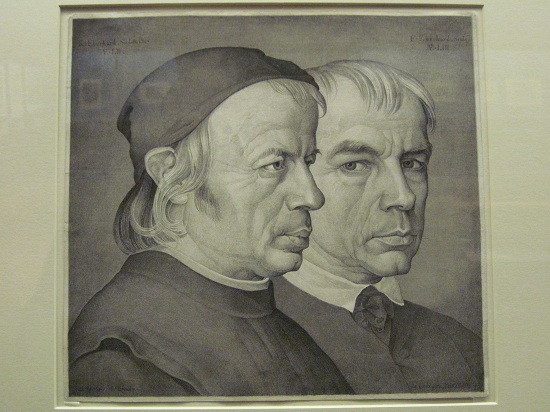
By Johann Anton Ramboux, 1822.
You can see it here, at the Amica Library:
In 1822, Johann Anton Ramboux accompanied the Eberhard brothers to Munich, where he executed this double portrait lithograph. Because he intended the print to be a gift to the sitters, only a small number of impressions were produced. This exceedingly rare work is an exquisite example of early German lithography, a technique which had only been invented in 1798.Ramboux, who had been a student of the French painter Jacques Louis David (1748-1825), lived in Rome between 1816 and 1822. There he befriended a group of German artists who had formed the Brotherhood of St. Luke (also called the Nazarenes). They inhabited a deserted monastery and lived a life of study and Christian devotion. Their art strove to restore the pious purity of early 16th-century Italian and German painting, emulating the strong draftsmanship of Raphael (1483-1520) and Albrecht Dürer (1471-1528). Such an emphasis on skillful drawing is evident in this lithograph: Ramboux beautifully modeled the two heads in light and shade.
And here's Ramboux's (mirror image) oil painting.
 Mick Hartley
Leave a comment