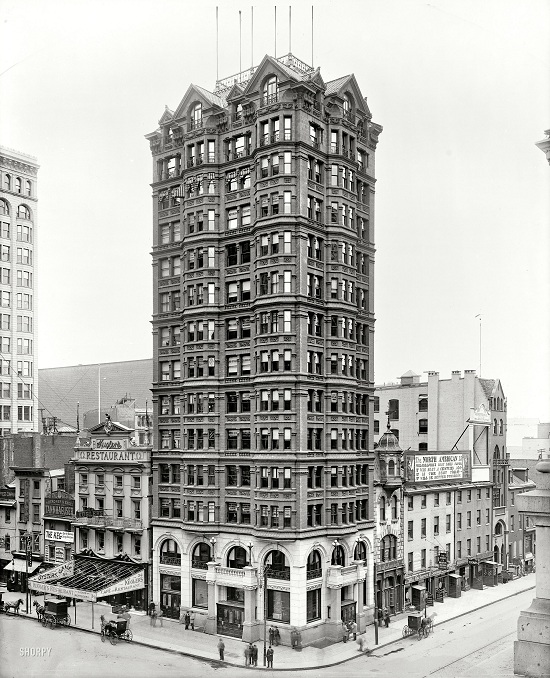
Nowadays the language of architecture is pretty much international, with the same big names – Foster and Partners, Skidmore Owings and Merrill, Cesar Pelli – using the same glass and steel technology to build almost interchangeable skyscrapers. Back in the day, around the end of the 19th Century, only the US was building high, and those early proto-skyscrapers were just like European buildings, in the Beaux-Arts style say, except they were taller. Like this:
SHORPY_westendtrustphilly
[Photo: Shorpy/Detroit Publishing Co.]

It was a unique American movement. There are still a few around, though most are long gone. This extraordinary tower, the West End Trust Building, was built in 1898 but was demolished in 1928 to make way for the Girard Trust Building, now the Ritz-Carlton Philadelphia. Even when it was first built this kind of structure, still using load-bearing masonry walls, was already on the way out: the first steel-framed skyscraper appeared (in Chicago) in 1885. 

It's easy to see why they knocked it down. It may have been structurally unsound, of course, though the Monadnock Building, at 20 stories the largest ever load-bearing masonry building (again Chicago), is still standing. But no, it's hardly a thing of beauty. Back in the Twenties, with the rise of Modernism and the influence of architects like Louis Sullivan and his "form follows function" mantra, this must've seemed like some monstrous decadence. But it was kind of magnificent.

Full size here.

Posted in

7 responses to “Philadelphia 1900”

  1. Dom Avatar
    Dom

    It makes me think of the old Lit Brothers in Philly.
    http://departmentstoremuseum.blogspot.com/2010/11/lit-brothers-philadelphia-pennsylvania.html
    There is a sign on the full picture for the “North American” newspaper. I remember my father talking about it.

    Like

  2. DaninVan Avatar
    DaninVan

    Interesting that steel reinforced concrete construction wasn’t mentioned. It’s certainly been a major contender in N.America.
    http://www.jfccivilengineer.com/reinforced_concrete.htm
    “Ingalls Building, Cincinnati, OH, 1903. Postcard postmarked 1906. The Ingalls Building (later renamed the Transit Building) was the world’s first reinforced concrete skyscraper, and it remained the tallest reinforced concrete building until 1923. The structural concrete, which is reinforced with twisted steel rods, is covered with a facade of marble, brick, and terra cotta. Arguments for using reinforced concrete for the Ingalls Building were that it would be fire proof and that it would cost less than a steel skeleton building. Previously, reinforced concrete had been used for bridges. ”
    http://www.officemuseum.com/IMagesWWW/1906_Cincinnati_skyscraper_dated_by_postmark_small.jpg

    Like

  3. Mick H Avatar
    Mick H

    OK, interesting, but then I wasn’t aiming for a comprehensive history of the development of architectural technology in North America in the early 20th Century. Had I been then yes, reinforced concrete should have been in there somewhere.

    Like

  4. Dom Avatar
    Dom

    You got me started on Philly architecture. I found this on youtube. It gives the interesting story about the Divine Lorraine on Broad street, and it gives you a sneak peak about the type of decay going on in Philly.
    http://www.youtube.com/watch?v=OWSgm_AJJwI&feature=related

    Like

  5. Mick H Avatar
    Mick H

    Weird: the first racially integrated hotel in the US, but men and women had to sleep on separate floors. Great looking building though.

    Like

  6. DaninVan Avatar
    DaninVan

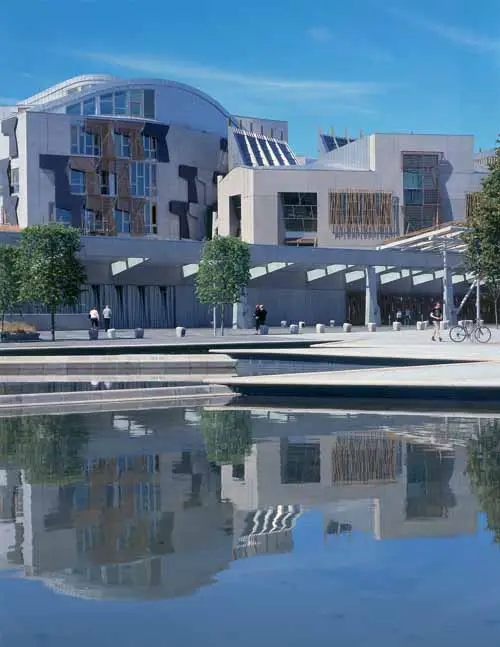
    Ah, but the point is, M.H., that reinforced concrete was the big breakthrough that Architects (and Engineers) needed in order to let their imaginations soar. On the other hand, some of the recent crap that’s been produced makes one long for the good old days…
    http://www.edinburgharchitecture.co.uk/images/jpgs/scottish_parliament_kh6.jpg

    Like

  7. Mick H Avatar
    Mick H

    OK – point taken.

    Like

Leave a comment