The response to my piece on the Bow Back Rivers a couple of weeks back has been remarkable – and of course very gratifying. I've received e-mails from as far away as Nigeria.
I mentioned in passing that one solution to the continued dereliction of muddy Leamouth might be to join up Bow Creek to East India Dock Basin, and use the lock there to link the Lea to the Thames. I'd never actually visited East India Dock though, so I thought I'd put that right last week.
Well…I'm in no hurry to go back. What a desolate place:
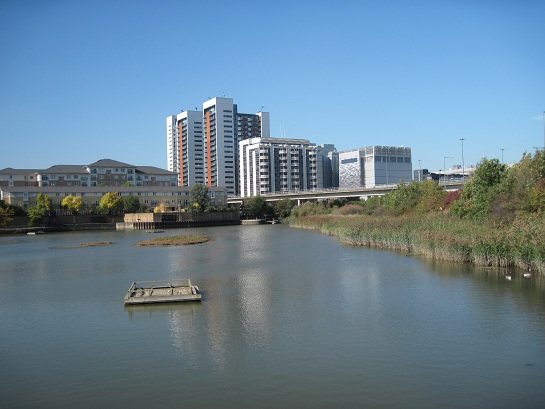
In keeping with current green thinking, it's been abandoned to nature: handed over to the bird-watchers.
I was, it hardly needs saying, the only visitor – though there was one workman doing some tidying up. This is just to the east of the towers of Docklands, yet how many people come here, I wonder? Five a week? The occasional disconsolate school trip, perhaps. "There, look everybody. D'you see? Over there by the reeds? It's a….it's a duck!"
It needn't be this way. They could still adopt the alternative Hartley Development Plan. Have a working lock either here, with a channel dug through to Bow Creek, or at Trinity Buoy Wharf where the Lea meets the Thames. Then all of Bow Creek and the Bow Back Rivers would stop being tidal mudflats, and become vibrant waterways for boats, anglers, walkers and the rest. East India Dock Basin would be redeveloped, as happened with St Katherine's Docks and Limehouse Basin - or Limehouse Marina, as estate agents like to call it. For people, not birds.
What's the point of this puritanical return to nature? There are plenty of green spaces up the Lea Valley already. Birds have got thousands of miles of coastline on which to prod, stalk, wade, stand and squawk. This is right next to Docklands, across from the Dome, near the beating heart of the metropolis.
This modish green thinking would, I get the feeling, be delighted if the whole city returned to nature: a kind of post-apocalypse scenario, with kestrels nesting at the top of high-rises, rabbits lolloping across the traffic-free roads, weeds breaking through the concrete. And bodies on the pavements. With signs:
"Please do not disturb the corpses.
They provide a home for local wildlife, a welcome breeding site for the blowfly, and a source of vital nutrients to animals such as foxes and rats."
We'll get there sooner rather than later if some of the gloomier economic predictions come true.
But I wonder: are these ecology enthusiasts being radical enough? Let's get serious about this. What about – and I offer this merely as one possible option – Docklands as a wildlife sanctuary for the White-backed Indian vulture? The poor birds are threatened with extinction in Asia, as they get poisoned when they feed on dead cattle injected with an anti-inflammatory steroid. They've already been seen, appropriately enough, in Croydon. In my proposed Docklands Ecology Park and Vulture Sanctuary, these magnificent creatures could be given a new life feeding on bankers; very few of whom, to my knowledge, have been injected with anti-inflammatory steroids.
It'd be a popular move. And it'd certainly make for more interesting school trips.
 Mick Hartley
Leave a comment