In which an accepted wisdom is overturned (via):
Easter Island was first an enigma, then a parable. The world's most isolated inhabited place, 1,500 miles from the next populated island in the Pacific, it was discovered by Europeans on Easter Sunday, 1722. Those first visitors—an expedition led by the Dutch lawyer Jakob Roggeveen—came upon an almost treeless expanse with perhaps 3,000 occupants, Polynesians who spoke their own distinct language. Scattered about the barren landscape were, incredibly, almost a thousand colossal stone figures, some weighing 75 tons. With their giant heads and tiny bodies, they faced inland, glowering at their makers like so many huge, surly bobble-head dolls.
Rapa Nui, as the island is called by its residents, was small—just 63 square miles—and almost devoid of natural resources. Its people had no wheels, metal or draft animals. The situation has baffled Easter Island researchers, among them famous names like Thor Heyerdahl and Jared Diamond, for decades: How could so few people with so little technology have carved and transported such a profusion of monster statuary?
Diamond's thesis, in his Collapse: How Societies Choose to Fail or Survive, became the generally accepted solution to the riddle. Easter Island had once been a thriving society, but the silly sods got carried away on a tide of hubris and grand project building into making these absurd vainglorious monuments to themselves, when they should have been pursuing a sustainable agricultural model based on renewable resources. Suddenly all the trees were gone – cut down to roll their ridiculous statues into place – and they were staring at a bare ruined landscape.
What are we humans like, eh?
So they became the classic case of eco-suicide, and the lesson for us was clear: unless we shape up our fate will be their fate writ large, and we'll find ourselves following our unfortunate and rather dim Polynesian cousins into oblivion.
Except, according to Terry Hunt and Carl Lipo in The Statues that Walked: Unraveling the Mystery of Easter Island, that's all nonsense:
The real culprit, according to "The Statues That Walked," was the Polynesian rat (Rattus exulans), which stowed away on the boats of the first Polynesian settlers. In laboratory settings, Polynesian rat populations can double in 47 days. Throw a breeding pair into an island with no predators and abundant food and arithmetic suggests the result: ratpocalypse. If the animals multiplied as they did in Hawaii, the authors calculate, Rapa Nui would quickly have housed between two and three million. Among the favorite food sources of R. exulans are tree seeds and tree sprouts. Humans surely cleared some of the forest, but the real damage would have come from the rats that prevented new growth.
"Rather than a case of abject failure," the authors argue, "Rapa Nui is an unlikely story of success." The islanders had migrated, perhaps accidentally, to a place with little water and "fundamentally unproductive" soil with "uniformly low" levels of phosphorus, an essential mineral for plant growth. To avoid the wind's dehydrating effects, the newcomers circled their gardens with stone walls known as manavai. Today, the researchers discovered, abandoned manavai occupy about 6.4 square miles, a tenth of the island's total surface.
More impressive still, about half of the island is covered by "lithic mulching," in which the islanders scattered broken stone over the fields. The uneven surface creates more turbulent airflow, reducing daytime surface temperatures and warming fields at night. And shattering the rocks exposes "fresh, unweathered surfaces, thus releasing mineral nutrients held within the rock." Only lithic mulching produced enough nutrients—just barely—to make Rapa Nui's terrible soil cultivable. Breaking and moving vast amounts of stone, the islanders had engineered an entirely new, more productive landscape.
The statues that walked? Jared Diamond assumed the huge stone figures – moai – would have required hundreds of people to move, which led him to believe that the island had been hugely over-populated. But the authors show that only only 15 or 20 islanders would have been needed to walk the statues along, rocking them from side to side the way you move a large wardrobe.
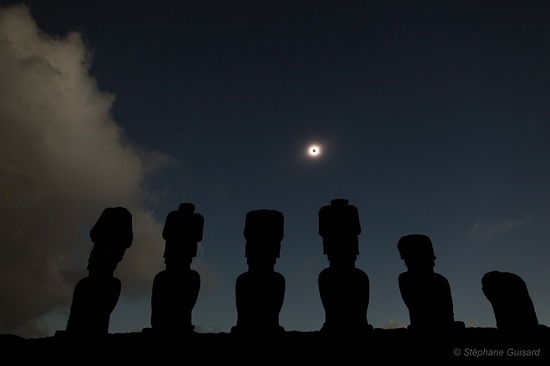
[Photo: Easter Island Eclipse, Stéphane Guisard]
A tale, then, not of human foolishness, but of human ingenuity.

 Mick Hartley
Leave a reply to TDK Cancel reply