Canal harbor and elevators, Buffalo 1910:
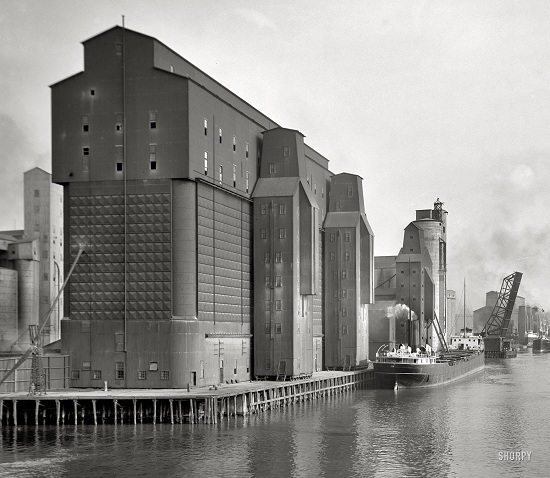
[Photo: Shorpy/Detroit Publishing Company]
Full size here.
As a Shorpy commenter notes, the huge elevators along the Buffalo harbour front, which stored grain from the Mid-West transported by ship across the Great Lakes, inspired some influential people:
When the Swiss architect Le Corbusier saw the pure cylindrical forms of Buffalo's massive concrete grain elevators, he exclaimed, "The first fruits of the new age!"
They are indeed massively impressive, as so many of these structures from the early days of industry and trade tend to be. The significant point, though, is that they were designed with a particular purpose in mind, and with little or no concern for aesthetics. Their beauty – if that's not too strong a word – lies very much in their adherence to the form-follows-function principle. Artistic appreciation came later. When you then take that particular style of aesthetics and apply it arbitrarily elsewhere out of some romanticised notion of modernity, as architects like Le Corbusier did for housing projects….well, the results aren't always quite so successful.
More happily they inspired a number of artists who wanted to celebrate the modernisation and industrialisation of America , like the Precisionists. Here's Ralston Crawford's 1937 "Buffalo Grain Elevators" at the Smithsonian:
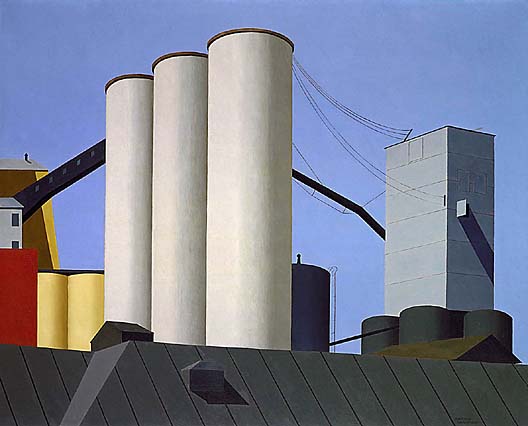
Buffalo now has a Grain Elevator Project:
Today many of these heroic monuments of the early modern era stand unused along Buffalo's waterfront, relics of a time when the city played a leading role in the storing and processing of the nation's grain. For the most part, they are forgotten by the community that once drew economic sustenance from them.
Buffalo's grain elevators – an ensemble of as many as twenty giant complexes mostly along the Buffalo River – need to be remembered. The layers of meaning that they have absorbed over the decades need to be interpreted. They need to be brought back into the consciousness of the residents of the city, to be seen, understood, appreciate, celebrated, and reused.
One can only wish them well with their task of interpreting those absorbed layers of meaning.
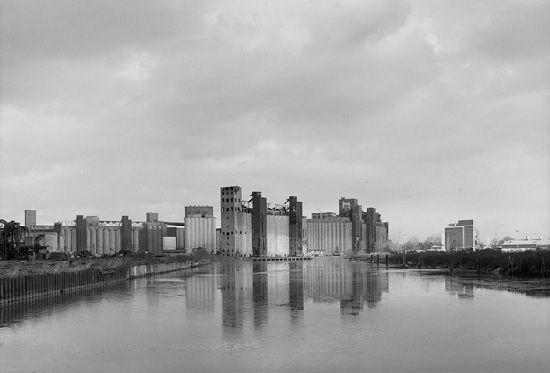
Here's a 1990 photo taken from here:
Another Shorpy picture from Buffalo's golden age as a busy working port, taken in 1905:
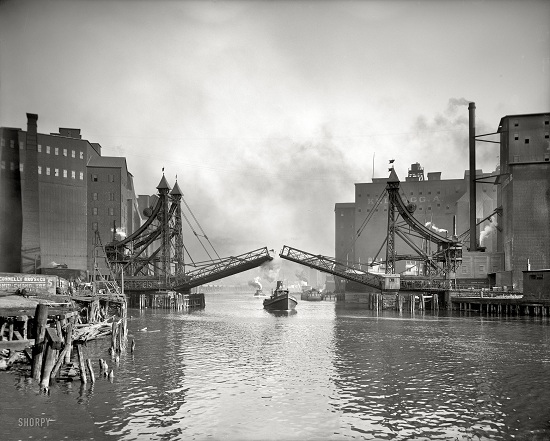
[Photo: Shorpy/Detroit Publishing Company]
And a modern look at those "pure cylindrical forms" which so captivated Le Corbusier:
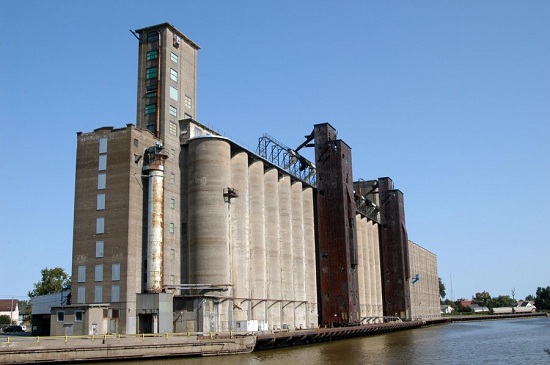
[Photo: ~skar578]
 Mick Hartley
Leave a comment