Dinka boy leading black bull:
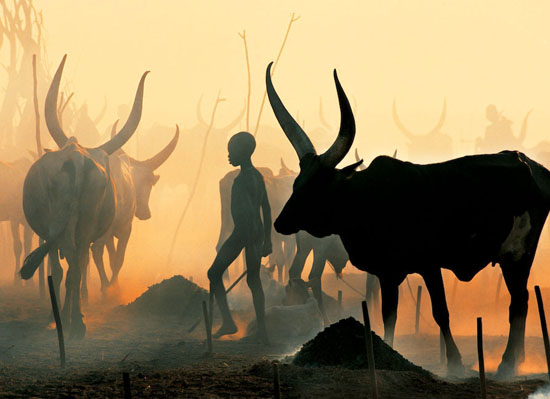
[Photo: Carol Beckwith/Angela Fisher]
From a collection of photographs by Carol Beckwith and Angela Fisher, Legendary Cattle Keepers of Sudan (via).
The Dinka, like the equally photogenic Nuba, best-known perhaps for that George Rodger picture of wrestlers from 1949 but also the subject of a photo-essay by Leni Riefenstahl, are very much National Geographic type material. The tone of the intro to these photos is typical:
This seminal volume on the indigenous African Dinka group is a landmark documentation of a vanishing people in war-torn Sudan. World-renowned photographers Angela Fisher and Carol Beckwith have devoted their lives to documenting the rapidly disappearing ceremonies and cultures of the indigenous people of Africa. In breathtakingly poignant images, they present a story that started with their first visit to the Dinka thirty years ago. Living in harmony with their cattle, the Dinka have survived years of war only to find their culture on the brink of vanishing forever. Where the White Nile River reaches Dinka country, it spills over 11,000 square miles of flood plain to form the Sudd, the largest swamp in the world. In the dry season, it provides abundant pasture for cattle, and this is where the Dinka set up their camps. The men dust their bodies and faces with gray ash—protection against flies and lethal malarial mosquitoes, but also considered a mark of beauty. Covered with this ash and up to 7’ 6" tall, the Dinka were referred to as "gentle" or "ghostly" giants by the early explorers. The Dinka call themselves "jieng" and "mony-jang," which means "men of men."
The photos are undeniably beautiful, but….well, it's all suffocatingly romantic at best, patronisingly essentialist at worst. As for that "7’ 6" tall" stuff…
…the popular belief that Dinka "often" reach more than seven feet finds no support in scientific literature. An anthropometric survey of Dinka men published in 1995 found a mean height of 176.4 cm, or roughly 5 ft 9.45 in in the Ethiopian Medical Journal.
For a refreshing change from that kind of tourist safari Africa there's an exhibition at the V&A I'd recommend: Figures & Fictions: Contemporary South African Photography. Africans in all their glorious variety. An intro here, and more detail here on the photographers included. Yes, there's the usual curatorial guff:
Photographs showing figures raise pertinent issues of identity: how the gaze of the camera, photographer and viewer is returned by the subject, and the balance of power which that interaction implies. The 'figure' also implies not only the human figure but also the metaphorically figurative. Photographs can be like a 'figure' of speech, composed of familiar words but containing an ambiguity between literal and figurative interpretation.
As the Fictions part of this exhibition's title suggests, it points not just to the geographical and social specificity of these photographs but also to the enigmatic relationship with the 'real' world that they seem to depict. A photograph is always a translation, distillation or filter of reality seen from the physical and conceptual standpoint of the person creating the image – as well as that of the viewer.
But all easily ignored. It's a great show.
 Mick Hartley
Leave a comment