The Art of Street Jewellery is a sumptuously produced book about those old enamel advertising signs that were so prevalent on British city streets from somewhere round the 1870s/80s up to the 1950s. This kind of thing. Not a particular interest of mine but, at a remaindered price in a secondhand bookshop this morning, it was hard to resist.
As well as beautiful reproductions of the signs themselves, there are a number of wonderful old photos of period shop fronts – like this one:
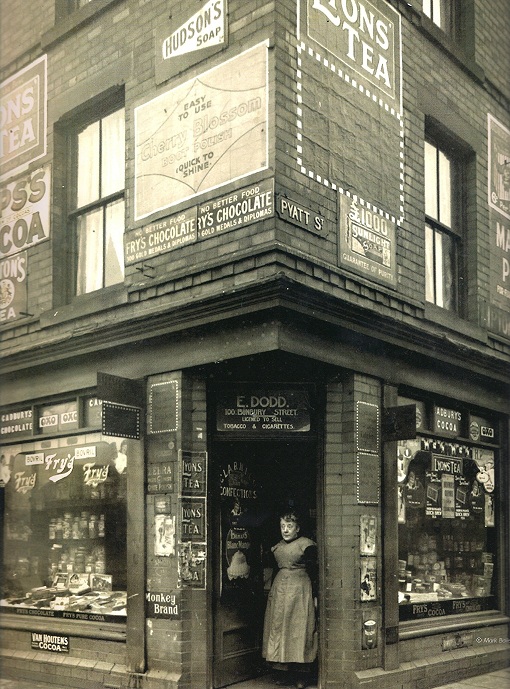
Where's that, I wondered? Pyatt Street? Let's have a look on Google Maps.
Less than a minute later – here we are, Pyatt Steet, Nottingham, junction of Bunbury Street (the address on the door, under E.Dodd, is 100 Bunbury Street). The same view, some 80(?) years later.
The wonders of the internet age, eh? I love that it's possible to do something like that so quickly.
What's immediately obvious, of course, is what we've lost; how visually exciting, how lively that shopfront is compared to the shut-up desolate look it has now. It's the same building, but that's about the best you can say for it. Whereas once it was a focus for the community, full of life and character – even if the poor woman seems a little apprehensive standing there – now it's just another bleak urban corner barely worth a second glance.
It's a similar story at Shorpy, the vintage photo website that I post from occasionally. Those old city street scenes from the early 20th Century are so much more interesting than the same scene some 100 years later. Usually a commenter will show the equivalent Google streetview, and even allowing for the fact that Google's raison d'etre is utilitarian rather than aesthetic, the comparison is depressing. Some recent examples: Little Rock c. 1910, and now: Detroit c. 1910 and now: Memphis c. 1910, now. Street life seemed so much more vibrant and interesting then.
 Mick Hartley
Leave a comment