What struck me about the Arshile Gorky exhibition at Tate Modern didn't seem to be what struck other reviewers. The story of the show, which is pretty much the story of the reviews, is that of the artist whose role in providing a link between European modernism and the birth of Abstract Expressionism hasn't till now been fully appreciated. As Times art correspondent Rachel Campbell-Johnston puts it:
Here is a painter who, almost single-handedly, carried the baton of Modernism across the Atlantic opening up a bleak mid-Twenties New York to new possibilities. André Breton described him as “the only painter in America” and de Kooning, when asked about his artistic origins, replied that they lay in 36 Union Square: the address of Gorky’s studio in Greenwich Village.
He was slightly ahead of the Jackson Pollack, Mark Rothko generation, and, as William Feaver in the Guardian tells the story, he'd worked his way through to his final abstract style by the mid-Forties, and then, just before it all took off in the Fifties and his pioneering role could be acknowledged, went and killed himself.
It's not that I'd want to disagree with any of that, but there are really two parts to the show. The main part does indeed show Gorky's development towards his final abstract style: though it has to be said that it seems to have taken him quite some time to break free and find his own artistic language. Perhaps the fact that he died so young – still in his forties – means that in a large exhibition like this we inevitably get rather too many early derivative pictures simply because there aren't enough late mature works to fill the walls. He starts off imitating Cezanne and Picasso, and then falls under the influence of the Surrealists, with Andre Breton even providing titles for his paintings: "Study for the Liver is the Cock's Comb", that kind of thing – stuff that Breton could make up in his sleep (that's a joke, by the way..surrealism?..dreams? automatic writing? Oh never mind). It's only late on, in his last few years, that you get some sense of an individual style – and then he's gone.
The other part of the show, which only takes up one gallery apart from an early self-portrait very much in the style of early Picasso, is the figurative stuff, and in particular the paintings of him as a child with his mother which he worked on for years, based on an old photograph from 1912. For this you need to know the story:
Gorky was born in the village of Khorgom, situated on the shores of Lake Van. It is not known exactly when he was born: it was sometime between 1902 and 1905. (In later years Gorky was vague about even the date of his birth, changing it from year to year.) In 1910 his father emigrated to America to avoid the draft, leaving his family behind in the town of Van.
Gorky fled Van in 1915 during the Armenian Genocide and escaped with his mother and his three sisters into Russian-controlled territory. In the aftermath of the genocide, Gorky's mother died of starvation in Yerevan in 1919. Gorky was reunited with his father when he arrived in America in 1920, aged 16, but they never grew close.
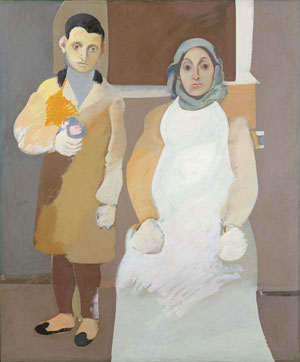 Well…being aware of that history is of course going to affect how you see the picture, but I thought the original, in situ in the gallery, was just immensely powerful and immensely sad. It's visible at the end through the first few galleries, and – to me, anyway – couldn't help dominating, and setting the whole tone for, the rest of the exhibition.
It would be no doubt insulting and simplistic to see the course of Gorky's life, and his eventual suicide, as governed by the tragedy that he lived through and witnessed as a child. There were plenty more immediate reasons why he might have wanted to take his life when he did: his studio barn burned down, he'd undergone a colostomy for cancer, his neck had been broken and his painting arm temporarily paralyzed in a car accident, and his wife of seven years left him, taking their children with her. And his contribution to the development of Abstract Expressionism was substantial and important. And yet…
Just as we should no doubt try to view Mark Rothko's paintings as they present themselves, but find it next to impossible to ignore the retrospective gloom cast over those heavy browns and purples by his eventual suicide, so with Gorky – for me at least – the black hollow eyes of his mother refused to let go.


 Mick Hartley
Leave a reply to Mick H Cancel reply