The face of a koala, the body of a sturdy kangaroo, and the mind of a killer wombat. Or something like that.
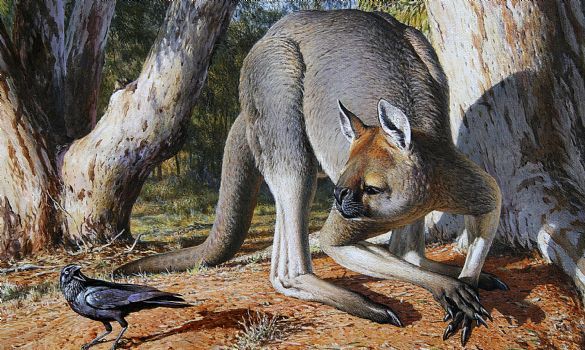
Scientists think they have discovered the reason behind the demise of the prehistoric Australian marsupial Procoptodon goliah– better known as the giant, short-snouted kangaroo. They say it was not climate change, as has always been assumed, but hungry Ice Age hunters.
The animal – about three times bigger than a modern-day kangaroo and with slightly different features – was one of many Ice-Age megafauna whose demise has long been debated among experts, but usually put down to the changing environment.
However an international team of scientists, led by Gavin Prideaux from Flinders University in South Australia, has discovered a different theory behind the reason the animal became extinct 45,000 years ago.
The research, published this week in the US journal Proceedings of the National Academy of Sciences, not only shines a new light on the demise of the animal – the largest kangaroo ever to evolve – but also on the landscape of Australia at the time.
While the scientists were unable to uncover direct proof of the hunting theory – such as a fossil or the like displaying wounds – they did so by a process of elimination….
According to the scientists, Australia was also once the home to rhinoceros-sized herbivores, marsupial lions, giant wombats and giant lizards, and suffered the worst extinctions of all the continents, losing 90 per cent of the larger species by 40,000 years ago.
The Times article gives the height of the beast as 6' 5, but, as a commenter points out, this is hardly larger than a Big Red. Wikipedia gives the height as 3 metres, or 10 feet, which is more like it. It was, after all, the largest roo that ever was. And now isn't.
Anyway, it's another nail in the coffin of the notion that only Europeans ever did anything as nasty as hunt animals to extinction.


 Mick Hartley
Leave a reply to Mick H Cancel reply