It's a dispiriting place, Tate Modern:
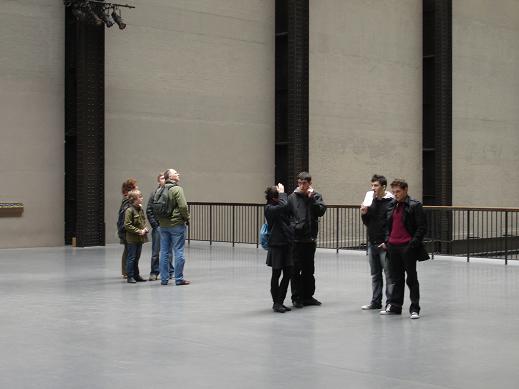
In the Turbine Gallery there's some tedious post-apocalyptic nonsense, but at least it's free. Upstairs one of the main current exhibitions is on American artist Roni Horn. You have to pay for that.
The show's full title is Roni Horn aka Roni Horn. Why? Because, well…
Horn is interested in the idea of pairing and doubling. Many of her intricately constructed drawings feature paired clusters of cut-up lines. She often uses two identical photographs in a single work, breaking up the images to give the viewer a sense of déjà vu, such as in Dead Owl 1998, a pair of photographs of a stuffed snowy owl.
That's right; a pair of identical photographs of a stuffed snowy owl, one right next to the other. From the catalogue:
Horn's pairs sometimes appear side by side, as in the diptych Dead Owl 1998, where the doubling of the photograph changes its emphasis: the work is about proximity and how the presence of two may alter the original identity of one. Horn's doubles are not always identical, but they are never polar opposites. If the artist thinks in pairs it is never to suggest a hiearchy between one element and another: each element in a pair has its own identity.
Horn's use of pairing and doubling always intensifies the encounter with her works. The effect of experiencing a form twice is one of amplification rather than repetition. The viewer becomes aware of the part they play between the two elements. 'The idea was to create a space in which the viewer would inhabit the work or at least be a part of it,' Horn has said.
Always intensifies the encounter with her works? Not for me.
Could you come across language like this anywhere but in an art gallery? It's vacuous, hectoring nonsense. It doesn't mean anything. It's covering up the total banality of the art on display. It reads like some kind of post-modernist discourse that's been processed through a de-jargoniser to make it acceptable for a fee-paying public that needs to be told, in the face of an art which can only be justified by recourse to modish concerns about difference and identity, exactly why they should be so thrilled to have paid out money to see this crap. But the problem with de-jargonising post-modernism is that you're left, largely, with nothing.
Not that the exhibition's devoid of interest or beauty. She does some nice coloured blocks of glass, which sit in the middle of the galleries. They "dramatise mutability"; they're "surprisingly transparent" or "dramatically reflective"; they have an "alchemical quality". Best of all, "The viewer intuits that though solid, the identity of the objects cannot be fixed, a condition which might mirror their own self-understanding". See? Not just art, but philosophy too. Know thyself – as a block of coloured glass.
And there are some large photos of the surface of the Thames which I liked – swirling, dark, eddying currents – until I noticed the tiny numbers scattered across the prints, about thirty per picture, each one linking to a footnote whose annoying tone of condescension and vacuity somehow managed to destroy any pleasure in the actual images. "Many footnotes are addressed to 'you', making the viewer a reader within the public space of the gallery, and encouraging his or her own reflections." Gee thanks – you mean we can think for ourselves? Well, only within the prescribed limits set by the footnotes, of course.
My favourite piece was "Cabinet of 2002". What could you best pick to exemplify all the kind of pseudo-concerns that seem to obsess artists nowadays?…subverting those old certainties of personal identity and objective truth and all that. How about clowns? Clowns are good. They're people…who've assumed different identities! They're made up to represent something they're not. So, you take photos of clowns – but the photos have to be blurred, obviously. "Mummy, why are all those photographs blurred? Couldn't they figure out the focus setting?" "Shh dear, it's art….":
Horn has made several works using portraiture which unsettles the genre's historical ambitions to represent the essential character of the portrayed subject. Cabinet of 2001 is one of Horn's most opaque works, comprised of a grid of 36 blurry images of a clown performing different emotions and expressions. The blurriness of the head shots curtails the descriptive or graphic nature of the portraits and contributes to a more visceral understanding and experience.
Perfect. Absolutely perfect. A work of art, I'm tempted to say.
She's not just an artist, Roni Horn; she's a writer:
Books are an essential part of Horn's practice; some of them are displayed in the cafe area outside the exhibition. Horn uses books in a different way to her more public works. 'The book is an intimate form, it mostly engages the individual individually. I can think of no other form so inherently private'.
Can't argue with that. A book mostly engages the individual individually.
However, true to her belief that 'things don't have fixed identities', her books loosen the definitive capacity of these bibliographical forms. A single photographic subject might recur through a publication, but there is neither a fixed sense of order nor a particular narrative progression. Instead readers navigate the books according to their wishes. For Horn, the arrangement of images in some of the books amounts to a proposal for 'a language without words'.
Sadly, she hasn't got there yet.
[Her Index Cixous at Amazon – "Inspired by the author Helene Cixous, this work questions the nature of language in its most fundamental sense, and proposes a new language, one without words, but which can be read as any other" – currently has a 5-star review, under the heading "The medium is the message", of another book entirely. Sometimes this post-modernism just gets too much for me.]
Why do we get exhibitions like this? Is it something to do with the cult of the artist? Or something to do with Tate Modern? I really don't know.


 Mick Hartley
Leave a reply to Mick H Cancel reply