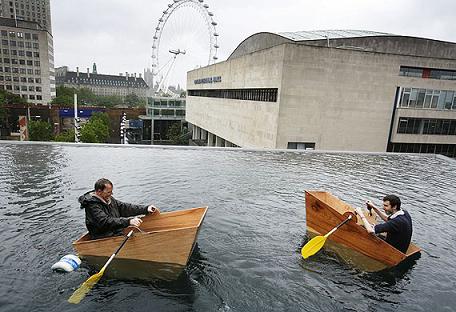
 I was persuaded, against my better judgement, to go to the Hayward Gallery’s 40th anniversary show, “Psycho Buildings“. The clincher was the prospect of boating on the roof, with a view of the London skyline. So we turned up, to be informed that the boating was off:
We very much regret that we need to carry out essential maintenance work on Gelatin’s Normally, Proceeding and Unrestricted With Without Title, 2008 (the boating lake).
Well, what are you going to do? We went in anyway (no reduction, mind). And, though it may be true that I wasn’t well disposed by now, what a poor exhibition I thought it was.
The sub-title gives the game away: “artists take on architecture”:
Psycho Buildings brings together the work of artists who creat habitat-like sculptures and architecturally inflected installations. These include structures that are designed to be explored psychologically, as well as environments that we can engage with physically.
So, nothing to do with architecture, but a lot to do with artists being self-indulgent.
By turns visceral, pungent, meditative, absurd, threatening, atmospheric, the art works in Psycho Buildings probe the ways in which built structures shape our imaginative and physical lives.
Installations: a word to send fear into the heart of all exhibition visitors. What it means is that each room is given over to an artist to create some kind of environment: an adventure playground for adults. The first gallery, for instance:
Ernesto Neto’s walk-in environments are ‘life experiences’, to be entered and explored in what he describes as a ‘mind-body continuity’. Evoking anatomy and the body’s internal architecture, Life fog frog…Fog frog also has the effect of making space palpable.
The work summons up a range of opposites; macrocosm and microcosm, airiness and weight, the nebulous and the clearly defined. It also draws our attention to the relationship between the figure and its background, and between inside and outside. Within the tent-like body our experience can be intimate, sensual and personal. Seen from outside or above …, the encounter is more detached: people moving inside the dome become phantoms; remote figures performing in a shadow theatre.
Speaking of the fragile fabric membranes from which his works are constructed, Neto says: ‘I believe that we as human beings are subjected to certain corporeal and temporal boundaries, and that the skin serves as a container in a culturally and physically determined world’. He adds, ‘This is where happiness lies, the region of occurrences where the relationship between human individuality and the world unfolds – physically, psychologically, and mentally.’ About our interaction with the work, he notes, ‘movement and the experience of scents are important, but so is contemplation: just looking and breathing’.
This is either fatuously obvious – “we as human beings are subjected to certain corporeal and temporal boundaries” – or almost entirely devoid of meaning. The actual work is a tent made of two layers of netting over a skeletal wooden frame, with some bags hanging down inside. One bag contained cloves, so everyone had a good old sniff: “the experience of scents are important, but so is contemplation: just looking and breathing“. Oh fuck off. It’s that combination of hectoringly condescending art-speak with the total banality of the work on display which just gets me every time. How do they have the nerve? Mind-body continuity? Making space palpable? What? It’s a fucking tent with a bag of cloves hanging down inside. Can I have my money back please?
Next up was Michael Beutler’s untitled piece, consisting of walkways through coloured paper. Really. My mood didn’t improve.
Michael Beutler’s sculptures are interventions within specific places, in which they interact physically and visually with their surroundings. Starting with the gallery space itself, he works in a spontaneous way, loosely responding to the architecture.
Again, this says nothing. He could have laid a turd in the centre of the room and it would be an intervention within a specific place, interacting physically and visually with its surroundings. It would have also that added olfactory dimension (the experience of scents are important, remember) as well as being a suitably spontaneous and indeed appropriate way of loosely responding to the environment. What it is, we’re presented with a series of semi-transparent walls covered in coloured paper which we wander through for all the world like some primary school presentation, or perhaps what some indulgent parents might have knocked up for their little girl’s 8th birthday party, for the guests to walk through and spot the balloons or whatever. Again that question, how can they get away with this? And charge for it? The catalogue vainly attempts to cover up the total vacuity of the actual work:
Constructed at great speed from florist’s tissue paper bonded onto mesh panels, the panels – which incorporate all sorts of accidental litter and sweepings from the ‘factory’ floor – are then shaped and distressed by being jumped upon. The tears and holes that inevitably result give the material its particular characteristics. It is yet to be seen how these panels will materialise into particular forms, but what is certain is that the final result will be a playful environment that exerts an influence on the way in which we perceive and negotiate this space.
The work hadn’t been finished when the catalogue was written: not that it stopped them writing about it. What should have happened, but I’m quite sure didn’t, was that on completion the curators wandered through the installation and told Michael Beutler that his piece was a complete pile of shite, and they were withholding payment. But being an artist means never having to say you’re sorry.
It gets better, but not much. There’s an exploding kitchen, with cinder blocks and bits of furniture caught in mid flight. As the artists (Los Carpenteros!) explain:
[W]e are interested in the fact that violence exists and that we have to deal with it, as with just another part of your everyday life, like going to the kitchen.
Eh? Well anyway, nice idea guys, but it’s been done already.
Rachel Whiteread has a darkened room full of dolls houses, with little lights inside:
No two houses in this carefully arranged diorama are exactly alike. What they have in common is their unexplained emptiness, and their collective abandonment.
Unexplained emptiness? They’re dolls houses, for Christ’s sake. It would have been considerably more disconcerting if they hadn’t been empty and abandoned. Loads of tiny little people sitting in their tiny little rooms wondering where the hell Rachel Whiteread’s got to….
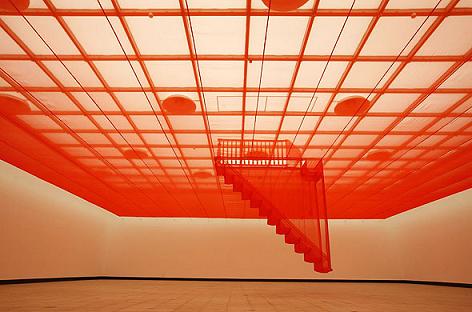 Upstairs there’s a gallery given over to Doh Ho Suh’s Staircase – V, a red gauze strip across the room with a red gauze, um, staircase. Yep, that’s it, in its entirety, in the picture there. Talk about subverting one’s understanding of architectural space!
Then there’s Mike Nelson’s To the Memory of H.P.Lovecraft, which has the gallery ripped apart as though by some unnameable beast:
In experiencing the aftermath of some hideous unexplained adventure, Nelson would like us to slip into a ‘meditative state where the act of movement and viewing absorb to the point where the visitor is reading the work subconsciously or storing the information to be re-read later, maybe within a context that makes sense of the information at some time in the future.’
Well, the meditative state eluded me. Nice idea, but it should have stayed an idea. Once again the weakness of the art is obscured by the artist’s lengthy and impenetrably abstruse explanation, and any failure to be duly transported by what’s on offer is blamed on us poor suckers who fail to respond in the requisite manner. If I’d come across this in a random building I happened to be visiting, I might well have had a sense of impending and nameless terror….but in an art gallery?
There’s a little cinema showing short films. As we entered, it was showing pictures of huge steel girders being dropped into wet concrete. The shluyrrpp sound was very pleasing; the high point of the exhibition for me. Well, in todays’ art world you take your pleasures where you can find them. But it did nothing to dispel the feeling of kids being let loose in the playground.
Which was reinforced by the final exhibit, Tomas Saraceno’s Observatory, Air-Port-City. It’s a plastic sphere with a transparent floor two-thirds of the way up. You take your shoes off and go inside the bottom of the dome, while others queue to climb some stairs and clamber out, two or three at a time, onto the plastic floor above, where they flounder around and lie face down making faces and waving at their partners sitting below with cameras ready. It’s play time: the men go up and release their inner little boys, and the women sit down below and do what women always do – smile indulgently at the show-off antics of their husband or children.
Asked about the utopian nature of his project, Saraceno remarks: ‘Utopia exists until it is created. A hundred years ago was it not considered to be a utopian thought that people could travel by aeroplane? Now, five hundred million people fly every year… The idea of utopia is in constant mutation and changes according to the era. My work tries to explore and interpret the present reality, using technological innovations for new social objectives.’
So utopia is people floundering around on plastic sheets? Well I don’t know, maybe it is. After an hour and a half of this, I didn’t really care any more. Personally I prefer art for grown-ups.
Here’s a slide show of images from The Guardian (from which I’ve taken the pictures shown here). Plus a couple of reviews, from The Times and the Telegraph; both mystifyingly positive – to balance out my possibly jaundiced view.


 Mick Hartley
Leave a reply to Noga Cancel reply