• The last word:

    https://platform.twitter.com/widgets.js

  • https://platform.twitter.com/widgets.js

  • From the Mail on Sunday:

    NHS chiefs are facing landmark legal action after 26 female hospital nurses protested about being forced to share a women's changing room with a transgender colleague who is biologically male.

    The women complained that the transgender nurse – who has not had gender reassignment surgery – had taken a 'keen interest' in female staff when they were getting undressed.

    They say they have found the situation 'intimidating and upsetting'.

    In a formal complaint, the nurses say they were stunned after the 'sexually active' trans nurse admitted to trying for a baby with a female partner and had stopped taking female hormones.

    But a human resources manager at the hospital trust allegedly said that the female nurses need to 'be more inclusive', 'broaden their mindset' and 'be educated and attend training'.

    Oh boy. There's always some idiot jobsworth happy to churn out the old Stonewall mantras.

  • https://platform.twitter.com/widgets.js

    https://platform.twitter.com/widgets.js

  • In Tablet, Jewish college students reflect on seven months of fear, isolation, and growing antisemitism.

    Ronnie Volman, University of California, San Diego:

    I was born in Israel and have been living in the United States since I was 3. On Oct. 7, as I frantically read the news, a friend on campus told me the attack was my fault and that I am directly “responsible for bombing kids.” Another classmate told me that I can’t possibly be peaceful because “Zionists are genocidal.” Yet another tried to insist that they don’t hate all Jewish people, just the Jewish people of Israel….

    Following Oct. 7, I lost countless friends and peers on campus for standing up against the undeniable rise in antisemitism, with my lived experiences as a Jewish person repeatedly undermined. I have been shunned and ostracized by a campus community that I once trusted to be an inclusive, open-minded forum for discussion. My former friends have deemed me to be a supporter of genocide, a colonizer, and an aggressor for not hiding my identity as an Israeli student. Rather than forming a ground for compassion, words such as “Zionist” and “Israeli” are now thrown around as insults….

    My family escaped the Soviet Union to build a new home in Israel. The lived experiences of my grandparents as openly Jewish people in the Soviet Union now regrettably resonate with me, as I navigate my identity as a Jewish student. They fled, hoping that their children and grandchildren would not have to endure the same confrontations with rampant antisemitism. A bridge from the past to the present, I grew up listening to stories about their struggles to live openly and without fear. Now, when I FaceTime my grandmother, she shares expressions of disbelief and dismay over distant echoes of her past that have manifested into my current experiences as a student on campus. For the first time—and this is something that I am ashamed to admit—I am scared to live my life as a proud Israeli and Jewish person.

    Yola Ashkenazie, Columbia University:

    I was at dinner with my roommates when a text came in. “I assume you saw the photo of you on Barfnard’s Instagram?” My heart sank. I hadn’t. What photo?

    I was aware that this Instagram account, associated with Students for Justice in Palestine, only posts photos of people and things that they hate. I hastily grabbed my phone and opened my Instagram app. It was a photo of me with Israeli flags. The insinuation was that I was deplorable because I appeared alongside Israeli flags. I brushed it off, assuming it might not reach many people or that most wouldn’t care much.

    I was wrong. The next day, on my way to psychology class, a student stopped me. “Oh, you’re that girl,” she said. Confused, I looked back at her, and she casually added, “You know, that one that supports genocide.” With that, she continued walking. Just a few minutes later, in class, a friend asked if I had checked Sidechat, Columbia’s anonymous social-media platform. A pang of fear hit me as I opened the app and saw posts about me. “That freak show girl from the news and Barfnard,” read one. “ZioTerrorist,” read another.

    While concerned friends and family warned me to be afraid of this sudden attention, what I felt was not fear but sadness. Not for myself, but for the end of productive conversation and meaningful discourse on my campus. Since October, I had been trying to convey that the loss of innocent life in both Israel and Gaza is a profound tragedy. I pleaded on national television that advocating for one group should not come at the expense of another. But it is evident that no one on campus hears me. My support for Israel has caused my peers to shut down, not listen. My support for Israel and my criticism of Hamas had branded me a baby killer and a genocide supporter.

    Joey Kauffman, Williams College

    At 9:40 a.m. on Thursday, May 2, I went to Paresky, Williams’ student center, to get some coffee. I had about an hour to spare before class, and I needed some caffeine. But as I was leaving Paresky, I saw someone doing something that I had never actually seen in person before: Someone was taking down hostage posters.

    There were around six posters that displayed the names and photos of hostages taken by Hamas on Oct. 7. If I remember correctly, one of the hostages on these posters was Thai. The others were Israeli. Many of them were likely Jewish. Some of them looked Ashkenazi while others looked more Mizrahi. On Oct. 6, these people were living normal lives. And on Oct. 7, these people and others experienced something so frightening that it goes beyond comprehension….

    For a moment, I just looked at the person taking down the posters. They were taking them down with speed and efficiency, as if this was just another part of their day. They took down the posters in the same way that I had gotten coffee in Paresky: It was just another thing on the to-do list, another task to get through.

    I looked out into the crowd of students rushing past Paresky. I looked around for someone to stand up and ask this person why they were taking the posters down.

    But no one did. I made eye contact with a Jewish friend of mine, someone who I know has family members in Israel and is scared about their safety. I mouthed the words “What the f–k” to him. I then realized that maybe I was supposed to be the one to say something to the person taking down the posters.

    I asked if they could keep the posters up, saying that they were compliant with school rules and allowed to be there.

    The person looked back at me, completely calm. They refused and said that the hanging of the posters tried to justify the genocide of Palestinians.

    I said that I didn’t put the posters up but that these hostages are innocent victims.

    They were already nearly done taking the posters down. “They’re settlers,” they said, and walked away.

    I tried to think of something, anything, to say to express the pain in my heart in that moment. But I couldn’t say anything. I just couldn’t.

    Sabrina Soffer, George Washington University:

    It all began with pervasive rhetoric in classrooms, online platforms, and public spaces. Soon, our campus was littered with posters and electronic graffiti bearing hateful messages: “Zionists fck off,” “Settlers, fck off,” “Free Palestine from the River to the Sea,” “Glory to our martyrs”—thinly veiled calls for the destruction of Israel and the celebration of mass murder. Then came demonstrations echoing deliberate calls for violence: “There is only one solution, intifada revolution!” Sometimes protesters would add that this is “the final solution.”

    Today, my friends and I find ourselves physically excluded from a so-called “liberated zone” on campus: an encampment exclusively for those who disavow the idea of a Jewish homeland. Self-proclaimed social justice warriors have cornered and spit on us, followed us around with cameras, and threatened to kick us off campus. When they say, “We want no Zionists here,” they really mean it.
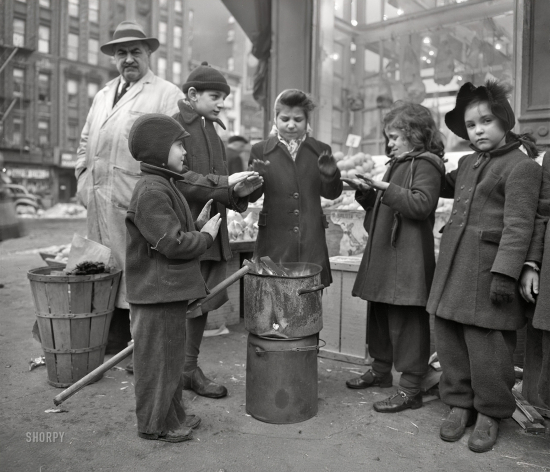
  • Marjory Collins, February 1943. "New York, New York. Italian-American children warming their hands by fruit stand outside a grocery store at First Avenue and Tenth Street."

    image from www.shorpy.com
    [Photo: Shorpy/Marjory Collins for the Office of War Information]

  • Neatly combining two of today's posts – on the Phoenix Cinema showing that Israeli film, and the BBC's institutional bias against Israel – this from the Telegraph:

    The BBC has come under fire for describing a pro-Palestine protest outside a London cinema showing a film about the Oct 7 attacks as a “vigil”.

    A demonstration was held at the Phoenix Cinema in East Finchley, north London, in response to the screening of a film about Hamas’s assault on Israel last year.

    Supernova was being shown as part of the Seret International Film Festival, but activists vandalised one of London’s oldest cinemas after writing “say no to artwashing” in red paint on the front of the building….

    A BBC London report on the events stated: “Pro-Israel supporters celebrated tonight after chasing away pro-Palestinian protesters who were holding a vigil outside the Phoenix Cinema in East Finchley.”

    Footage showed a crowd of Israel supporters holding flags and signs while cheering and dancing.

    The broadcast was met with criticism online from those who said the BBC had shown “horrendous bias” in its coverage.

    Danny Cohen, former director of BBC Television, told The Telegraph: “For the BBC to describe this pro-Palestinian protest as a ‘vigil’ is utterly sickening.

    “The protest aimed to disrupt and delay the screening of a documentary about a massacre of innocent young people at a music festival. The BBC’s anti-Israel bias is more and more evident with every day that passes.”

    Nicole Lampert, a journalist, wrote: “Could BBC News have got this more wrong? Every day I am more and more furious about their horrendous bias.

    “Pro-Palestine supporters weren’t trying to hold a ‘vigil’.

    “They were trying to stop people seeing a film about the massacre of the Nova festival. They had earlier daubed the cinema in blood-red paint and called the documentary ‘artwashing’.

    “Jews and allies showed them enough is enough: we are mourning but our spirit and love of life cannot be dimmed.”

    Laura Cellier, who hosts Middle East Now on the Tel Aviv-based television channel i24News, posted on X, formerly Twitter: “A vigil? They came to intimidate people. They were trying to stop people from seeing a film about Hamas atrocities. What is wrong with the BBC?”

    A message distributed to the activists before the demonstration, that was also posted online, referred to the screening as “artwashing” and said: “Join us outside Phoenix cinema in protest of the Israeli Government-sponsored film festival, Seret.

    “Bring noise. Drums, bells, pots and pans, whistles, rice bottles.”

    A vigil, but not as we know it.

    [Rice bottles?]

  • Here we go again. Jennifer Sieland at Reduxx:

    A man who identifies as a woman has been sentenced to 16 years in prison after being found guilty of sexually assaulting multiple young boys. In their statement on the sentence, Lancashire Police declined to use pronouns for Joanne Evans, while local media referred to him as “they/them.”

    Evans, 40, was first arrested in 2020 after police became aware that he had been sexually preying on young boys in Swansea. The youngest victim was just 8 years old at the time he was sexually assaulted, and two additional victims who came forward were both under the age of 13.

    Evans was charged with assault by penetration of a child and sexual assault by touching of a child, but was not remanded to custody. Earlier this month, he was expected in Burnley Crown Court but refused to appear, resulting in a jury finding him guilty in his absence.

    On May 17, Evans was sentenced to a total of 17 years, with 16 years in prison and 1 year on community license….

    In the statement, Lancashire Police did not use pronouns for Evans, but noted that he “uses different male and female names and identities.” The statement did not include what other names or identities Evans utilized.

    In media coverage of the sentence, most outlets referred to Evans by gender neutral “they/them” pronouns.

    Hmm – non-binary, then.

  • Back north of the border, with Literature Alliance Scotland (LAS) – which is, as Magi Gibson notes, “one of Scotland’s leading and most powerful publicly-funded literary organisations”. Under Resources on their website they have a document (pdf) on Supporting Trans Writers.

    For bookshops:

    • don’t sell TERF books/platform TERF authors.
    • Don’t expect trans booksellers to sell them. Trans people who see TERF books or ‘gender criticism’ in a bookshop will understand that the bookshop doesn’t want them there.

    Just like when you go into a bookshop and see a book on Marxism, you know the bookshop doesn’t want anyone there who holds opposing views on Karl and the gang. It can be very traumatising.

    On the other hand, you know…that’s not how bookshops work. A leading literary organisation might be expected to know that – and not be encouraging censorship.

    Update: now removed.

    https://platform.twitter.com/widgets.js

  • Following Danny Cohen's blistering attack on the BBC's Gaza coverage earlier this week, here's Ian Austin in the JC – The BBC’s mistakes are an institutional problem:

    I have spent decades defending the BBC. I always believed it to be the best broadcaster in the world, with the best journalists and the most rigorous standards.

    Its public funding means it has a special duty to uphold impartiality and accuracy. But there are 200 territorial conflicts in the world and none of the others are covered in remotely the same way as Israel and Palestine.

    About 180,000 people have died in Myanmar where 18.6 million need humanitarian aid, but we don’t hear about that very much on the BBC. Even the war in Ukraine no longer attracts the same scrutiny as Israel’s campaign against Hamas. Yemen is suffering the world’s biggest humanitarian catastrophe, but that hardly gets a look-in either.

    [Darfur is worth a mention here too, where Arab militias are continuing their genocidal campaign of rape and massacre against the black African population, but no one – and certainly not the BBC – really cares. As I noted a couple of weeks back, whoever's doing the PR for the Arabs is doing one hell of a job: killing and looting in Sudan to mass indifference, yet the world's biggest victims in Gaza.]

    Concerns about the BBC’s approach go beyond the war in Gaza. A particular low point was the appalling report which blamed schoolchildren celebrating Chanukah in Oxford Street for a racist attack in which they were the victims. Last July, after a wave of terror attacks in Israel, a breathless Jeremy Bowen dashed dramatically to Israel overnight – not to report on the civilian victims but to cover the IDF’s attempt to arrest the terrorists responsible.

    When a violent, racist mob stormed an airport in Russia’s Dagestan and surrounded plane landing from Israel chanting “We are here for the Jews … We came to kill them”, the BBC described them simply as “anti-Israel”.

    The BBC has refused to refer to the rape, kidnapping and slaughter of civilians on October 7 as terrorism, but a presenter insisted that “Israeli forces are happy to kill children” in an interview with Naftali Bennett. It claimed Israel was “targeting medical teams and Arab speakers” at Gaza’s largest hospital and reported unverified allegations by Hamas that the Israeli army was carrying out “summary executions” of Palestinians in Gaza six times. We had to wait more than a fortnight before they finally admitted it had not been true….

    The reporting of the explosions at the Al-Ahli hospital in October – for which the BBC apologised – was even worse. BBC correspondent Jon Donnison said: “It’s hard to see what else this could be, really, given the size of the explosion, other than an Israeli airstrike or several airstrikes.” Bowen piled in, claiming the hospital “was flattened”. He said: “The missile hit the hospital not long after dark … The explosion destroyed Al-Ahli hospital.”

    Reports of the incident had a very serious impact. Joe Biden’s visit to the Middle East was disrupted, with the cancellation of a summit in Jordan with Arab leaders and the President of the Palestinian Authority. Protests took place in more than a dozen countries. Synagogues were attacked in Tunisia and Berlin.

    Independent investigations showed the cause was actually a rocket fired by Palestinian Islamic Jihad at Israel that had landed in the hospital’s car park. The hospital had not been “flattened” or “destroyed”. Bowen admitted his reports had been wrong but said, “I don’t regret a thing and I don’t feel bad at all.”

    Gary Lineker is the face of BBC football but retweeted a post calling for the country’s team to be banned from international competition. He said a video by Corbyn-supporting hard-left campaigner Owen Jones in which the academic Raz Segal accused Israel of “genocide” was “worth 13 minutes of anyone’s time”.

    Last week he referred to the October 7 atrocities as “the Hamas thing” but described Israel’s campaign to deal with the terrorists and free the hostages as “the worst thing I’ve seen in my lifetime”.

    The BBC guidelines are clear: “Everyone who works for the BBC,” they say, “should ensure their activity on social media platforms does not compromise the perception of or undermine the impartiality and reputation of the BBC.”

    The failure to uphold the guidelines when it comes to Lineker makes the board and senior managers look weak and foolish.

    We would all accept that a huge broadcaster will occasionally get things wrong, but the scale and frequency of mistakes now looks like an institutional problem.