
• We heard about the exciting new play Terf C*** back in January. Its subject is JK Rowling and, as the title may suggest, it's not altogether supportive of her gender-critical stance. Now, apparently, they're having trouble finding actors for its Edinburgh Fringe debut. Well, trouble finding female actors. No problem with the men:

    A play that criticises JK Rowling’s views on gender is struggling to cast women with 90 actresses so far rejecting parts.

    The stage production, which is set to debut at the Edinburgh Fringe, has already caused outrage over a working title which labelled the gender-critical Harry Potter author a c—-.

    The production is yet to cast any of the female roles, including that of Rowling herself.

    The part of Harry Potter film star Emma Watson has also been repeatedly turned down, and around 90 actresses have refused to take part in the project amid concerns over its critique of Rowling….

    Actors have been found for male leads, who will portray Harry Potter cast members Rupert Grint and Daniel Radcliffe.

    Creative producer Barry Church-Woods told the Telegraph: “This project has met some kind of resistance every step of the way, though I’ve been generally surprised by how difficult it has been for us to recruit the female cast in particular.

    “It’s a well-paid gig meeting industry standards and the script is terrific.”…

    It has been suggested by producers that some actresses may not want to appear in a play critiquing Rowling and ruin their chances of appearing in the lucrative new Harry Potter TV series on the Max streaming service.

    Rowling is acting as executive producer for the series, and will be involved in key decision-making.

    Mr Church-Woods said: “We’ve had agents reluctant to put names forward, I suspect, because they do not want to damage their clients chances of landing roles on the new Potter TV series.”

    Well of course, yes, that must be it. The men, inspired by the terrific script and unconcerned about any possible damage to their careers or chances of featuring in the high-paying Harry Potter franchise, don't have a problem. For them art comes before money. For the venal grasping women, alas, it's a different story.

    Or it could be that they find the whole thing deeply offensive, while the men are happy to join in with the abuse of women who speak out.

  • Pride, now:

    https://platform.twitter.com/widgets.js

  • Joan Smith on the Labour manifesto:

    It’s Stonewall lite: the Labour manifesto, which was the party’s chance to win back disillusioned women, has brazenly confirmed the influence of trans activists instead. Unveiled with great fanfare, it contains a series of pledges that will delight zealots who peddle fantasies about the oppression of transgender people. What Labour hasn’t done is take notice of feminist lawyers and the Equality and Human Rights Commission, who all say that the Equality Act urgently needs clarification to protect single-sex spaces.

    The party isn’t even honest about its proposals on sex and gender, adding a nervous gloss to make them sound more reasonable than they are. Using the language of gender theory, it describes “conversion therapy” as abuse and promises “a full trans-inclusive ban on conversion practices”. Labour frontbenchers, including the Shadow Health Secretary Wes Streeting, must be aware that Dr Hilary Cass has warned against any such ban, suggesting it might “make professional fearfulness worse than it already is”. So Labour has added a line about “protecting the freedom for people to explore their sexual orientation and gender identity”, directly contradicting the first half of the pledge….

    Starmer’s Labour party believes that human beings can change sex. It insists they should be helped to do so in law, regardless of the impact on women. It supports “the implementation of…single-sex exceptions” in the Equality Act, but won’t make a simple change that would prevent malicious challenges to organisations running rape shelters and refuges.

    In a bad week for women, the Lib Dems and Greens have embraced self-ID, while Labour is well on the way. If this general election has done nothing else, it has confirmed how few politicians are listening to women. Across the centre-left, these demands are in the ascendant, and that leaves a lot of us with nowhere to go — and no one to vote for.

    And Kate Barker at Spiked:

    The Labour Party’s manifesto, unveiled earlier this week, promises to bring forward legislation for a ‘trans inclusive’ ban on conversion therapy. This will send a chill through the consulting rooms of therapists around the UK….

    There’s no doubt that gender dysphoria is real. Girls, in particular, are expert at turning their adolescent distress inwards. Anorexia, bulimia and cutting are all expressions of self-hatred and fear. These should be met with empathy and counselling. The lobbyists for a conversion-practices ban urge an affirmation-only approach that would assist in the self-harm of girls by handing them control of the scalpel.

    Therapists who demure will face challenges from furious lobbyists and may find themselves disbarred, or even criminalised. Those therapists who don’t believe in magical genders, and recognise that trans is a social contagion now primarily affecting young girls, will simply avoid this area of practice altogether. That means reduced provision at a time when child mental-health services are already so stretched that they are failing the most vulnerable.

    The timing is terrible on Labour’s part. Its manifesto commitment arrives just as the scientific facts and evidence begin to intrude upon the fantasy of ‘trans joy’. A recently released study, based on outpatient-billing data for all legally insured persons in Germany, shows that the majority of young people outgrow their struggles with their gender identity. It notes that 73 per cent of 15- to 19-year-old females with a gender-identity-related diagnosis desist after five years. Yet Labour, in hock to an old promise, has decided that a conversion-practices ban is the least-worst bone to throw to activists.

    It's like demanding that anorexic teens be immediately confirmed in their belief that they're really too fat and should go on a starvation diet – and anyone suggesting otherwise must be punished.

  • An article in Nature – yes, that Nature, one of the world's most prestigious scientific journals…Beyond the trans/cis binary: introducing new terms will enrich gender research:

    “Are you transgender?” Participating in a study for their public-health class, neither Alex nor Luna knew how to answer. Alex uses they/them pronouns and identifies as agender. They are also among a growing number of young people who have been raised in a gender-neutral manner: their parents did not refer to them as a boy or a girl until they were old enough to choose for themselves. Whatever genitals Alex was born with is not common knowledge. If you are agender and were never assigned a gender, does that make you transgender?

    As for Luna, today she identifies as a woman, which aligns with the gender she was assigned at birth. But this is a recent development: Luna identified as a boy for as long as she can remember and, after coming out as trans, lived openly as one throughout her childhood and adolescence. As a woman who has detransitioned, she often feels that she has more in common with transgender women than with cisgender ones, whose gender identity corresponds to the gender they were assigned at birth. Although Luna doesn’t call herself transgender, she fears that answering ‘no’ to the study’s question means that her gender trajectory and experiences will be erased.

    How to deal with these seemingly intractable problems? Yes, there is hope.

    Scientists need terms that are flexible enough to capture the nuances of people’s experience, that leave space for language to evolve and that are nonetheless pragmatic enough to be used in research.

    The term ‘gender modality’ could enable researchers to broaden their horizons.

    A person’s gender identity is their sense of gender at any given time. By contrast, gender modality refers to how a person’s gender identity relates to the gender they were assigned at birth. It is a mode or way of being one’s gender.

    The best-known gender modalities are ‘cisgender’ and ‘transgender’, but the term allows for other possibilities, such as ‘agender’, which includes those who do not identify with any gender, and ‘detrans’ or ‘retrans’ for people who have ceased, shifted or reversed their gender transition. The term also makes space for gender modalities specific to intersex individuals, gender-questioning people, people with dissociative identity disorder and people with culture-specific identities (see ‘Many ways of being’). Gender modality serves a similar purpose to sexual orientation, which describes a facet of human existence and makes space for orientations beyond gay and straight.

    But a word of caution, lest our enthusiasm carries us away.

    Gender modality is not a panacea. Rather, it is one piece in the toolbox of those who engage in research involving human participants, whether in the medical, biological or social sciences. Its power lies in what people make of it. Our hope is that researchers and others will play with it, stretching it and exploring its full potential. Rather than foreclosing the evolution of language, gender modality welcomes it.

    Not everyone is male or female. Not everyone is cis or trans. The sooner we make space for these truths, the better. And inviting scientists to adopt the concept of gender modality will hopefully foster research that better reflects the intricacies and nuances of our increasingly gender-expansive world.

    The first step in science should never be to assume that something is correct. It should be to engage with the world in front of us — in all its magnificent complexity. Researching gender should begin with critically engaging with current language and concepts. Thoughtfulness, flexibility, curiosity and empathy are what science needs.

    Some kind of connection with reality? Is that something science needs?

    Apparently not.

    One of the authors, Florence Ashley, is "metaphorically a biorg witch with flowers in their hair!" 

    Florence is a transfeminine jurist, bioethicist, public speaker, and advocate. They are the author of the acclaimed book Gender/Fucking: The Pleasures and Politics of Living in a Gendered Body (CLASH Books, 2024).

    [Via Jerry Coyne.].

  • https://platform.twitter.com/widgets.js

  • As we feared. Childen deluded into the fantasy that they were born in the wrong body and require medical intervention will, under Labour, have their delusions confirmed – on pain of prosecution. 

    https://platform.twitter.com/widgets.js

  • https://platform.twitter.com/widgets.js

  • https://platform.twitter.com/widgets.js

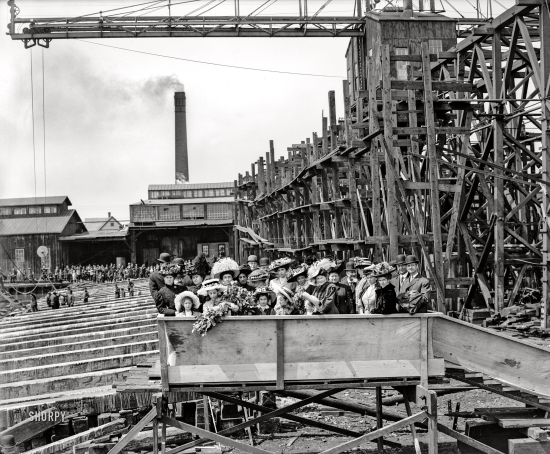
  • April 28, 1909. Wyandotte, Michigan. "Launching party, steamer Benj. Noble." Before and after.

    image from www.shorpy.com

    image from www.shorpy.com
    [Photo: Shorpy/Detroit Publishing Company]

    The Benjamin Noble sank exactly five years later:

    Top-heavy with a cargo of steel rails, the Benjamin Noble capsized in a squall 20 miles out from Duluth on April 28, 1914, vanishing into Lake Superior with the loss of all hands. After 90 years as a "ghost ship," its wreck was discovered at a depth of 400 feet off Knife Island in 2004, the front half buried in 40 feet of mud — "heavily overloaded, just a submarine waiting to happen."

  • Julia Davis has been monitoring Russian propagandists since 2019, and has now collected together a collection of essays and article for her new book, In Their Own Words.

    For more than two decades, the Kremlin’s agitators have been tasked to lay, in advance, the groundwork for various domestic and foreign actions by the regime of Vladimir Putin. Thus, Russian state-controlled media provides crucial clues for deciphering the—often sinister—goals that the government of Russia was and is planning to pursue abroad, from election interference to military invasions. The goal of the sum of these activities is the establishment of a new world order—with Russia at its helm. Before the large invasion of 24 February 2022, Russian state media portrayed the West as incapable of opposing Russian aggression. Putin’s propagandists cheered for war against Ukraine, predicting it would be quick and victorious. Misreading the ability of the West to unite and miscalculating Russia’s capabilities in confronting determined Ukrainians, Russia ended up in a quagmire of its own creation.

    Timothy Snyder has written a foreword:

    When Putin ordered a full-scale war on Ukraine, the propagandists suddenly had a problem. Before the attack, as we are reminded in this book, there was great confidence among Russian propagandists that Ukraine would fall to Russia in "two days" or even "ten minutes." But when Russia actually did undertake a full-scale invasion of Ukraine in February 2022, it set off a chain of events that the propagandists found hard to master.

    For one thing, they had been cut out of the loop. The invasion was meant to be its own propaganda, a "special military operation" that overthrew the Ukrainian government in three days, followed by a victory parade and a warm welcome by the Ukrainian masses. This did not happen, and was based upon a worldview (Putin's) that was both obviously wrong and impossible to criticize. Russian propagandists switched immediately to the comfortable idea that the war was really against America, and that America had initiated. Rereading Julia Davis's essays, I was struck by how quickly this happened — within a few days.

    The Ukrainians themselves had to be dehumanized. This was a direct consequence of the senselessness of the war. Russians had to be made to feel that they were somehow superior, and that war had some kind of logic. Its premise, as Putin had made clear, was that there was not really a Ukrainian state or nation; this was all a conspiracy, and would collapse immediately. If, as it emerged, more Ukrainians defended themselves than expected, that did not mean that Ukraine was real; it just meant that logic of the special military operation, killing the elites, had to be extended ever further downward into the population.

    As Julia Davis shows, Russian propagandists use openly genocidal language over and over again, urging the extermination of vermin, worms, demons, zombies, etc. Putin's grotesque "denazification" framing of the war is genocidal. If all Ukrainians are defined as Nazis by nature, then it is right to kill them all. The "Nazi" claim has never had anything to do with political reality (the actual fascists, the ones in Russia, are calling for genocide), and always had everything to do with justifying that murderous project.

    And a warning:

    Russia needs America to bail it out of its war with Ukraine. When you read Julia Davis's summaries of Russian propaganda day after day, it is abundantly clear that the propagandists themselves (despite all of the bluster) are aware that the war did not go according to plan, and indeed is going very badly. Again and again they are put in impossible positions: when Ukraine takes territory; when Russia fails to take territory; when more Russians have to be mobilized; when Yevgeny Prigozhin tries a coup. They cannot criticize Putin, and they know that Putin cannot win unaided: and so they root for his allies abroad.

    And, in particular, they root for Trump.

    This itself is worth emphasizing, at a time when many Europeans and Americans seem to be asking how Ukraine can win. The answer is simple. Ukraine can win if Europeans and Americans believe it can, and continue to help. Ironically, that emerges quite clearly from these pages. Russia's propagandists know this. They are relying entirely on their own domain, that of discourse. The war is not going well for Russia on the actual battlefield. The Europeans and the Americans are bearing essentially no costs. But if they can somehow decide that they are weary, Russia can win.