• Good news on the puberty blocker front. From the Times:

    Gender clinics will be forced to release data on the outcomes of thousands of children who received puberty blockers on the NHS.

    Wes Streeting, the health secretary, has announced a law change to allow researchers to study the long-term impact of medical interventions given to children in distress about their gender.

    The data of 9,000 people who were treated at the Tavistock gender identity clinic as children, before the clinic closed in 2023, will be linked with their adult NHS records to see how they have fared.

    The study, led by NHS England, will evaluate how treatments such as puberty blocking drugs have affected long-term mental and physical health.

    The data linkage study was a key recommendation of the Cass Review in 2024, which advised overhauling gender services on the NHS. However, six of the NHS’s adult gender clinics had refused to co-operate with the medical research study and hand over data on their patients. Many of their patients were initially treated with puberty blockers as children before being transferred to adult clinics for cross-sex hormones and gender-reassignment surgery.

    This should have been done from the start, as per the Cass Review. And should obviate the need for the Pathways trial. The data’s out there.

  • The poor lamb has been accused of antisemitism after saying that humanity has a common enemy in Israel. Cue the tiny violin.

  • The new regime in Syria seemed at first to be a welcome change from the chaos and brutality of the Assad years, but it wasn’t long before tales of violence against minority groups emerged….Alawites, the Druze, and in particular the Kurds. Giran Ozcan in Fathom – How Syria’s transition went off the rails:

    It is easy, and wrong, to find simple causes for the recent violence in Syria. Examples include claiming that al-Shaara is taking orders from Turkey to attack the Kurds, or that the Kurds are being maximalist by seeking to retain the SDF and their self-rule in the north east.

    Instead, the anti-Kurdish campaign of 2026 and the violence against other minorities in 2025 are part of al-Sharaa’s four point playbook.

    First, al-Sharaa and the Syrian transitional government possess an extreme Islamist mindset. The interim constitution makes Islamic jurisprudence “the principal source of legislation,” meaning that the state will be run on religious principles.

    That, in a nutshell, is the problem. The new president, Ahmed al-Sharaa, may have scrubbed up nicely to give the impression that he’s put his Al Qaeda past behind him, but he’s still an Islamist.

    Also concerning is that western support for al-Sharaa and his “unified” Syria impedes the post-9/11 struggle against Islamist extremism and jihadism. The unified, unaccountable Syria that al-Sharaa is building will have the same results in the future as such a state had in the past – repression, corruption, and extremism. U.S. policy after 9/11 was to push for openness and reform in the Middle East. Although Obama and subsequent presidents dropped George W. Bush’s emphasis on democracy, there remained an understanding that Islamist extremism and jihadism constitute threats to the United States and its friends. The alliance with the Kurds was a logical outcome of this policy. All the strands of Kurdish nationalism are hostile to Islamist extremism and jihadism as they deny Kurdish identity. The Syrian Kurds are particularly averse to Islamist extremism as they believe that the most powerful means of economic and social development is the empowerment of women. Any attempt to drop the Kurds as security partners and to rely on the goodwill of jihadis could be a fatal error.

  • Owen Matthews in the Spectator – ‘More than half our squad were executed’: Inside Russia’s rotten army:

    For a more complete depiction of the reality of the war in Ukraine from the Russian side, take a look at the feature-length documentary Russians at War, available on YouTube. This extraordinary film was made by the Canadian-Russian filmmaker Anastasia Trofimova, who got herself unofficially embedded with a frontline infantry company fighting in Donbas after a chance encounter on a train with a solider. The picture that emerges as Trofimova follows the unit from the spring to autumn of 2023 is of a rag-tag force of undisciplined, reluctant civilians who have mostly signed up only for the money. All are, notionally, volunteers desperate enough to risk their lives for a signing bounty. But many speak of their desperation, their revulsion at the war, and of the corruption and ineptitude of their commanders.

    ‘We are people with broken fates,’ complains one private who has just returned from the front lines. ‘We were dumped, then got surrounded. Out of our battalion of 900 just 300 made it.’

    Trofimova’s film was shot in 2023. But by all accounts the situation in the Russian army in Ukraine has deteriorated dramatically since then. Storm V, a Telegram blog that reports from the Storm ‘penal/volunteer’ battalion fighting near Pokrovsk, reported in a 14 February post that the unit – made up mostly of released prisoners – lacked ‘even the simplest armour, helmets, masks, generators, magazines for machine-guns’. The unit was regularly chosen for frontline duty because ‘they are told, “You know both cold and hunger, so go ahead, you are more prepared for a life of survival.”’ Commanders, according to the anonymous (and unverified) author of the blog, openly talk of ‘meat assaults’ – the practice of throwing infantry forward into the drone-saturated ‘death zone’ between the two armies. ‘On all fronts [Storm V] are at the forefront of the attack,’ says the blogger. ‘They are not given medals, those are received by those who follow.’

    Footage of Russian soldiers being punished for drunkenness and desertion by being taped naked to trees in the freezing cold, then being whipped or punched by officers, appear regularly on Russian social media. This month Denis Kolesnikov, a junior sergeant in the 1435th Regiment, posted a video blog where he explained that he deserted his unit because commanders were demanding bribes not to send men to the front lines. ‘Over half of our squad, about 50 people, were executed by commanders,’ claimed Kolesnikov, blogging from Russia, not from Ukrainian captivity. ‘Everyone must pay money to commanders. When we line up, everyone is told how much they owe. Each person was told to pay from one to three million rubles [£10,000 to £30,000]… not to go to the contact line. As soon as money runs out, they get sent there or killed.’….

    In Iraq and Afghanistan I did 13 official journalistic ‘embeds’ with various frontline US and British units between 2001 and 2005 – including the US Third Marine Corps during heavy fighting in Fallujah. The extreme professionalism and discipline of the British and American armies, even under fire, was hugely impressive. The contrast with the chaotic, corrupt, amateurish and utterly unwilling Russian army that is fighting in Ukraine could not be starker. Putin’s forces may command deadly missiles, long-range drones and a modern air-force. And on the ground massed artillery and successive meat-waves of men recruited as cannon fodder may grind slowly and bloodily forward. But a threat to Nato? Not in a million years.

    I’m surprised he doesn’t mention the BBC’s The Zero Line: Inside Russia’s War, which I watched last night – a very powerful expose of the scarcely credible brutality in the Russian army, with soldiers executed by commanders and tortured for dissent.

  • Hannah Barnes in the New Statesman:

    The proposed NHS-backed “Pathways” puberty blocker trial “could not have received more oversight and scrutiny”, the Health Secretary, Wes Streeting, told parliamentary colleagues in January. It had gone through “rigorous rounds of scientific, clinical, ethical and regulatory review”. How, then, to make sense of the U-turn from the Medicines and Healthcare Products Regulatory Agency (MHRA) on 20 February? The medicines regulator had initially given its approval for Pathways, which is being led by researchers from King’s College London (KCL). In a letter to KCL, the MHRA raised significant safety and ethical concerns, prompting the trial to be paused.

    On one level, this suspension can be seen as scientific scrutiny working well. After the trial was announced in November 2025, hundreds of clinicians voiced “grave disquiet” about the trial’s design. I have scrutinised the trial’s documentation and asked, in the New Statesman, whether participants are being told enough about the balance of risks and benefits. Perhaps the MHRA has listened.

    But it is also pertinent to ask why the regulator approved a study it now says risks sterilising children, damaging their bones, and impairing their cognition. Everything the MHRA appears to now be concerned about was known at the time of approval. The true reason behind the regulator’s actions is as yet unclear. 

    Perhaps they’ve been surprised by the strength of opposition. Perhaps they’re beginning to realise the full horror of a government/NHS trial whereby children are given life-changing drugs to see if it cures them of a delusion picked up on social media. It’s not going to look good on anyone’s CV.

  • A useful essay from Adam Louis-Klein, in Sapir, on “the latest pseudoscience to overtake academia”:

    In his 1946 book Hitler’s Professors, linguist Max Weinreich documented how the German university — then the pride of Western scholarship — fell with terrifying speed into the service of Nazi ideology. Within months of Hitler’s rise to power, professors across disciplines had issued declarations of loyalty. They did so not only to secure their posts but to align themselves with a social and political movement that promised prestige, resources, and renewed relevance. Entire research institutes were founded, fields reorganized, and new disciplines invented around the “Jewish Question.”

    Weinreich revealed a moral and epistemic collapse that converted scholarship into ideology. Anti-Jewish libels  do not circulate on their own. They require institutional prestige to stabilize them. The university has long been an effective instrument for transmuting defamation into knowledge, serving not as a barrier to harmful ideology but as its most efficient vehicle.

    At the moment of writing, the university has been lost to a new pseudoscience: antizionism. And there are Jewish faculty, like Fishberg before them, who lent it credibility. Our urgent and ambitious task is to make them see the scholarly error, as Fishberg eventually did, and get them to reverse course.

    What the Nazi university did with the “Jewish Question” the contemporary university now does with the “Zionist Question.” Entire disciplines — anthropology, among them — have been reorganized around antizionist libel, based on a Manichean worldview in which “Zionist professors,” “Zionist ideologues,” and “Zionist administrators” are singled out as enemies of justice. In this imaginary, “Zionist” does not denote genuine persons or positions; it works as an all-encompassing metaphor of corruption that must be purged.

    Antizionism is the ideology that treats Jewish peoplehood and sovereignty as an intrinsic injustice. It is today’s evolved form of anti-Jewish hate, less crude than classical antisemitism, but no less potent. Antizionism is more abstract, systematized, and rhetorically refined — ideally suited to academic environments that reward oppositional performance and repackage hostility as critical thought.….

    Academia: the breeding ground of pseudoscience. Particularly US academia.

  • A BBC report:

    A row has broken out over an event’s single-sex attendance policy.

    Rosie Hayes told the BBC multiple venues in Brighton had cancelled or stopped hosting trauma-healing classes organised by her group Sisters Heal for the victims of sexual assault, rape and domestic abuse, which were limited to “biological women only”.

    She has claimed the venues were pressured into dropping the event due to “intense harassment” from what she called “trans activists”.

    Terf Watch Brighton, which describes itself as a grassroots collective of journalists reporting on “anti-trans efforts”, said it was not aware of any groups or networks coordinating opposition to Sisters Heal.

    Of course the Beeb go straight to Terf Watch Brighton as their reliable source.

    Hayes, who is a co-founder of Sisters Heal, told the BBC she restricted attendance to the class because “a lot of women cannot heal in a mixed-sex space”.

    “Female survivors [of sexual abuse and domestic violence] have been harmed by male bodies, male voices, male presence, male physicality,” she said.

    “It’s a trauma response that they have, which isn’t cognitive.

    “They can’t reason themselves out of it.”

    Terf Watch Brighton told the BBC the groups run and advocated for by Sisters Heal and similar organisations are discriminatory to trans women, and deliberately divisive.

    “Their purpose is always, at least in part, to push trans women out of society – it is unreasonable not to expect complaints and political opposition.”

    The old trans bullshit. Of course women need single sex spaces to heal. But for the trans activists everything has to be about them – “to push trans women out of society” ffs.. Never mind the trauma of the actual women, supposed to take second place to the imagined slight felt by the men in dresses.

    Of course Terf Watch Brighton have the last word. Well, this is the BBC:

    Terf Watch Brighton said the line drawn for the need for “single-sex services” was “arbitrary, unevidenced, and based on prejudiced myths about how gender operates in society”.

  • Photos from the Times news in pictures feature today:

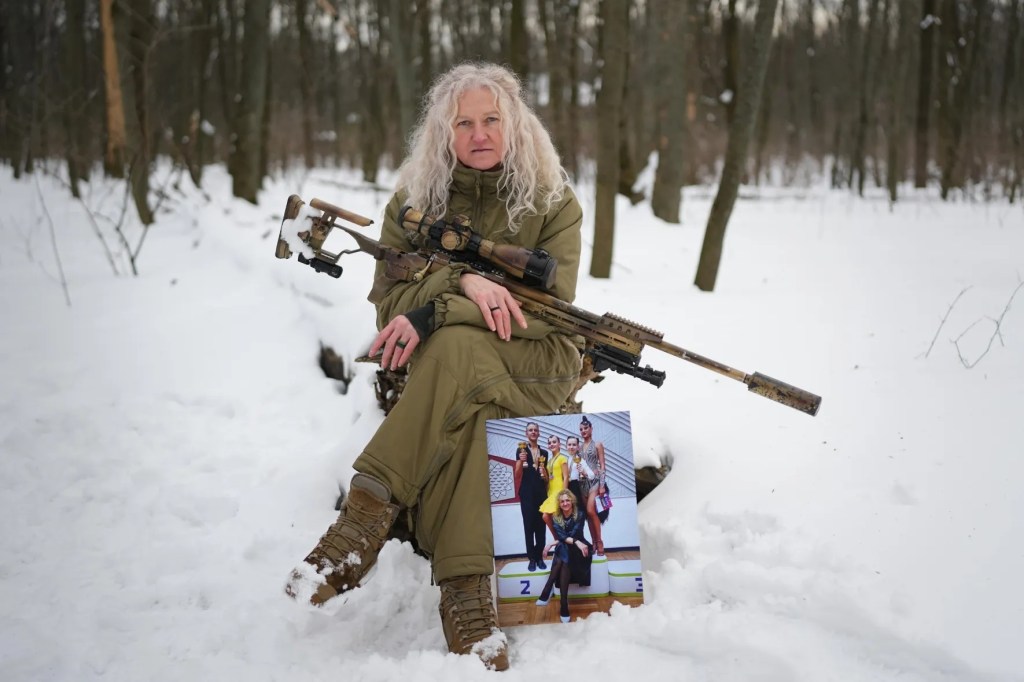
    Tetiana Khimion, 47, now a sniper in the Ukrainian army, poses in a park in Kyiv with a photograph of herself as a dance teacher before the war. [Sergei Grits/AP]

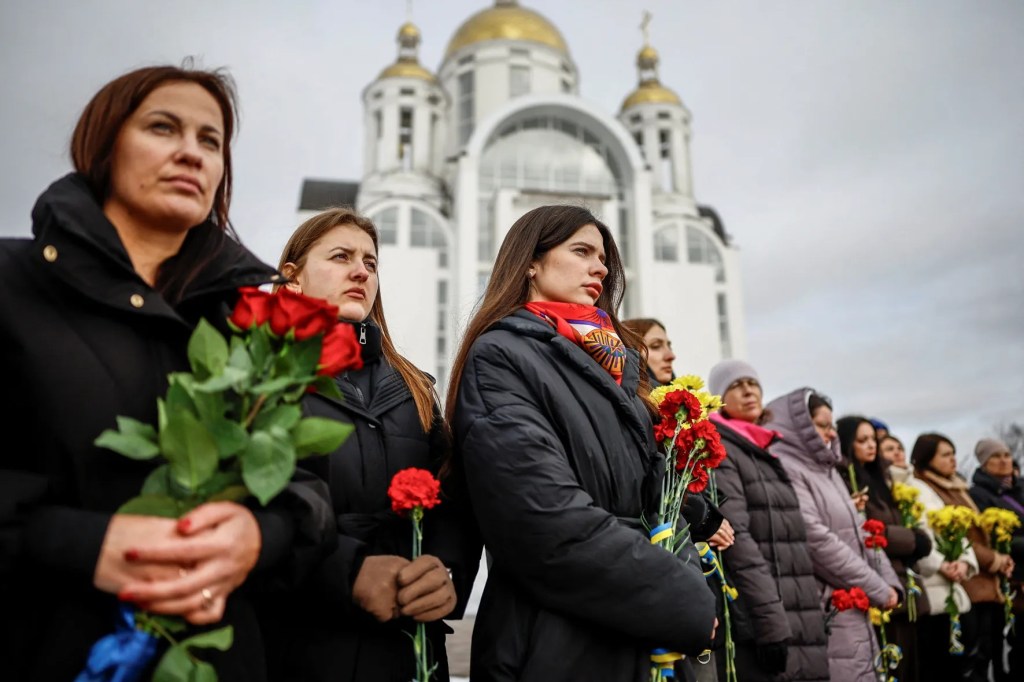
    People bring flowers to pay tribute at a memorial in Bucha for the victims of Russian troops, marking the fourth anniversary of the invasion. [Alina Smutko/Reuters]

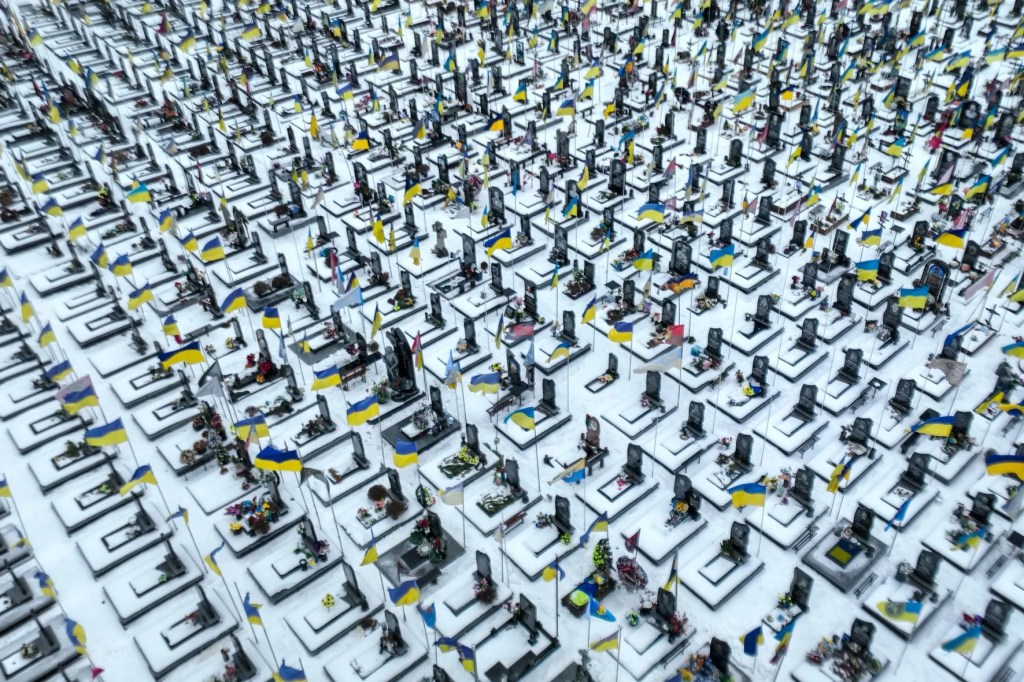
    The graves of thousands of fallen Ukrainian military personnel in Kharkiv. [Chris MGrath/Getty Images]

  • From an interesting little essay by Peter Himmelman on Facebook:

    Over the past several years, and especially since October 7, 2023, I have watched something unfold that is difficult to explain, especially if you assume it emerged entirely on its own. On that day, Hamas carried out the largest massacre of Jews since the Shoah. Families burned alive. Young people hunted down. Children murdered and taken hostage. And yet within hours, even before the scale of the atrocity was fully understood, a counternarrative appeared.

    Israel was blamed. The victims were recast as perpetrators. The language spread with astonishing speed. Genocide. Colonialism. Resistance. These words did not emerge gradually. They arrived pre-packaged, as if they had been rehearsed and readied for a moment of maximum psychological effect.

    And then something else became visible. The language replicated.

    The same phrases appeared on handmade signs in New York and London. The same chants were heard on campuses separated by oceans. The same formulations, the same accusations, the same moral certainties, delivered with the strange precision of actors who had never met but somehow shared the same script. There was a theatrical aspect to what we were seeing.

    Not in the sense that the emotions were fake. I assume much of the vehemence was sincere. But sincerity does not preclude choreography. Actors can believe deeply in the lines they have been given. They can inhabit them fully. What was striking was the uniformity. The compression of complex history into identical slogans. The speed with which those slogans moved from iPhones to city streets.

    To understand how this happens, it helps to follow the structure that supports it.

    Last week, I listened to an important conversation between journalist Melissa Chen and Israeli historian and analyst Haviv Rettig Gur. Chen said something that clarified the geopolitical foundation beneath events that otherwise seem disconnected.

    “Iran,” she said, “is able to behave the way it does because China is willing to absorb the cost of its isolation.”

    This is not speculation, it’s is an observable economic relationship. For decades, Iran has been the subject of international sanctions intended to limit its ability to fund its military and its regional proxies, including Hamas, Hezbollah, and the Houthis. Those sanctions cannot achieve their intended effect if Iran continues to sell its primary export.

    Today, according to energy analysts, roughly eighty percent or more of Iran’s heavily discounted oil exports go to China. Tankers move across the sea, sometimes disabling their tracking systems. Oil is transferred ship to ship, relabeled, and sold. China receives the energy it needs to sustain its vast industrial economy. Iran receives the revenue it needs to sustain its regime. And with that revenue, Iran continues its regional project.

    Iran’s leadership has never hidden its intentions. In 2005, then-President Mahmoud Ahmadinejad called for Israel to be “wiped off the map,” language that has been echoed and reiterated by senior Iranian officials ever since. This objective is rooted partly in revolutionary ideology and partly in theology. In the Iranian regime’s view, Israel represents both a Western outpost and a non-Muslim sovereign presence on land they consider inherently Islamic. Its existence is seen not merely as a political problem but as a civilizational affront. This belief has practical consequences.

    Iran provides funding, weapons, and training to its proxies. They, not Iran, carry out the attacks. The attacks provoke war. The war provokes global reaction. And institutional trust across the West begins to erode.

    That chain reaction now unfolds in a digital information environment shaped heavily by platforms such as TikTok, owned by the Chinese parent company ByteDance.

    You may not see China when Jewish students are harassed on Western campuses. You may not see Iran when protesters chant for Israel’s elimination. You may not see the economic and ideological structures that connect oil fields, social media feeds, and society-dissembling street demonstrations.

    But invisibility is essential to their function. The most effective form of influence is the one that feels like your own conclusion.

    War, it turns out, no longer requires bombs. Sometimes it requires only a story, and the patience to let others tell it for you.