• Thea Sewell, a philosophy student at Cambridge, suffered personal attacks and ostracism from fellow students after they learned that she’d bought books by gender-critical authors – one of the reasons why, with two others, she set up the Cambridge University Society of Women last October. For women only.

    Here she is today in the Telegraph – No sign of the Cambridge pro-trans mob when activism is really needed:

    It has been an interesting first year for the Cambridge University Society of Women. I’ve been branded a “Terf” (trans-exclusionary radical feminist); gender-obsessed critics have tried to shut us down and members of our group have faced persistent hostility online.

    All of this hatred stems from the fact that we believe in the reality of biological sex and define a woman in those terms. Before Easter, when we hosted three incredible Afghan women who have lived under the Taliban’s misogynistic rule, it was hard not to notice the stark contrast. As I expected, none of our fierce critics attended the Afghans’ talk. They missed out.

    Faryal Ghaznawi, Farida Hamidi and Sakina Yousufi, who spoke to an intimate audience of around 30 people, are here on the Chevening scholarship, a one-year master’s programme funded by the Government, aimed at “outstanding emerging leaders from all over the world”. These are women who understand, in the most concrete terms, what biological sex means – because it is precisely on that basis that they are oppressed.

    All three of our speakers know what it feels like to really struggle. Sakina had to lie to the Taliban, surrender her passport at gunpoint, and persuade a stranger to pose as her male guardian so she could get to Britain. When she was stopped and questioned, she said she was travelling abroad for medical treatment. Had the truth emerged, she might have been imprisoned or killed.

    After the bans on female education, Faryal worked undercover as a mental health and psychosocial support officer. She travelled across provinces to provide therapy for women who had experienced rape and forced marriage. Faryal told us about a 13-year-old girl sold into marriage to a much older man. The girl was beaten, subjected to sexual abuse and forced to do domestic labour.

    Equally striking was how the these three heroines spoke about education. It was not an abstraction or a luxury. It was a lifeline; a condition of survival. One of them put it simply: “When the body is trapped, the mind has to become a palace”.

    And it was, in part, through the contrast with that mental refuge that the freedoms of Britain came into focus. Farida arrived in England in the evening. She had never been outside at night. She stood there, realising she could do so without fear, and thought: “This is life, this is peace.”

    Yet the government has now imposed a blanket ban on student visas for Afghans in the face of public pressure, on the grounds that they have a record of claiming asylum. “Political posturing” says Newell. Surely there’s a place for women like these, given what they suffer back home. They deserve our support.

    No interest, of course, from the gender activists.
  • From the ever-so-excited BBC article:

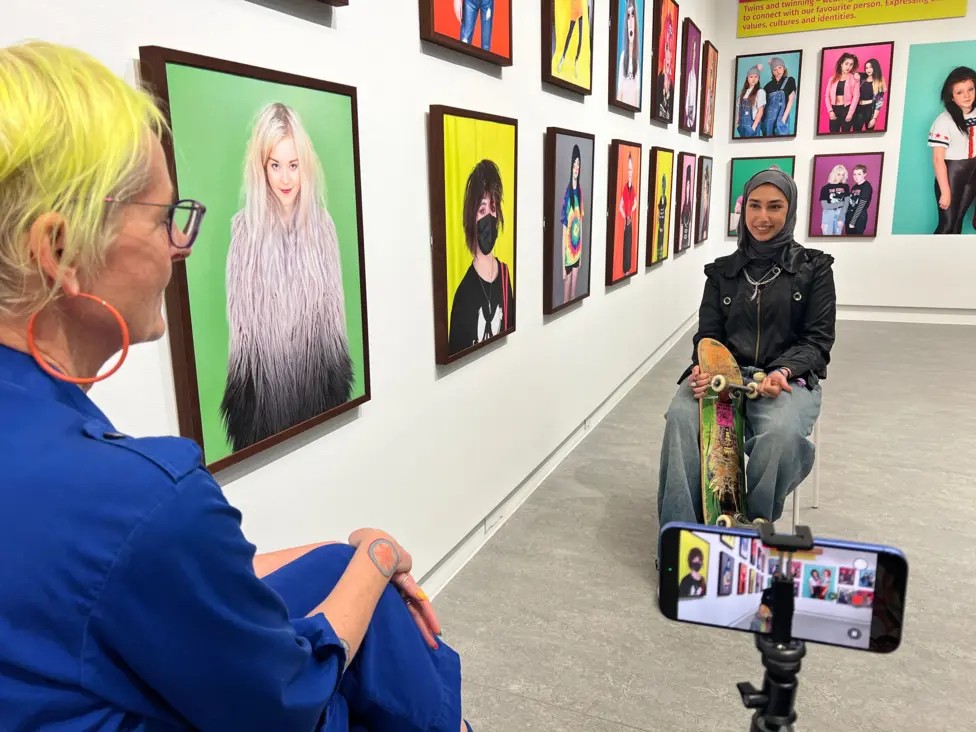
    A new exhibition at a city gallery includes images depicting youth culture across the UK, capturing the “collapse of gender binaries”.

    The Saturday Town project, by photographer Casey Orr at the Herbert Art Gallery and Museum in Coventry, features 95 images collected over 13 years….

    “People use fashion and style to explore their identities, find their tribes and state their values,” said Orr.

    “The biggest single change that is reflected in my exhibition is the collapse of gender binaries in 2016 – it was a revolution and was incredible to witness,” she added.

    Some she photographed were people using their chosen names for the first time, she said, “and I have photographed and been a part of trans and non-binary kids feeling seen and celebrated”

    It suddenly happened in 2016, this gender binary collapse? Gosh, why did no none ever think of doing it before?

    Some gender binaries never change though. Still just women wearing the hijab.

  • 20-year-old Brodie Mitchell told the President of the Friends of Palestine Society, Huda El-Jamal, that her keffiyeh looked like a “tea towel” after she called him a “wannabe Jew” because he was defending Israel and mocked him for not wearing a Jewish “hat”.

    In a classic case of double standards on campus, Brodie was handed a nine-week suspension the following day “for alleged conduct that could be considered hate speech”. He was told his comments were “Islamophobic”, “racist”, and “anti-Palestinian” and was barred from campus and forced to leave his student accommodation.

    Surrey Police have now confirmed they have sent a file to the Crown Prosecution Service (CPS) for a charging decision — meaning Brodie could face prosecution for saying El-Jamal’s headscarf looked like a “tea towel”. Meanwhile, she faced no disciplinary action and continued her studies as normal.

    Welcome to two-tier Britain.

    Story in the Telegraph:

    A student is facing possible hate crime charges after making a joke comparing a pro-Palestine activist’s headscarf to a tea towel….

    Mr Mitchell, who describes himself as a non-Jewish Zionist, became involved in the confrontation at Royal Holloway’s freshers’ fair last September, after Huda El-Jamal, the president of the Friends of Palestine Society, allegedly described him as a “wannabe Jew” and asked why he was not wearing a Jewish yarmulke or kippah.

    He responded by telling Ms El-Jamal: “You’re wearing a tea towel on your head”, referring to her keffiyeh scarf. The scarf is a symbol of the Palestinian cause.

    Mr Mitchell was suspended from the university the next day for the duration of a nine-week investigation by Royal Holloway “for alleged conduct that could be considered hate speech”.

    He is now taking the university to court over its decision to temporarily suspend him from his studies.

    Lord Young of Acton, the general secretary of the Free Speech Union, called the case “a deeply shocking story”.

    He said: “An argument between two students has been blown out of all proportion by Royal Holloway. Brodie should never have been banned from campus and placed under investigation, let alone reported to the police.”

  • …”His work helped me to contextualize the emotions I was experiencing, as no one had ever done before; he never stopped making me feel human.”

    But, while Vic was made to feel human by his therapist, David stopped being human to Vic on October 7th, when he didn’t celebrate the massacre of Jews, because he is one himself.

  • “The ongoing genocide of MMIWG2SLGBTQQIA+ people”.

  • The Onion have form here. In February 2023 they did an Exclusive Interview with JK Rowling.

    For instance

    Onion: “Would you tell us about a time that you were personally victimized by a trans person”

    Rowling: “Yes, I remember it like it was yesterday: you see, I was personally advocating for their total annihilation and then a few of them said some mean words to me on the internet.”

    Hilarious. Boy, these guys can really do that satire shit…

  • The situation began during what should have been a standard team meeting. In the informal chat before proceedings began, Karen, in response to another colleague, expressed support for the Olympic Committee’s decision to exclude male athletes from women’s sporting categories. Within minutes, she received a private message from the Trust’s Head of Equality and Inclusion, informing her that she had “upset a lot of people”.

    The following day, she was told that her “attitude” towards transgender individuals needed to be discussed.

    Three months later, Karen was called to a formal meeting with senior figures at Cambridgeshire and Peterborough NHS Foundation Trust, where she was questioned about her views on trans people and her ability to provide them with compassionate care.

    Believing the matter to have been resolved, Karen was then contacted by the Queen’s Institute of Community Nursing (QICN), which informed her that it had received a complaint about alleged “transphobia” and “bigotry”. She was instructed to delete her social media posts or risk losing her honorary title. The experience caused her significant and understandable distress.

    At that point, Karen turned to the Free Speech Union for support.

    The FSU wrote to QICN on her behalf, setting out her legally protected right to hold and express gender-critical beliefs under the Equality Act 2010. Shortly thereafter, QICN dropped its investigation and issued a full apology, acknowledging that there was “no case to answer” and that Karen had “done nothing wrong”.

    Following a Subject Access Request (SAR), it emerged that the complaint had been made by a senior activist colleague, who had also disclosed information from a confidential internal process – despite that matter having been closed without any disciplinary action. This disclosure appeared to be a malicious attempt to damage Karen’s professional reputation and facilitate the removal of her honorary title.

    Any repercussions for this nasty “senior activist colleague” who disclosed confidential information? If not, why not?

  • Maarten Boudry again.

    ….and disgraceful charade surrounding the honorary doctorate of Francesca Albanese.

    “After fifty years living in Antwerp and forty years at the University of Antwerp as student, assistant and professor, I’m leaving. I no longer feel at home in the city and feel completely estranged from my university that has become a hotbed of radicalism and has completely lost its sense of academic values of critical thinking, discussion and genuine diversity of viewpoints. I fear that the student generation that – with the support of the university authorities – has now become indoctrinated and brainwashed to a point of no return. My son who was born and raised in Antwerp and who wears a kippa,  has been called a child murderer on the street by a Flemish person and was told to “get out of here”. At the university the students are shouting that Jews should get out of Palestine. He and his family are leaving too. It just became a bad place for Jews.”

    This is on you, rectors. You have made universities into hostile places for Jews (unless they ritually denounce zionism and Israel). They will abandon you and take all their learning, knowledge and wisdom with them.

    And don’t worry, @UGent, you have scarcely any Jewish professors left to begin with. The great Jewish linguist and classicist Julien Klener has long since retired. When I met him recently, he told me how relieved he is not to have to endure this ideological madness anymore.

  • Belgian philosopher Maarten Boudry revisits the 1971 debate between these two philosophical titans of the left, on the subject “Is there such a thing as ‘innate’ human nature independent of our experiences and external influences?” The difference between the two was that one, Chomsky, was an heir of the enlightenment, whereas Foucault’s project was to destroy enlightenment thinking. In a nutshell, modernism vs postmodernism.

    What is this gulf that separates them? Noam Chomsky rose to prominence in the late 1950s with his groundbreaking critique of behaviorism. This school of psychology, founded by John Watson and developed by B. F. Skinner, holds that human behavior can be explained entirely in terms of learning through conditioning. At birth, the mind is little more than an undifferentiated lump of clay, gradually molded over the course of our lives. Rubbish, said Chomsky. As a linguist, he argued that the mind of a newborn is already equipped with a battery of innate capacities. How else could a child acquire a spoken language so effortlessly, on the basis of such remarkably sparse input? These innate structures — not only for language acquisition, but for other domains of social life as well — are shared across all of humanity.

    Foucault’s perspective could hardly be more different, as quickly becomes apparent in Eindhoven. The French maître-penseur harbors a deep suspicion of Chomsky’s notion of a universal human nature, quoting the Chinese revolutionary leader with approval: “Mao Zedong spoke of bourgeois human nature and proletarian human nature, and for him, they were not the same” (this was 1971, with the bloody Cultural Revolution still raging). For Foucault, concepts like “truth” and “knowledge” are inextricably bound up with prevailing structures of power. From which vantage point, he asks pointedly, does a professor at the renowned MIT speak when he invokes a universal human nature? What power structures lurk behind such a claim?

    Foucault also dismisses Chomsky’s faith in moral progress as naïve. What is hailed as progress, he argues, often amounts to subtler and more insidious forms of oppression. He sets about puncturing Chomsky’s vision of an ideal society: even if we succeeded in reorganizing society in accordance with this supposed human nature, new forms of oppression would simply emerge, in a different guise and with different victims. Chomsky doesn’t buy that — but he concedes that, if Foucault were right, he could no longer support the anarchist revolution. By the same token, any decent person should now distance themselves from the communist revolutions in Russia and Cambodia under the Khmer Rouge, which produced little beyond bloodshed and misery.

    Hmm. Chomsky’s principled opposition to the Vietnam war later became a fixation on the evils of American society, and the west in general, with a concomitant blindness to the faults of revolutionary movements – none more so than the Khmer Rouge. He refused to countenance the genocide stories until they became undeniable. Anyway…

    Then Foucault delivers a retort that visibly startles the linguist. Why, my dear Chomsky, should that come as a shock? Surely it is no reason to abandon the revolution. For the first time in history, the proletariat has an opportunity to seize the reins of power after centuries of oppression under feudal and capitalist systems. It is only to be expected that they might resort to “violent, dictatorial, and even bloody power.” High-minded ideals like justice and equality, Foucault explains, are typically a cover for power: “I can’t see what objection one could make to this,” he replies, genuinely puzzled. For Foucault, moral principles are not objective, but exist only within specific configurations of power — a view that seems to preclude the very idea of moral progress.

    Chomsky would later reflect that Foucault was the “most amoral person” he had ever met — not immoral, but amoral: someone deeply skeptical of any standards of right and wrong.

    Amoral and immoral, given the posthumous stories of Foucault’s sexual abuse of young boys in Tunisia.

    The chasm that opened up that evening in Eindhoven was more than a quarrel between two intellectuals. It marked a fault line running through the modern world. Let’s give names to the two continents on which Chomsky and Foucault reside — the intellectual Arctic and Antarctic: modernity and postmodernism. A modernist believes in the Enlightenment project of continual human betterment through scientific knowledge and free debate. A postmodernist, by contrast, is deeply suspicious of these very ideas.

    Or, to put it another way, all bad ideas come from France.

  • At The Hill this morning: