• https://platform.twitter.com/widgets.js

    I haven't seen any corroboration that Arafat Irfaiya is scheduled to be released. There's a list of some of the Palestinian prisoners being freed at the JC.

    From JFeed (if you have a strong stomach):

    The potential release of Arafat Irfaiya, who brutally murdered 19-year-old Ori Ansbacher after specifically hunting for Jewish victims and showed no remorse while bragging about his actions, raises devastating questions about the true cost of prisoner exchanges as families of terror victims face the possibility of seeing their loved ones' killers set free.

    Five years ago, terrorist Arafat Irfaiya, who set out to commit an attack while wearing a kippah, encountered 19-year-old Ori Ansbacher in an isolated nature area near the Biblical Zoo. Ori loved to spend time alone in nature, drawing and writing.

    Irfaiya stabbed her multiple times and dragged her 150 meters while she was still alive, then raped her. During the rape, he continued stabbing her until he nearly decapitated her.

    This monster in human form, who never stopped smiling throughout his trial, received life imprisonment plus 20 years.

    Here are his disturbing interrogation responses, revealing his state of mind:

    Irfaiya: "I made my parents proud because of what I did."

    Investigator: "How do rape and murder cause pride?"

    Irfaiya: "I didn't just rape someone – I killed a Jew. You can't understand because our thinking is different. If you ask anyone standing at a military checkpoint if they would be happy to kill a Jew… you'll see I did what every Arab dreams of."

    Investigator: "Why didn't you do it earlier if you desired it so much?"

    Irfaiya: "This is what Allah planned for me (laughs). The murder is the best and most important thing I've done in my life. If she had stayed alive, it would mean I failed in what I planned and failed my mission – that would have been the worst feeling in my life."

    He described planning to enter Jerusalem through the forest to kill multiple Jews while wearing a kippah to blend in, but said when he saw "the Jewess" he understood Allah had sent her to him. He waited by her body hoping to surprise and kill more Jewish people, saying he would have been blessed to die as a "shahid" (martyr) in the attempt.

  • https://platform.twitter.com/widgets.js

    Full text:

    Just this week, I learned of two lifelong Dems—social science prof and humanities prof—who've gone full MAGA as a result of what they witnessed or endured.

    I know of many others, myself included, who, while unable to countenance Trump, have gone from loyal Dems to reviling the party. Indeed, a former student, a black man FWIW, reports that he dutifully voted Harris but was surprised to find himself secretly relieved when she lost.

    The wound that the overweening American left has inflicted upon itself, and the empowerment that it has gifted a party which it officially regards as an existential fascist threat, surely amounts to one of history's most egregious own-goals.

    A comment:

    I’m one of these people. I’m mixed race, letters behind my name, 2x Obama voter who thought Republicans were Draculas. This election cycle I donated to Donald Trump and knocked on doors in my small town. The most intriguing thing about my swap over is I’ve been asked dozens of times by conservatives why I came around to supporting Donald Trump but liberals have either stopped talking to me, or just assumed I voted Kamala and told me she lost because everyone is a racist. I think the lack of curiosity for how other people live and think will cause long term issues for leftists and liberals.

  • Jonathan Spyer at the Spectator – Hamas has exploited Israel’s weaknesses:

    When Hamas launched its war on Israel in October, 2023, it did so on the basis of a clear analysis of Israeli society, according to which it hoped to achieve its objectives.

    Given the nature and extent of the massacre of 7 October 2023, it was surely clear to the Palestinian Islamist movement that Israel’s response would be to seek to destroy the ruling regime that Hamas had established in Gaza since 2007. Hamas’s leaders hoped to avoid this outcome, however, by the taking of Israeli hostages. This would be followed by a bargaining process in which Hamas would exchange the lives of the hostages for its continued rule in Gaza.

    The ceasefire deal currently being implemented by the government of Israel and the once and future rulers of Gaza suggests that Hamas may well have achieved its goal….

    The choice facing Israel was stark. Its decision is clear. The remaining important question is why. Why has the Jewish state opted once again to agree to a massively lopsided exchange of captives, which will involve the release of hundreds of individuals convicted of murdering Israelis, often in the most savage and brutal of ways? 1,904 Palestinians are to be released in the first phase, in return for 33 Israeli hostages….

    So why? Why the agreement to such apparently absurd deals?

    Israeli society is small, and possesses a high level of social cohesion of a particular kind. Israelis are not, and do not feel themselves to be, strangers to one another. Strongly felt perceptions of national, communal and religious identity, along with shared experiences of conflict, contribute toward a powerful sense of shared destiny among Israel’s Jewish inhabitants and to a lesser degree also among its non-Jewish ones. This produces the high levels of solidarity and mutual commitment which have been very much on display over the last 14 months of war. But it also, paradoxically, leads to prisoner exchanges which by any measure make no strategic sense at all, enable enemies to achieve their goals, and for obvious reasons incentivise further hostage taking.

    It now seems, looking back, that the Israeli aim of destroying Hamas was always a pipedream. Why? Because there's nothing there to take its place. Hamas has controlled life in Gaza (with, let's not forget, the help of UNRWA) to such an extent that there's just no alternative. There's no civil society to take over post-Hamas. Unless Israel had decided to take control of Gaza again – which they clearly had no wish to do – then the return of Hamas after the ceasefire was inevitable. The killings of the Hamas leaders was of symbolic significance, but others will just take their place. The destruction of the tunnels and the Hamas infrastructure? It'll all just get built again.

    It's like the Iraq war: the destruction of the Saddam regime was the easy part. Afterwards…nothing…a vacuum which the Iranians were quick to exploit. Syria? There was no possibility of some kind of people's uprising to replace Assad. Civil society had been destroyed. In place of Iran and Russia we now have Turkey and its Islamist proxies calling the shots. Lebanon? Too early to tell, though there are hopeful signs. Maybe there's enough of a civil society left to save the country. Maybe the destruction of Hezbollah is the one positive that emerges from this whole mess. That, and the weakening of Tehran.

    Though I suppose, with Trump coming in, matters may change….

  • Meanwhile in Australia:

    https://platform.twitter.com/widgets.js

  • Kunwar Khuldune Shahid, a Pakistan-based correspondent for The Diplomat, writes in the Spectator on how Pakistan’s rape culture led to the UK grooming gangs:

    Certain attitudes dominate Pakistan. There is a gory mix in the country of Islamic supremacism, primitive tribalism and violent misogyny, which encourages some men to prey on girls. That many of these girls are underage has little sway on these men, since both their religious beliefs and customs see all females who have reached puberty as being fully grown women. This translates into a rape culture that in recent decades has seen young British girls being mercilessly violated. Sexual harassment by Pakistani men has been reported elsewhere as well, including in Turkey.

    Pakistan’s sexist culture in built on skewed notions of ‘honour’ and ‘morality’, with women deemed property of men, and required to be under male supervision or custodianship.

    Traditionally, ‘honourable’ women keep themselves segregated and limit their visibility in public. Any transgressions by women are considered immoral, and often result in violence. Islamic modesty codes which ask women to cover up so they are not harassed further fuels the idea that female ‘honour’ is linked to the lack of a woman’s visibility. Islamic traditions establishing sexual slavery also encourages the ‘loverboy’ abuse strategy.

    In many cases, the Pakistani grooming gangs in the UK targeted Caucasian non-Muslim girls because they are lower in the ‘honour’ scale. This is exacerbated by the ‘white woman fantasy’ prevalent across Pakistan. European women are often fetishised in the pop culture of Pakistan, and often depicted as lusting after desi men. Many Pakistani novels, films and TV shows feature western and westernised women being ‘loose’. Similarly, Pakistani grooming gangs have deemed British girls ‘easy meat’ or ‘fair game’.

    In this culture it's the women who are responsible for rape, not the men. The men can't be blamed for following their "natural" inclinations. If young women go out on their own, without a guardian, unveiled, then they're asking for it.

    In Pakistan, rape culture and the belittling of sexual abuse isn’t just a feature of rural or tribal areas. Former military dictator Pervez Musharraf accused women of ‘using rape for moneymaking’, while Imran Khan, as prime minister, blamed the way women dress and their lifestyle choices for the rise in rape cases across the country. Khan continues to enjoy massive popularity among overseas Pakistanis, including in the UK. His playboy lifestyle during his cricket days – and later political career as a born-again Muslim – is often considered by young Pakistani men as the ideal life template….

    While the failure of the British authorities to protect young girls from grooming gangs is lamentable, there is something currently missing to stop these crimes happening in the future. There needs to be a much greater backlash to these crimes within the Pakistani community. While many progressive and liberal Pakistanis condemn sexist violence at home, when these crimes take place in Britain, they join their predominantly conservative fellow community members in a conspiracy of silence. Ostensibly this is because they are afraid of racism and ‘Islamophobia’. For many of these progressives in Pakistan, upholding the myth of cultural equivalence is more important than providing justice to the victims and prevention of these monstrous acts. It would be far better to speak up against these crimes, instead of looking to pin the blame elsewhere.

    Indeed. Where are these condemnations from within the Pakistani community?

  • https://platform.twitter.com/widgets.js

  • Refreshing honesty from Kishwer Falkner, Chair of the Equality and Human Rights Commission, in today's Sunday Times – I’m afraid there is a Pakistani problem, and we must root it out:

    For two weeks the government said no to calls for a public inquiry into the grooming scandal. Now it is trying to deflect criticism by setting out its “next steps”. They are not enough.

    What Yvette Cooper, the home secretary, is promising is better data, a limited general audit (the multitasked Baroness Casey of Blackstock has been asked to defer her social care review to prioritise this), five local inquiries (out of a possible 50), a review of “cold” cases plus a few other technical measures. All this, she tells us, will uncover the truth and provide justice where things have gone wrong.

    Truth, Cooper implies, has been in short supply in the past two decades while children have been raped and abused, and “despite all the inquiries, no one listened and nothing was done”. She doesn’t seem very curious as to why, which is what a wider statutory inquiry should try to answer.

    Maybe she would be more curious if she experienced my deep shame every time the “Asian” grooming scandals are mentioned. I’m a first-generation female migrant from Pakistan who naturalised as a British citizen. I’m a secular Muslim and I’ve grown up, lived and worked in Muslim-majority countries, so I am well versed in the cultural and religious mores of those countries.

    It is obvious that there are regressive attitudes towards women, especially non-Muslim white girls, in parts of the south Asian diaspora in the UK. But why does it appear that Pakistanis, or a subset of Pakistani men, are so overrepresented in the gang rape outrages? Is it the clash between the respectability demanded by their community and the temptations of the night-time economy in a sexualised western culture? What about the role of sometimes dysfunctional marriages with spouses from Pakistan, still accounting for half of all male Pakistani marriages? Or the baradari clan system that encourages a closing of ranks? …

    We need an understanding of the cultural patterns, as Cooper concedes, not to demonise a whole community but to hold the pathology of a subset up to the light and ensure it never happens again. It would also provide the platform for a proper repudiation of the crimes by the Pakistani community itself. For a community so concerned about “honour” and “shame”, it is dismaying to note that there does not seem to have been a loud, community-wide disavowal of these crimes, nor a shunning of those released from prison (some far too early).

    And what of the collective failure of the public authorities? The anti-white racism shown towards the victims was mirrored by a kind of hands-off racism shown towards the offenders: “That’s what they do, don’t they? Everyone knows about it, so there’s nothing to see here.”

    The “warped ideas of community relations”, as the prime minister describes it, the acceptance of parallel lives and community self-policing and the acquiescence in the weaponisation of racism and victimhood — that too is a cultural pathology, a bastard child of well-meaning anti-racism, that needs to be held up to the light and banished from our institutions.

    Liberal, multiethnic societies are a permanent balancing act between accommodating difference and embracing common norms. What to do when some groups become too inward-looking and stray too far from the common norms? This too is, at least indirectly, unavoidable territory for a statutory inquiry and something that Labour has not been afraid to tackle in the past. Gordon Brown tried to define British values, Tony Blair looked at social cohesion through the lens of Muslim extremism and both brought weight to the national conversation. Labour needs to rediscover that burning concern for national integration even at the risk of further alienating its Muslim voter base.

    One reason the government may struggle to do this is that it is trying to pass a legal definition of Islamophobia. Andrew Norfolk, the former Times reporter who uncovered many of the grooming crimes, points to accusations of Islamophobia often closing down proper investigation. Yet the preferred definition would further reinforce that obstacle to justice and is so catch-all that it is a blatant elevation of one religion for special protection over all others.

    The new definition originated from a flawed report by parliamentarians in 2018, which I spoke against in the House of Lords. I explained that we already had legal protections against religious hatred, which adequately protected Muslims. The government needs to explain what the problem is that existing laws do not cover.

    In a multiethnic country with little consent for the present high levels of immigration, the majority cannot live in fear of exposing minority wrongdoing. The grooming scandal and what it has revealed about the reflexes of public authorities provides the opportunity to shape a new national consensus about where to redraw that line between difference and common norms. We need to reimagine our goal of an open and diverse Britain, one that expects all of us to live well together, even if that involves giving up part of our previous lives. Mirpur has no place in Manchester.

    Thank goodness for Kishwer Falkner. She's already faced off a campaign to oust her for standing up to the trans activists.

    There is, surely, a straight line from the dress of many Muslim women here in the UK – wearing not only the hijab, but often enough a niqab face veil with a slit for the eyes – to the rape gang scandal. It's the same mentality that has women not fully covered as like meat left out for cats: irresistible to men. It's the women who are responsible for rape, not the men. The men can't be blamed for following their "natural" inclinations. As we know only too well, this is commonplace throughout the Islamic world, from Iran to the scarcely credible anti-women dictates of the Taliban in Afghanistan. So white girls walking around freely, in a liberalised Britain, are like meat left out for the cats: just asking for it.

    We assumed, reasonably I suppose, that with assimilation this would improve. But the Muslim Pakistani immigrants, especially in the smaller northern and midlands towns and cities, tended not to mix. They weren't interested in assimilation. Even here in London the sight of women in veils is still common – and not just older women. Quite a few younger more stylish Muslim women wear the niqab. Only their husbands at home – their guardians – are allowed to see their faces. And we, out of politeness, out of "respect" for other cultures, don't say anything.

    Still, with brave outspoken women like Kishwer Falkner, there's hope.
  • Just another day in academia:

    https://platform.twitter.com/widgets.js

    Abstract:

    We argue in this paper that what separates permissible from perverse acts of killing, or sex with, an animal is a matter of material and symbolic space. We focus on interspecies sex –which is often, but not always, bound up with killing –to argue that what separates permissible from perverse acts of interspecies sex in India, or husbandry from bestiality, is where it occurs geographically in proximity to an upper-caste, anthropatriarchal imaginary of a Hindu nation. We argue that the state-sanctioned abattoir and its breeding facility are spaces of normalized exception, in which anthropatriarchal violences are relatively permissible, and on the same grounds as in the “human” space of the home. We trace interspecies sexual contact across spheres of bestiality, animal husbandry, petkeeping, and population control. We conclude with a queer bestial ethics of avowal, one that dispenses with anthopatriarchal innocence towards a more capacious embrace of the panspecies desire for touch and thriving.

    The panspecies desire for touch and thriving. – or, sex with animals, and why it's really fun. Throw off the anthropatriarchal chains and live!

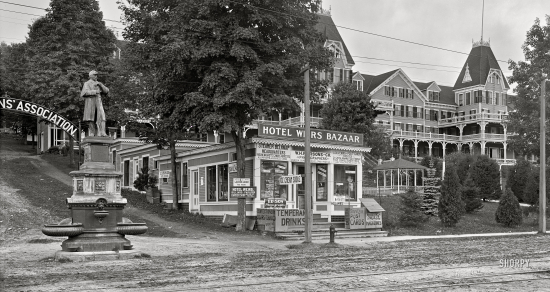
  • Ca. 1906. "Lake Winnipesaukee, New Hampshire. The New Hotel Weirs and Soldiers' Monument." 

    image from www.shorpy.com
    [Photo: Shorpy/Detroit Publishing Company]

  • Members of the British Association for Counselling and Psychotherapy [BACP] are responsible for a new app, “Exploring Lesbian Culture for Trans Femme”. Yes, it's the return of the cotton ceiling. Bev Jackson at The Critic has the details:

    The resurgence of “cotton ceiling” rhetoric among — of all people — members of the BACP – “a professional body representing counsellors and psychotherapists in the UK” — is like a rotting corpse rising to the surface of your local lake.

    You remember the “cotton ceiling,” right?

    In 2012, a trans-identified man named Morgan Page ran a workshop at Planned Parenthood Toronto entitled “Overcoming the Cotton Ceiling: Breaking Down Sexual Barriers for Queer Trans Women.” The aim was to teach “transbians” techniques to pass through the “cotton ceiling” — a cute term for women’s underpants. In other words, it taught straight men who “identify” as women how to get lesbians into bed. …

    In 2022, the “cotton ceiling” workshop came up during the Allison Bailey case, in which Bailey, then a barrister, sued her chambers, Garden Court, and Stonewall UK for discrimination and harassment. For me, the weirdest sentence of that trial came from the witness Cathryn McGahey QC, a former vice-chair of the Bar Council’s ethics committee. When asked her views on the “cotton ceiling” phenomenon — about helping men find ways to get into lesbians’ knickers — McGahey cast about for an analogy. In a lightbulb moment, she compared the “cotton ceiling” workshop to “South Africa attempting to racially integrate society.”  I. Kid. You. Not. 

    I’ve never seen contempt for lesbian sexuality displayed quite so blatantly. Maybe McGahey had heard Nancy Kelley (then Stonewall CEO) describe us as “sexual racists” and stowed it away for future use.

    Fast forward to 2025, and to an initiative called VODA — “Self-Care for LGBTIA+ Lives.” It’s won awards — from UK StartUP Awards and Attitude.(2)

    VODA is promoting an app called “Exploring Lesbian Culture for Trans Femme”. Remember: “trans femmes” are male. The app focuses entirely on the validation of the “trans femmes”, without any acknowledgment that other people — you know, women — may be involved….

    This is essentially an invasion manual. It shamelessly encourages men who self-define as lesbians to “claim their space” in the lesbian community.

    Four of the six-strong VODA team are also BACP members. Their involvement in this app is unclear, but they have certainly not distanced themselves from it. The app seems to be a profound breach of the BACP’s Ethical Framework (2018)….

    The message promoted by the VODA app — and by “LGBTQ+” and former human rights organisations — is that “male lesbians” are victims to be coddled while the rights of actual lesbians don’t matter. I’m sick of this upside-down logic. People born male cannot be lesbian and should not be encouraged to invade lesbian spaces. To see a therapists’ organisation cheering on this violation demonstrates that the “cotton ceiling” discourse is alive and well.

    I hope the BACP will be receiving a strongly-worded complaint about this grotesque app, which encourages men to trample on lesbians’ right to dignity and to their right of association.

    You think a battle's been won, and…zonk…up it pops again. Playing whack-a-mole with the trans activists.