
• Ameer Kotecha, former British consul general in Ekaterinburg, on why he’s finally resigned from the Foreign Office:

    Nearly five years ago, on the day Kabul fell to the Taliban, I was among several thousand officials invited to mark World Afro Day (for those unaware: “a global day of celebration and liberation of Afro hair”) with a panel discussion featuring a director charged with matters of national security.
    This week, with war raging in the Middle East and the RAF base in Cyprus under attack, the main news on the Foreign Office internal intranet was about the “New FCDO Capability Framework and self-assessment”, with all staff urged to “Take charge of your development”.

    These provide a decent illustration of why, after over a decade, I have resigned from the diplomatic service.

    The dysfunction runs deep. In recent discussions about how the Foreign Office could improve productivity with AI, some senior colleagues were more concerned with the need for an environmental impact assessment than for any proposed gains. Colleagues in the Department for International Development (now merged with the Foreign Office) justified to me their refusal to limit working from home to two days a week on the grounds that they didn’t want to work in a “colonial” office building. This is not culture war mudslinging. It illustrates a civil service culture hopelessly distracted by the peripheral, to the neglect of its core mission.

    Amorphous “civil service behaviours” have become the guiding principle of recruitment and promotion: it doesn’t matter what you’ve achieved, so long as you can spin a good story about it. The civil service has too few officials with science or tech backgrounds, or any private sector experience. Under-performers are usually shuffled sideways or allowed to plod along.

    Government lawyers often see only risks, not solutions: when successive foreign secretaries asked me to help get our embassies and consulates serving more British produce to boost exports, I was told it would breach procurement law to favour British suppliers over foreign ones.

    And that’s before we even get to the whole Stonewall capture business across the Civil Service….
  • Daniel Finkelstein in the Times on Starmer’s obsession with international law, reinforced by his choice for attorney-general, Lord Hermer:

    Can it really contravene international law to act against a regime that wages wars by proxy all over the Middle East, sponsors terrorist murderers all over the world and is building a ballistic missile and nuclear capacity to make good on its threats to bring death and annihilation to other nations? What sort of law only allows action after nuclear weapons have been built or deployed? The idea that this action is not self-defence, and not legal as such, seems to me completely naive.

    Just ask Israel. Tehran has made no secret of its main foreign policy objective: to destroy the Zionist state. Was Israel meant to wait till after Tel Aviv had been obliterated before striking back?

    Naive seems about the right word for Starmer’s whole position. He seems to have no feel for what it might be like to be a political leader, so just stumbles along, blindly clinging to the small print of international law – the only world he understands..

    Our position makes little sense diplomatically. It has been a major aim of the Starmer government to maintain a close alliance with the increasingly erratic American administration. In the long term we clearly need to be less reliant on the US but the prime minister judged that this would take time. Our position over Iran has made a mockery of his entire approach to the Trump administration.

    It makes little sense morally. We are now engaged in a war we regard as illegal. We are not on the side of the Iranian people yearning to be free, nor on the side of the opponents of all wars. We seem to have lost a sense of who our allies are and who the enemy is. The cheers ring out from Tehran apartment blocks, while in Britain you hear the sound of humming and hawing. A massive war has broken out. It wasn’t at a time of our choosing, or in a way we would have planned, but surely we should at least know which side we are on. Australia does. Canada does.

    And it makes little sense practically. It was obvious that if Iran were attacked it would lash out at its regional enemies and therefore at our friends. And obviously we would need to defend them. It’s ridiculous to think that the US could be in a war in Iran and that we would remain uninvolved. But now we have lost much of the goodwill that would have come with this involvement.

  • Why has Iran been targeting the UAE and other Arab states with missile strikes? Stirring up the old Sunni-Shia divide? Inadvertently perhaps, but, according to the WSJ, it’s less subtle than that:

    The apparent calculation was that, by targeting rich Persian Gulf monarchies that hold sway with the Trump administration, Tehran could force Washington and Israel into a rapid de-escalation.

    Iran’s expectation was that, by squeezing oil shipping through the Strait of Hormuz and disrupting air traffic, it would cause unbearable pain to the Gulf nations that depend so much on expatriate workers, tourism and overseas trade.

    So far, this calculus seems to have backfired. Gulf states, rattled by volleys of Iranian drones and missiles targeting their hotels, ports and airports, are concluding the Iranian peril must be confronted. Rather than seeking an offramp, the prevailing mood in the Gulf—at least for now—is that the Iranian regime can’t be allowed to get away with this unprecedented onslaught on its neighbors.

    “Iran is coming to the countries and people of the Gulf and saying: ‘You know, I am actually your number-one threat.’ This has long-term implications, regardless of whoever is actually in power in Iran,” Anwar Gargash, diplomatic adviser to the United Arab Emirates president, said in an interview. “Targeting Gulf states is completely irrational, and very shortsighted.”

    It’s got to the point now where Qatar has reportedly carried out strikes inside Iran.

  • Suzanne Moore in the Telegraph:

    There will come a day when I don’t have to try to persuade anyone that medicalising and sterilising children is not a good idea. There will come a day when professional people do not lose their jobs or status after trial by X (Twitter), which is adjudicated by activist curtain-twitchers who pore over social media looking for evidence of wrongthink. But we are not there yet.

    Just ask Prof Jacob George. The professor of cardiovascular medicine at the University of Dundee, whose social media posts have praised JK Rowling and indicated a gender-critical stance, was appointed chief medical and scientific officer at the Medicines and Healthcare Products Regulatory Agency (MHRA) in January. His concerns about the NHS’s controversial puberty blockers trial led to the Department of Health pausing it. Yet he has now been recused from having any more involvement in the trial.

    So we see it again. If you don’t hold the orthodox line on gender – trans women are women, trans men are men and non-binary is valid – beware out there, especially if you work in the public sector. The clones whose cerebral cortexes have been removed in exchange for a badge, a flag and a lanyard have had their brains filled with pink and blue candyfloss.….

    The puberty blocker trial is turning into quicksand, pulling down anyone associated with it. It has done Cass no good, it has damaged Streeting immensely and it has shown the complete McCarthyism of the upper echelons of the NHS. And that is without even mentioning the actual harm it may do children.

    The harm it will do children – if it goes ahead.

  • From the JC:

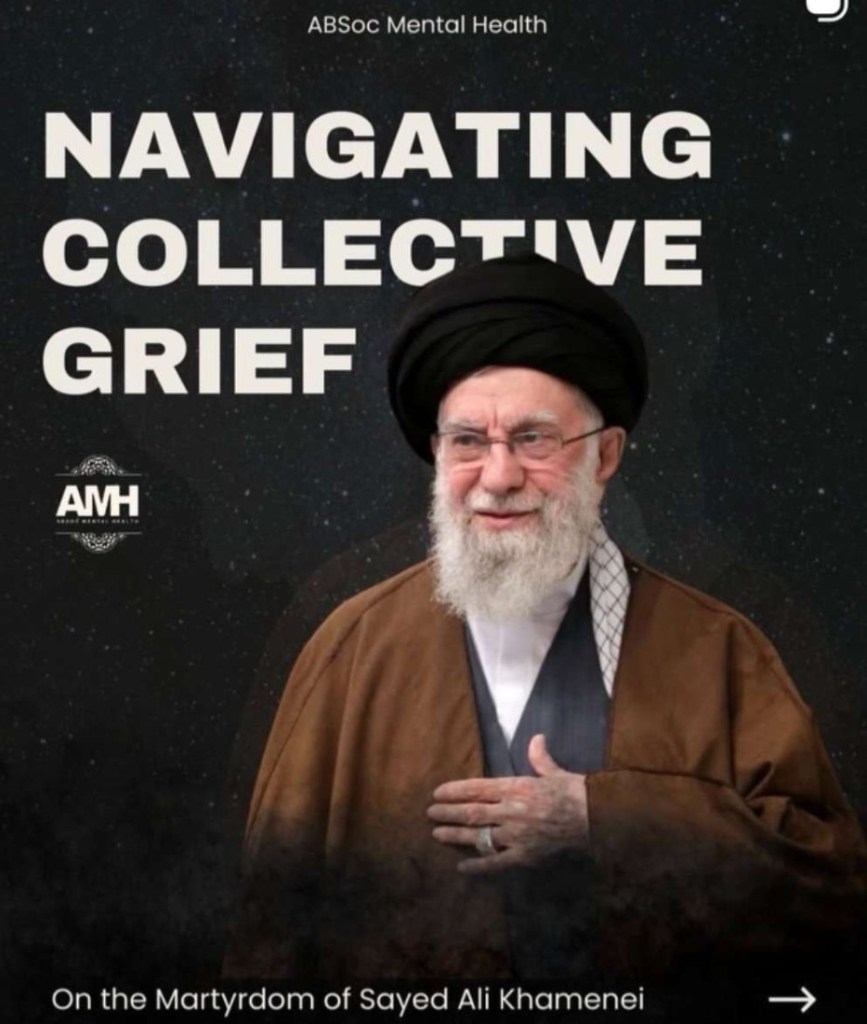
    A student society has given advice on how to deal with “collective grief” following the death of Iran’s supreme leader, Ayatollah Ali Khamenei, in Israeli strikes on Tehran on Saturday.

    On university campuses across the country, dozens of Ahlul Bayt Societies, also known as Absocs, have posted messages mourning the regime leader.

    The Muslim Student Council (MSC), the national umbrella organisation overseeing dozens of Absocs (many of which are officially affiliated to British student unions), posted a black and white image of Khamenei and informed followers that an Iftar event to break fast for Ramadan had been cancelled “out of respect and in honour of our beloved Shuhada [martyrs]”.

    Greenwich Absoc shared an image mourning Khamenei and reposted material about the ICE vigil on Sunday, including the statement that “our leader is today a great martyr”.

    UCL Absoc encouraged its followers to recite a mourning prayer for Khamenei, sharing a post on Instagram stating: “Please recite Surah Al Fatiha [the first chapter of the Quran] for our beloved Sayed.”

    “Condolences on the martyrdom of Ayatollah Sayed Ali Khamenei,” it said, adding: “We will remain steadfast.”

    The student society, which is affiliated with the UCL student union, has posted three videos of Khamenei and has organised an event in a UCL campus building, which will “commemorate the fallen”.

    The society also shared a post from Absoc Mental Health, a separate group that claims to be “breaking stigma [about mental health] through the Quran & Ahlulbayt,” which stated: “ABsoc Mental Health send their condolences to you all on the martyrdom of Ayatollah Ali Khamenei. This is an unimaginable loss for the entire Ummah.

  • Iranian activist Leila Farahbakhsh blocks a peace march in Florence against the US and Israeli military attack.
    She shouts her heart out as the “pacifists” try to silence her.

    “I am Iranian. I have a right to talk!”

  • In the verdict issued by the new authorities, she was found guilty of “spreading corruption on earth and denying Allah.”
    “I would rather face death with open arms than live in disgrace, forcibly covered with a veil. I will not kneel before those who expect me to repent for half a century of my struggle for equality between men and women. I am not prepared to wear the chador and take a step backward in history,” Parsa wrote in her farewell letter to her children.

    Farrokhroo Parsa (Persian: فرخرو پارسا; 24 March 1922 – 8 May 1980) was an Iranian physician, educator, and parliamentarian.

    She served as minister of education under Amir Abbas Hoveida and was the first female cabinet minister. Parsa was an outspoken supporter of women’s rights in Iran.

    During the outset of the Islamic Cultural Revolution, Parsa was executed by firing squad on 8 May 1980 in Tehran due to her feminist beliefs.