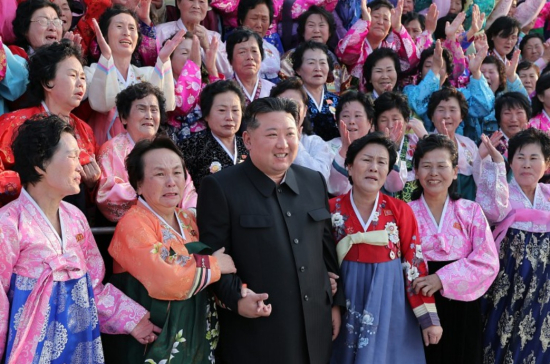
• Kim Jong Un posing for a commemorative photo with participants:

    Screenshot 2025-03-28 174749

    An unfortunate side-effect of being a semi-divine leader who can do no wrong is that no one will tell you about lapses in your personal hygiene. The women here, though they do their best to conceal their discomfort, are clearly affected by the inescapable odour.

  • Genevieve Gluck on the tale of Nonnie Marcella Lotusflower:

    Reduxx has learned that a trans-identified male currently incarcerated at a women’s prison in Washington state has been charged with intimidating a public servant and malicious mischief in the first degree after he threatened and assaulted a female correctional officer. Nonnie Marcella Lotusflower, born Nathan Goninan, has a history of violence against women and is currently serving a 10-year sentence at the Washington Correctional Center for Women (WCCW) for the murder of a teen girl.

    NONNIE-LOTUSFLOWER-ASSAULT-1392x783

    Because where else would you place a violent and unhinged misogynist who murdered a teenage girl? 

    Lotusflower previously. Supported by the ACLU, of course.

  • Helen Joyce on the turn-around in coverage of trans issues. 

    Decades ago, when the first men who said they were women were admitted to women’s spaces, any commissioning editor who was told about it dismissed it as a sideshow. By the time vast numbers of people started identifying as trans, it was rejected because it had been happening for ages and was everywhere.

    Also working against news coverage was a determined disinformation campaign. Youngsters were being taught at school and university that it’s impossible to define male and female objectively or to know which individuals are which. Older people were being convinced by lobby groups which wilfully misrepresent the law that if a man said he was a woman it was compulsory to play along.

    Few people actively opposed the propaganda because those subjected to it mostly believed it and those spared it mostly didn’t know about it, and if they did, found it implausible that anyone could believe anything so dumb. Now that trans is everywhere, that mutual ignorance has ended. The two groups are increasingly clashing in workplaces, schools and everywhere else. And even if the new belief system doesn’t set editors’ news senses tingling, the clashes do….

    More broadly, the narrative about trans issues is changing. Geoffrey Crowther, editor of the Economist from 1938 to 1956, used to tell young journalists to “simplify, then exaggerate”. That may sound like unnecessary advice in the era of churnalism and social media, but it expresses a timeless journalistic truth: a story can only ever be about one thing.

    And for many years, every trans story stuck to a singular narrative: the struggle of the uniquely oppressed and suffering person born in the wrong body, with everyone else relegated to supporting roles if they were lucky and bigoted villains if they weren’t. Now the narrative is in flux: you can still easily find stories about celebrities’ brave trans kids but there’s room to point out that other people’s rights and interests matter too.

    Once enough people got their heads around the story, it flipped like an optical illusion. The same facts and events that were once dismissed as too crazy to be happening became the sort of crazy that makes great copy.

    Stop the machines at Manchester and Glasgow. Clear the line to Belfast and Paris. Pretending men can be women has been destroying institutions and women’s lives for years now. And finally, it’s news.

    It's got very little to do with people's attitude in general. The majority always understood the insanity of this belief that men can become women just by saying so. It's just that now, at last, the media have started to do a little more honest reporting.

  • Jake Wallis Simons in the Telegraph on the Gazans protesting against Hamas:

    Over the last 48 hours, there have been more protests against Hamas inside Gaza than we have seen over the past 17 months in London. The marches first emerged in the north of the Strip, with beleaguered Gazans bravely calling for the release of Israeli hostages, facing down reprisals from their jihadi overlords. When did you last hear such demands at the rallies endured by our capital on Saturdays?

    The uprisings are ongoing. They have spread south, even erupting in the Hamas stronghold of Jabalia in Gaza City, where a protest in 2019 was viciously repressed by the jihadis.

    It is impossible to know whether they will be snuffed out by hastily recruited 16-year-olds with Kalashnikovs or if this is the start of something bigger. But the episode has already neatly revealed the deplorable hypocrisy at the heart of Gaza activism in Britain, seemingly more concerned with feeding a lust for the denigration of Israel than the welfare of the Palestinians.

    Yet the media are not that excited. 

    From one point of view, you’d have thought that the story would be widely covered. After all, aren’t many progressives normally keen to make a distinction between the fanatics of Hamas and the innocent civilians of Gaza as soon as an Israeli bomb lands? The problem, however, is that what serves the narrative in one context can have the opposite effect in another.

    The unpalatable truth is this: in the back of every liberal mind there lurks a guilty sympathy for Hamas. They have learnt not to say it out loud, but in a brain addled by decolonisation dogma and critical race theory, it is hard to resist the siren call to embrace the most savage jihadism simply because it fits.

    The white man is the enemy. The imperialists are to blame. Colonialism is the worst evil ever to befall mankind and the underdog deserves solidarity, ergo resistance is justified. This is how they think.

    Yasser Arafat’s alignment with the decolonisation movement in the Sixties, in particular the Algerian defeat of the French, was a stroke of genius which won unquestioning solidarity from the Left. The delusion persists today.

    The reality, of course, is that most Jews are not white. Israel is not a colonial power. The Palestinians have been offered a state on several occasions – including the 2008 Olmert proposal, which satisfied 100 per cent of their supposed demands – but turned down every one in favour of bloodshed.

    Hamas is no different from Islamic State. “Resistance” is simply code for the wanton rape, butchery and mutilation of families in their beds, motivated by fanatical religion (Israel withdrew from Gaza in 2005, for God’s sake). But when you’re wearing your anti-Israel goggles, such subtle distinctions as these become cloudy. Pretty soon, you end up thinking Yahya Sinwar is Che Guevara.

    Shamefully, this dogma continues to dominate on the Left today. You just can’t shake them out of it. So we see activists in London, in their keffiyehs and crop-tops, tearing down hostage posters just as the weary people of Gaza take to the streets in defiance of their jihadi oppressors.

  • A powerful editorial from the JC – With a genocidal enemy, diplomacy is not an option:

    The first casualty of war is famously the truth. Nowhere is this more evident than when Israel is forced to defend itself.

    For 17 months, the media breathlessly parroted Hamas casualty figures with less scepticism than a Bank of England report would receive. Few news outlets ever questioned Hamas’s miraculous ability to tally hundreds of deaths within minutes or to instantly determine which were civilians and which were terrorists, sorry, “militants”.

    When Israel resumed its offensive, the media fell right back into form, treating Hamas's claims again as undisputed facts. Even when these reports do acknowledge the Hamas-run Gaza Health Ministry, they usually omit the standard disclaimer that the numbers “could not be independently verified”—a caveat reserved almost exclusively for Israeli statements. Trust the terrorists and doubt the Middle East’s only democracy; that's the not-too-subtle subtext….

    Which brings us to the biggest untruth of all: the delusion that diplomacy could actually resolve this conflict. Britain’s ambassador to Israel, Simon Walters, expressed this fiction best (or worst). “I have worked in and around conflicts for thirty years, and grew up in Northern Ireland during the height of the terrorist campaigns. One of the main lessons I take from that experience is that at some point the fighting has to stop and diplomacy begin. That point is now,” Walters posted on social media. The facile comparisons between the IRA and Hamas distort the realities of both conflicts.

    Even evil exists on a spectrum. As Andrew Roberts argues, the IRA, for all its bloodshed, never committed the barbarism Hamas unleashed on October 7 or sought the destruction of Britain. It demanded territorial change, which made a political solution possible.

    Hamas, by contrast, is explicit in its genocidal intentions. So what's the diplomatic solution–meet them halfway?

    It's the same old story: the delusion that inspires such mind-bogglingly stupid comments about diplomacy is based on the cherished belief that this is another war about territory which can be resolved through getting round a table and talking. But Hamas aren't interested in diplomacy: they're an Islamist group bent on the destruction of Israel and the killing of Jews – because for them this is all about Islam. They say it often enough. It's no great secret. But for the media and the political class, this goes against the story they're telling themselves and telling us. So they ignore it, and keep to the same old  blame-Israel line.

  • https://platform.twitter.com/widgets.js

  • https://platform.twitter.com/widgets.js

    What could possibly go wrong?

  • Julie Bindel's latest book – Lesbians: Where are we now? – is published next month. Hadley Freeman interviews her for the Times:

    If anyone wants to make a documentary about lesbians in Britain over the past half-century, they should get Julie Bindel to tell her life story. Bindel, 62, a writer and radical feminist, is like a lesbian Zelig, present at pretty much all the key events, from marching with radical feminists in 1970s Leeds to joining the anti-nuclear women-only protests at Greenham Common in 1981 and onwards….

    From Bindel’s perspective, trans rights go against everything feminism and the gay rights movement represent. “It’s an ideology so wedded to gender stereotypes that its actual flag is pink and blue,” she writes. Yet in 2015, Ruth Hunt — then the CEO of Stonewall — added the “T” to the LGB acronym, mashing together very different groups with conflicting rights, given “LGB” is about sexuality and “T” is about gender identity. “I texted Ruth saying, ‘Why have you done this? This is in complete contradiction to everything Stonewall stands for,’ ” Bindel says. “She just wouldn’t engage at all.”

    Bindel became a target for gender activists. “It’s had a profoundly life-changing effect. I went from thinking of myself as someone who fought for women and girls to wondering if I was a bigot, like they said. But I know a man can’t be a woman.”

    Just like when she was a teenager, Bindel found solidarity among other lesbians (plus a few of us straight birds). Yet not all lesbians agree with her: Hunt, as well as a few other high-profile lesbians — including the Labour MP Angela Eagle and the broadcaster Sandi Toksvig — have insisted there is no conflict of rights between trans people and women. Why does she think that is? “Because they’re classic liberals, not feminists, who saw the writing on the wall and went along with it to be liked and be kind.”

    Many gay men have also turned against her. “When gay men needed us, like during the Aids crisis in the Eighties, we were there. So the way they abused lesbians in the name of gender activism has been a terrible betrayal,” she says.

    In 2020 the LGBT online newspaper PinkNews claimed that a prominent lesbian journalist and a “powerful network of international lesbians” had “groomed” young women to be sceptical of gender ideology. Everyone who read it knew that the article was referring to Bindel, she says, “mainly because there aren’t that many lesbian journalists who are publicly out in this country”. Rowling told Bindel she should sue the publication for libel. “Jo said, ‘If you want to take them to court I will help you.’ ” In 2021 they settled and PinkNews apologised. “I always said they were seething misogynists,” Bindel says.

    Bindel has a plane to catch: she is going to visit Vancouver Rape Relief, the centre she wrote about back in 2004 — which, she says, has stayed firmly women-only. She is looking forward to talking to the young lesbians who work there now “because it can’t just be us old ’uns fighting the fight”. When she comes home there will be more women to protect, more fights to fight. “It never ends!” she says cheerfully. Where are the lesbian heroes? Here is the lesbian hero.

    She's stuck to her guns throughout. Before all the gender nonsense I think it's fair to say that she was seen as something of a fringe figure on the radical feminist left. An unapologetic Andrea-Dworkin-quoting lesbian? Hmm, not so sure about that. Now though…well, the article comments are full of praise…brave, principled, a hero. The times have caught up with her.

  • Not just sending arms and soldiers: the next stage for North Korea is to send workers to help rebuild all the towns and cities bombed to rubble by the Russians.

    North Korea began selecting workers and technicians in early March for reconstruction projects in Russian-occupied areas of Ukraine, including the Donbas region. These labor assignments, already agreed upon with Russia, appear designed to earn foreign currency while strengthening bilateral relations between the two countries.

    A source in North Korea told Daily NK recently that the country is reviewing plans to send groups of 1,000–2,000 workers for Ukrainian reconstruction projects. Skilled construction workers and technicians would be deployed first, followed by additional workers as needed….

    In addition to overseeing ideological training for workers bound overseas, the Ministry of State Security is engaged in technical discussions with Russia about managing North Korean workers on assignment. The two countries are coordinating operations to prevent disruptive behavior, including potential defections.

    “We’ve already held deliberations on several issues with the Russians. The number of workers to be deployed, their working conditions, and the method of compensation have already been addressed in negotiations. We’ve been informed that the Russians view these ideas positively,” the source said.

    Since approximately 150 North Korean workers dispatched in January 2024 are already engaged in reconstruction work in the Donbas area—rebuilding roads and buildings, including homes, schools, and businesses—North Korea sees few obstacles to sending more workers overseas.

    While Russia and Ukraine have yet to agree to a ceasefire or peace treaty, and Ukraine could raise objections over territorial rights, North Korea reportedly views this not as an obstacle but as an opportunity. By sending workers preemptively, Pyongyang hopes to secure a claim on reconstruction projects in Ukrainian territory occupied by Russia.

    “Given international optics, North Korea will not officially send workers until a ceasefire has been reached. But unofficially, authorities are already proceeding quickly with health checks, intending to dispatch workers as soon as possible,” the source said.

    Perhaps the North Korean influence will extend to the provision of monumental heroic statues, in the style of those glorifying the Great Leader and Dear Leader prevalent in North Korea. Putin and Kim Jong-un, maybe…or, even better, Putin and Trump. Together, in gold leaf, from the famed Mansudae Arts Studio – provider of monumental statues to dictators across Africa – towering over the sea-front at Mariupol. Trump would be delighted: it might even give him ideas for home. A massive golden Donald to replace the Washington Monument….

  • After that OfS fine, Kathleen Stock at UnHerd looks back with little regret to her time at Sussex:

    The most egregious bit of the Sussex policy, in my eyes, was a clause which required that “any materials within relevant courses and modules will positively represent trans people and trans lives”. This seemed to me more like an instruction from a client to an advertising agency than a serious pedagogical commitment. Certainly, nothing like it existed for any other protected group, either at the time or since. This clause made it practically impossible to discuss with students what I saw as the severe detriments of defining “woman” in terms of inner feelings of gender identity, not biological sex: cases such as the trans-identified male prisoner Karen White, sexually assaulting female fellow prisoners in 2018, while “her penis was erect and sticking out of her trousers”, as was reported in a court trial shortly afterwards.

    I tried to raise the matter with superiors but to no avail. Once, in a fraught meeting with a member of the senior management team, I was asked with some anxiety if my focus on male sexual assault statistics in relation to single-sex facilities implied I actually wanted to represent trans people negatively. Staggered at the stupidly Manichean terms being offered, I protested it did not, but did not feel believed. Over time, my teaching about sex and gender in feminist philosophy grew increasingly cautious, and most of my criticism of the sudden sanctification of gender identity took place elsewhere.

    Still, in other ways I tried hard to raise the alarm to colleagues about the effects of trans policies on free expression, long before large fines on offending institutions were ever in the offing. I published letters in national newspapers, and gathered anonymous testimonies from colleagues across the country about how, in practice, academic freedom on sex and gender was being chilled. For a while, I was possibly the UK’s leading expert/biggest pub bore on the subject, collating a huge list of the most ludicrous clauses in university trans policies, circulating them to journalists, and writing about them in the press myself.

    There was UCL’s policy, for instance, still online as I write this, which effectively turns lecturers into deferential intellectual lackeys, insisting that “If a trans person informs a staff member that a word or phrasing is inappropriate or offensive, then that staff member should take their word for it, and adjust their phraseology accordingly”. Or how about the University of Leeds’ version, also still up, which amalgamates two of the clauses found in breach at Sussex: “The University will strive to ensure that its curriculum does not rely on or reinforce stereotypical assumptions about trans people and that it contains material that positively represents trans people and trans lives.”

    Academics who supported the introduction of these policies liked to pretend they only outlawed the truly “bad” sort of speech — you know, where bigoted, transphobic things were really being said — and not innocently meant or harmless statements. But how anyone was supposed to know the difference remained unclear; and especially not where Stonewall had taken the HR reins and was decreeing that “transphobia” now included “denying” someone’s gender identity “or refusing to accept it”. I have written or spoken variations upon that last sentence literally hundreds of times in the last five years, and so have lots of other people. I can’t tell you how bored I am of making such remedial points, obvious to anyone not educated into this level of stupidity. Yet many of these dim-witted, claustrophobic policies are still in place in universities across the land, right now.

    As we know, Sussex vice-chancellor Sasha Roseneil – "originally trained as a sociologist, and later as a group analyst and psychotherapist, she has played a leading role in establishing the interdisciplinary fields of Gender Studies and Psychosocial Studies" – is not happy about the OfS fine.

    Aside from her complaints about process, Roseneil also argues that the OFS’s ruling now makes it “virtually impossible for universities to prevent abuse, harassment or bullying, to protect groups subject to harmful propaganda, or to determine that stereotyped assumptions should not be relied upon in the university curriculum”. Leaving aside the daft idea that “stereotyped assumptions” can never be true — just think of the stereotypes about academics, for a start — I also think this complaint isn’t right. All university managers need to do is stop defining concepts such as “abuse”, “harassment”, or indeed “harmful propaganda” absurdly loosely, in order to pander to rapidly expanding notions of student victimhood and the crazed demands of moronic campaigners. This is not cold fusion or Fermat’s Last Theorem.

    Or indeed rocket science, or brain surgery. 

    In any case, while I’ll never back down on saying sex matters more than gender identity, I’m mostly out of the gender wars now. I certainly did my time in the trenches. And I also gladly renounce the title “Professor”; I’m a former professor at most. In truth, no academic title means much to me anymore, such is my disgust for my former profession. Really, I’m a civilian now, with nobody looking over my shoulder. “He will win who knows when to fight and when not to fight”, is another Sun Tzu aphorism. And I really hope my former employer gets the hint.

    Also, "revenge is a dish best served cold".