• Last month Professor Jacob George was recused last month from participation in the puberty blocker trial after the shock revelation that he’d expressed a belief on social media in the reality of biological sex. Which rather suggested that ideological compliance was considered more important than scientific expertise by the trial promoters.

    Now, though, Doctors urge Wes Streeting to reinstate scientist in puberty blocker row:

    More than a hundred doctors have written to Wes Streeting, the health secretary, demanding he “immediately reinstate” a scientist who was removed from overseeing a puberty blocker trial over accusations of bias.

    Professor Jacob George, chief medical and scientific officer at the Medicines and Healthcare Products Regulatory Agency (MHRA), intervened to get a puberty blocker trial paused last month over concerns the drugs would cause “long-term biological harms” to children.

    George was subsequently withdrawn from any involvement in the NHS trial over old social media posts in which he stated that sex was a “basic biological fact” and praised JK Rowling’s position on the issue.

    However, an open letter, signed by 130 health professionals, says it is “extraordinary” that the scientist could be removed from a role simply for “knowing that sex is real and important”. 

    It warns that the decision to remove George will have a “chilling effect” on scientists and medical professionals because it implies that to hold senior posts they must be “ideologically aligned” with the view that people can change sex.

    The letter says: “This decision, apparently predicated on Prof George’s acknowledgment of the significance of biological sex, represents a direct assault on evidence-based medicine, the statutory duty of candour and the professional rights of medics in this country.”

    It has been signed by experts including Professor Sir Stephen O’Rahilly, an endocrinologist at the University of Cambridge, and a dozen consultant psychiatrists including Dr Stella Kingett and Dr Az Hakeem.

    The letter was sent to Streeting as well as the chief executive of the MHRA, the medical regulator. It calls for the MHRA “to provide a transparent justification for its actions or, failing that, to immediately reinstate Professor George to his full duties”.

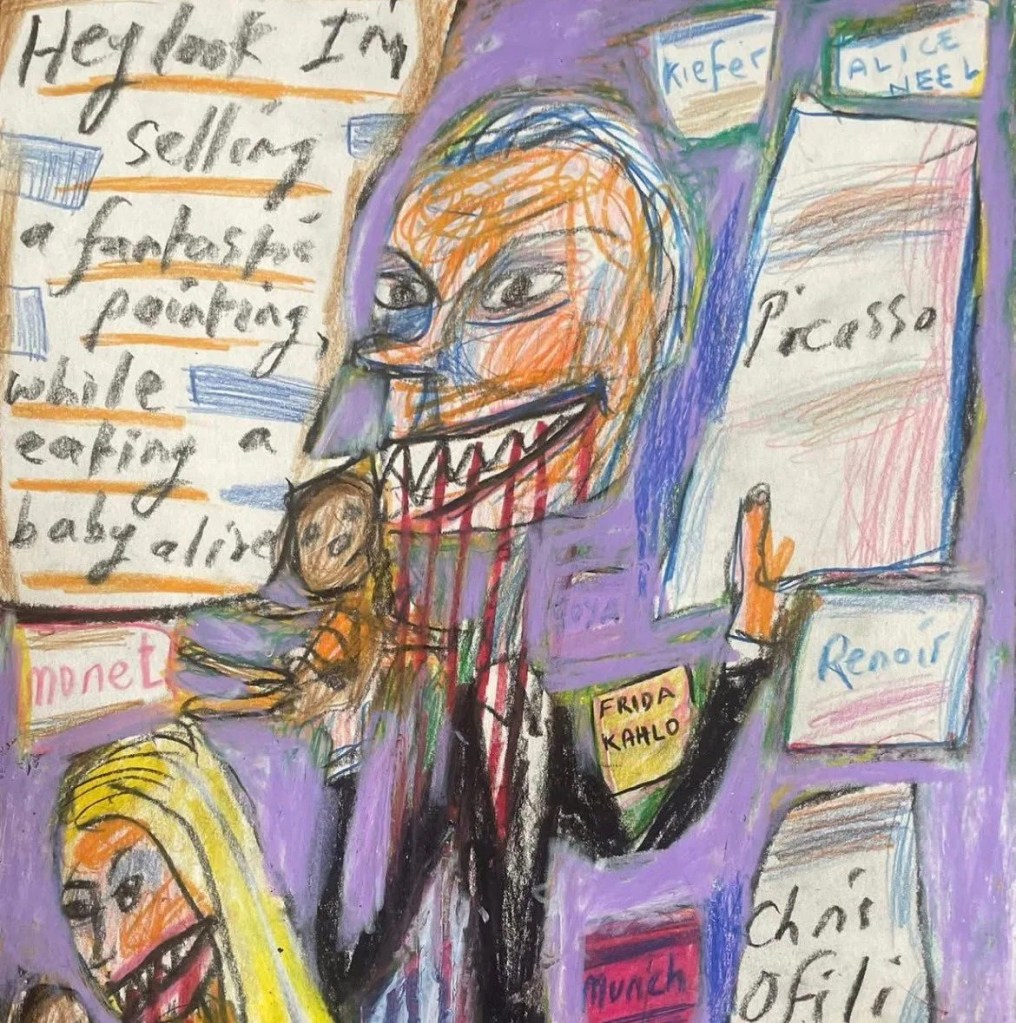
  • A new low. From the JC – Labour council promotes exhibition showing ‘Jews’ eating babies:

    Drawings at an art gallery in Thanet in Kent have been accused of  featuring imagery that is antisemitic and Israel’s representative to the UK has called for the authorities to intervene.

    JC writer and Telegraph columnist Zoe Strimpel posted on social media following her visit to Matthew Collings’ Drawings Against Genocide at the Joseph Wales Studios in Margate that she was “shocked by the use of Nazi imagery – the room is full of the Star of David pasted around figures meant to be Israelis and the Jewish ‘lobby’ spewing blood”.

    Images in the exhibition include one of a smiling IDF soldier, with a Star of David in between their legs, standing over what appear to be a pool of blood and a human skull. The caption “New order forever now” featured several more skulls and a pool of blood.

    A different image cast doubt on Hamas’ sexual violence against Israelis on October 7, saying prominently: “No evidence that sexual violence was used on October 7”, despite testimony from survivors and a report by the Dinah project, partly funded by the British government, found that it was “widespread and systematic”, with gang rape occurring in at least six separate locations in southern Israel.

    Also:

    Israel’s charge d’affairs to the United Kingdom Daniela Grudsky commented: “This isn’t art. It isn’t free speech. It’s antisemitism – crude, aggressive, and completely indefensible. It should be treated with the full seriousness of the law.”

    The CST’s Dave Rich shared Strimpel’s post and commented: “These are the kind of wild antisemitic scrawls that used to only show up in hate mail incidents. Nowadays you can get an art exhibition out of it.”

    It’s grotesque. The artist, Matthew Collings, would appear to be seriously disturbed. These scrawls are at the extreme end of the antisemitic spectrum, yet Thanet’s Labour council are happy to put it all on display, and indeed publicise it.

    More at the Telegraph.

  • Sonia Sodha in the Times makes an effort to find some middle ground on Islam in the UK – Left and right are misreading Muslim Britain.

    The right is increasingly turning British Muslims into a lightning rod by conflating Islam with the political ideology of Islamism, which seeks the state imposition of sharia. And the Labour government has just adopted an official definition of anti-Muslim hostility that is unnecessary (people of all faiths are already protected under existing law) and will have a chilling impact on people’s ability to talk about the above issues, in a world in which the Crown Prosecution Service unsuccessfully pursued a criminal case all the way to the High Court against a Turkish man who burnt the Quran as a political protest, and a Batley schoolteacher has had to remain in hiding since 2021 after he showed a caricature of the Prophet Muhammad to his class.

    A brave effort, but it would be good to have some clearcut idea of how Islamism differs from Islam. Or to hear some brave Muslims speaking out against the hard-line Islamists.

    The unfortunate truth is that Islam is openly supremacist and inflexible, and has, historically, imposed its vision – essentially that of a 7th century Arabian warlord – by force and by fear rather than by reason and persuasion.

  • It’s a condition that affects only women, so of course they’ve made a trans woman their representative. From the Times:

    Amanda Craig, who has published nine novels and was longlisted for the Women’s Prize for Fiction in 2021, spoke out after Steph Richards was named as the parliamentary engagement officer for Endometriosis South Coast.

    Endometriosis is a chronic and painful gynaecological condition in which cells similar to those in the lining of the uterus grow in other parts of the body. It affects one in ten women in the UK.

    Craig, who suffered from acute endometriosis in her forties, said the appointment of Richards was “absolutely ridiculous”. She added: “It’s as ridiculous as someone purporting to speak for black people when they’re white.

    Richards, who was born male but identifies as female, stepped down as the charity’s chief executive in 2024 after women’s rights campaigners objected to her in the position, saying it was “insulting”.

    It has now emerged that Richards, 73, who is also chief executive and founder of the trans campaign group TransLucent, has taken up a new role representing the charity to parliamentarians.

    Rosie Duffield, a gender-critical independent MP, said she felt “uncomfortable” when invited to an event in parliament by Richards and described the appointment as “inappropriate”.

    She said: “I am really uncomfortable that of all of the tens of thousands of women affected, someone who is biologically male is coming to speak about this in parliament who can have no possible lived experience of this condition.

    “There are lots of women that would need this kind of support out there who would be able to talk about the lived experience in a much better way than someone who’s never menstruated in their life.

    “This is a senior spokesperson’s role, so it’s somebody speaking on behalf of an awful lot of sufferers and you can’t, in my opinion, do that if you can have no possible awareness of what women’s bodies go through.”

    Would they get a woman to campaign on behalf of prostate cancer sufferers? I’m guessing not. This only works one way. And “Steph” Richards has a history of violent and aggressive campaigning against women speaking out. He enjoys the business of humiliating women.

    In response to the fresh criticism of her position, Endometriosis South Coast insisted that it was “scientifically inaccurate” to suggest endometriosis was a condition that only affected women.

    A spokesperson for the charity said: “It affects people of all genders, including trans men, non-binary, and intersex individuals.”

    Oh ffs. Only if they’re women.

  • The article, a review of Mark Mazower’s book On Antisemitism, does not start well:

    In April 2024, six months into Israel’s genocidal assault on Gaza….

    That quote in full, in the final paragraph:

    The irony of contemporary antisemitism is that its increasingly contradictory, “smokescreen” quality exposes, perhaps more clearly than ever before, that antisemitism has never really been about the Jews: it has always been a discourse, the object of which is history and power itself. While Jews will remain its victims—in stochastic hate crimes, university firings, arrests by German and American police—Palestine and Palestinians are now its principal targets, along with U.S. civil society itself. Max Horkheimer and Theodor Adorno got it right already in 1947: “the victims are interchangeable.” If we are puzzled by this contradiction, it is only because “the anti-Semitic psychology has largely been replaced by mere acceptance of the whole fascist ticket.”

    So now Palestinians are the principal targets of antisemitism. Well of course. So the term loses all meaning, and Jews once again get erased.

  • Christina Lamb in the Sunday Times, on the Iranian women footballers:

    “My Choice, My Homeland” was emblazoned across a giant billboard in Valiasr square in central Tehran. Iran’s female football team stood on stage flanked by officials and cheered by flag-waving crowds for a heroes’ welcome shown live on national television.

    The Lionesses, as they are known like the English team, had lost all three of their matches in the Women’s Asian Cup in Australia, and the ceremony on Thursday did not last long because of the nightly bombings by US and Israeli jets. But, to the Iranian regime, their return home was a major victory given that days earlier, the captain, five players and their kit-woman had been in a safe house in Brisbane, hoping to defect. In the end only two stayed behind.

    “What is certain is that these athletes are loyal to the homeland, flag, leader and revolution,” declared Mehdi Taj, the president of the Iranian Football Federation. The women standing on stage, wearing the mandatory black hijab over their kit, sang along to the national anthem as the camera zoomed in. Then they stood grim-faced, presumably wondering what their future holds.

    Less than three weeks earlier they had been denounced on state television as “war traitors” for staying silent as the anthem played before their opening match.

    Just that morning another athlete — Saleh Mohammadi, a 19-year-old wrestler — had been executed, along with two other young people for their role in the protests in January, in which as many as 30,000 are believed to have been massacred by regime forces.

    The goalkeeper from the men’s national team, Rashid Mazaheri, has been missing since comparing Ayatollah Ali Khamenei, the former supreme leader, to the devil in an Instagram post shortly before the start of the war on February 28.

    The Lionesses, some as young as 21, had faced an impossible choice between returning to a war-torn land and a repressive regime that had slaughtered thousands, including some of their friends, or asylum in Australia that would give them freedom and safety but put their families back home at risk.

    “This is a terrorist regime which will find anything they can to use to put pressure,” says Mohammad Taghavi, 58, who once played in the national team and is now living in exile in the UK and working as a sports commentator. He said he was in indirect touch with the team. “If they find your weak point is your family, they will use that. And these girls are just kids, imagine them listening to their mums begging them not to let them be killed.”

    It may be surprising that a country like Iran, with so many restrictions on women’s behaviour and dress, has a national women’s football team. Until recently, women were not allowed to attend matches, sneaking in disguised as men. In 2019, a young woman named Sahar Khodayari, known as the blue girl, was arrested after trying to get into the Azadi stadium in Iran. She set fire to herself on the steps of the court and died in hospital.

    But countries must allow female spectators and have a national women’s team to be Fifa compliant, so the men can qualify for international tournaments such as this summer’s World Cup, where Iran is due to play.

    The Iranian Lionesses receive little funding and facilities and are often the target of abuse by hardcore supporters of the Islamic regime. To meet dress codes, they play in long-sleeved jerseys, leggings and black hijab to cover their hair.

    Eventually all but two of the Lionesses returned home: that is, were forced to return home.

    As half the team waited at a hotel in Kuala Lumpur, their team-mates in the safehouse in Brisbane were beginning to get cold feet.

    “The regime in Iran started threatening their families and basically took their families hostage,” Shiva Amini, a former Iranian national football player who now lives in exile, wrote on social media.

    “Because of that, they were forced to withdraw their asylum and go back to Iran.”

    Taghavi, the former player now in the UK, said: “I told them, ‘Don’t come back.’” He believes the regime got to someone inside the safehouse to persuade the others not to defect.

    “Plants from the intelligence were to tell the others in the safe house, ‘If you don’t go back, your families will be killed’,” he claimed.

    [Leigh] Swansborough said: “If you know the regime, it was more than likely someone was going to be a compromised mole. Had it been handled differently, I think the outcomes would have been very different. I really think the Australian government doesn’t understand how far-reaching the power of the regime is.”

    By last Saturday night, only two remained — Atefeh Ramazanzadeh, 34, and Fatemeh Pasandideh, 21. They were photographed last week, training with the Brisbane Roar, without hijab for the first time.

    The others joined up with their team-mates in Malaysia and then flew to Turkey from where, last Wednesday, they travelled by bus to Tehran. They find themselves in Iran, now in its fourth week of bombing and with the regime still in control despite losing so much of its leadership.

    There was to be no Hollywood-style happy ending. “These players, the ones that went home and the ones that stayed, had to make the hardest choice of their life and there was no winner,” said Swansborough.

    Despite the heroes’ welcome, she fears the worst. “When things get quiet, they will get their punishment,” she said. “And we won’t hear about it because there’s no internet. It could be as minimal as football suspensions. It could be punishment. It could be torture.

    “We know they kill athletes. And this is why people need to take it seriously. There’s still a chance that some of these players could be killed.”

    Nothing yet from Gary Lineker.
  • The responses to this are well worth a read. Yes to Jenni Murray; no to Harman.

  • David Collier compares and contrasts BBC coverage of two hospital explosions: the Al-Ahli hospital in Gaza back in October 2023, and an apparent Pakistani airstrike which devastated a drug rehabilitation hospital in Kabul.

    The sustained dishonesty of the Al-Ahli hospital coverage still astonishes:

    Within minutes, claims of an Israeli airstrike killing hundreds spread around the world. The BBC was central to that coverage, giving the story sustained prominence and leading with it for days.

    The truth began to emerge quickly. The explosion was caused by a misfired Islamic Jihad rocket, which landed in a car park rather than the hospital itself. The number of fatalities was significantly lower than first reported. But by then, the original narrative had already taken hold, and several outlets, including the BBC, were reluctant to let it go.

    The BBC’s reporting drew widespread criticism and serious allegations of bias. Yet in the absence of a comparable event, its coverage could still be framed as a one-off failure.

    That is no longer the case.

    On 16 March 2026, an apparent Pakistani airstrike devastated a drug rehabilitation hospital in Kabul. Early reports were strikingly familiar: a hospital hit, claims of hundreds dead, and attribution to an airstrike – swiftly denied by the air force accused.

    These similarities created a rare opportunity. A near like-for-like test of how the BBC responds to such events.

    The comparison is revealing. And it is deeply troubling….

  • From the University of Chicago Press – Theses on the Future History of Trans People: On Trans Messianism.

    In this article, drawing on Walter Benjamin’s “Theses on the Philosophy of History,” in particular the set of theses Benjamin discarded as he edited, I argue that trans embodiment constitutes a form of living in a messianic moment of simultaneous past, present, and future. What we trans people have been, are, and will be opens a horizon of potentiality for embodiment against emerging forms of anti-trans animosity.

    Well….we knew that trans people were special, but “living in a messianic moment of simultaneous past, present, and future”? Wow. That special? Each and every one of them a magic cult figure. And we thought they were just sad men with a porn fetish.

    It’s been going for a while. it seems, this trans messianic stuff. A quick Google search revealed this, from 2018:

    This essay examines how two trans public figures, Lou Sullivan and Jennifer Finney Boylan, try to realize the need for transgender legibility through messianic rhetoric. Messianism is a site of contention in queer theory, between advocates for either antirelational queer theory or queer utopianism. This essay sees messianic rhetoric as a strategy found in the public speech and writing of Sullivan and Boylan, each of whom instrumentalize it to achieve legibility. Such rhetoric works to the political end of broader transgender acceptance. However, it also relies upon a flattening of trans life into a monolith. Messianic rhetoric legitimates a singular narrative of “how to be trans” through excluding other possibilities. Public speech that rejects this universalizing messianic impulse is possible. The zine “Fucking Trans Women” represents such a possibility, focusing attention on experience and pleasure over narrative linearity, thus providing one path forward for trans public speech.

    The author:

    Siobhan Kelly is a doctoral candidate in Religion, Gender, and Culture at Harvard University. Their work draws from queer theory, transgender studies, and critical theory to study religious rhetoric in identity construction and embodiment. Siobhan received a B.A. in Religion from Tufts University and an M.T.S. from Harvard Divinity School.

    There’s a whole other world out there, in campuses across the US.