A two-part history of the North Korean socialist-kitsch style of monumental statuary in post-colonial Africa, from the Daily NK:
North Korea has long relied on unconventional means to earn hard currency in the face of sweeping international sanctions that have effectively shut off most legitimate export channels. One of the more distinctive methods has been the export of architectural and monumental construction services to African nations, carried out through Mansudae Overseas Projects, a Pyongyang-based state company that deploys North Korean artists, engineers, and construction workers abroad to build statues, public buildings, and monuments under contract with foreign governments.
The scope of this work across Africa is considerable. From towering bronze figures on Atlantic-facing hillsides to presidential palaces and independence museums, North Korea’s construction footprint on the continent reflects both a hard-currency strategy and, in several cases, Cold War-era political solidarity that outlasted the ideological moment that produced it. The United Nations Panel of Experts on North Korea has flagged Mansudae Overseas Projects as a significant sanctions-evasion mechanism, estimating that contracts in Namibia alone may have generated tens of millions of dollars for the regime. Revenue flows under government control, with a portion reportedly directed toward regime operating costs or routed through opaque financial channels.
The best known of these monstrosities is Senegal’s huge African Renaissance Monument, which at least managed to outrage the local imams with its semi-naked figures.
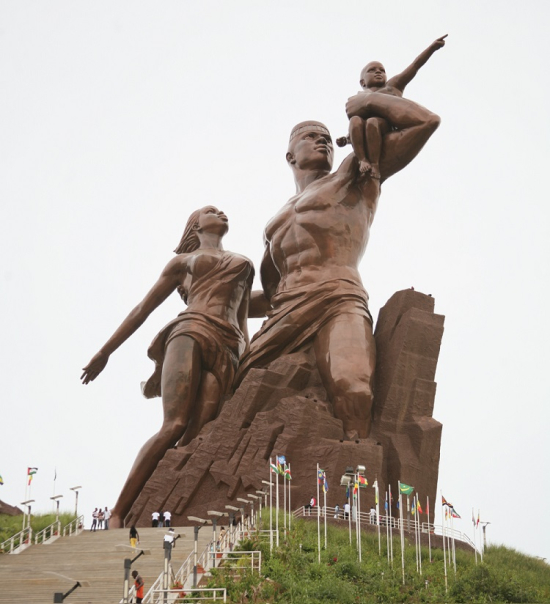
Elsewhere we see Ethiopia’s Derg Monument, plus three in Namibia: Heroes Acre, the State House, and the Independence War Museum.
In part two we have Zimbabwe’s National Heroes Acre, Algeria’s Martyrs Memorial, Angola’s Agostinho Neto Memorial, and Botswana’s Three Dikgosi Monument.
Zimbabwe’s National Heroes Acre:
Located on the outskirts of the capital Harare, the Zimbabwe National Heroes Acre is a national cemetery and war memorial honoring those who contributed to the country’s liberation struggle and subsequent development. The site commemorates veterans of the Second Chimurenga — the guerrilla war waged against Rhodesian colonial rule during the 1960s and 1970s — and others designated as national heroes. Features include a tomb of the unknown soldier, large-scale statuary, an eternal flame, murals, and a museum. The site’s design incorporates two AK-47 rifles positioned back to back. Hero designation and burial rights are administered by the Zimbabwe African National Union–Patriotic Front (ZANU-PF), the ruling party that has governed Zimbabwe since independence, and the government.
North Korea’s direct involvement in the site is well documented. North Korean architects and sculptors participated in the initial design and construction phases. The memorial is widely reported to have been modeled on Pyongyang’s Revolutionary Martyrs’ Cemetery, a prominent hilltop monument complex north of the capital. The collaboration reflects the close political and cultural ties between Harare and Pyongyang in the years immediately following Zimbabwean independence in 1980.
No mention, we can safely assume, of the Gukurahundi – the mass killings/genocide from 1983 to 1987 perpetrated by Mugabe’s ZANU forces, helped by the North Korean-trained 5th Brigade, against the Ndebele ethnic group which largely supported Mugabe’s rival Joshua Nkomo. Now conveniently forgotten.
 Mick Hartley
Leave a comment