A report on Tehran’s hidden art collection, from the Times of Israel:
This time last year, art enthusiasts in Tehran were celebrating an extraordinary event. A masterpiece by Pablo Picasso, “The Painter and His Model,” went on display in the city for only the second time in decades. It was shown at the Tehran Museum of Contemporary Art, in an exhibition entitled “Picasso in Tehran” — a rare highlighting of a different face of Iran, with similarly rare approval from the Islamic regime.
The 1927 painting was described by Bloomberg last week as “arguably the most important canvas in the world that cannot be visited or seen.” The work that helped inspire Picasso’s “Guernica,” which showcases the destruction caused by the Spanish Civil War, it sits in what Bloomberg called “one of the world’s most dangerous cities.”….
Like dozens of other masterpieces in the museum, “The Painter and His Model” has spent virtually all of the 47 years since the Islamic Revolution shut away in TMOCA’s vaults, considered too inappropriate by the ayatollahs for display.
The museum’s core collection was assembled in the 1970s by Queen Farah Pahlavi, wife of then-shah Mohammad Reza Pahlavi.
Deeply passionate about art, the queen took advantage of the soaring prices of oil to bring to Tehran some of the best modern and contemporary art, acquiring works by Picasso, Andy Warhol, Claude Monet, Jackson Pollock, Vincent Van Gogh and dozens more, including Jewish and Israeli artists such as Marc Chagall and Yaacov Agam, and gay ones like Francis Bacon. In 2018, the value of the collection was estimated at $3 billion.
Amazing.
A couple of images..
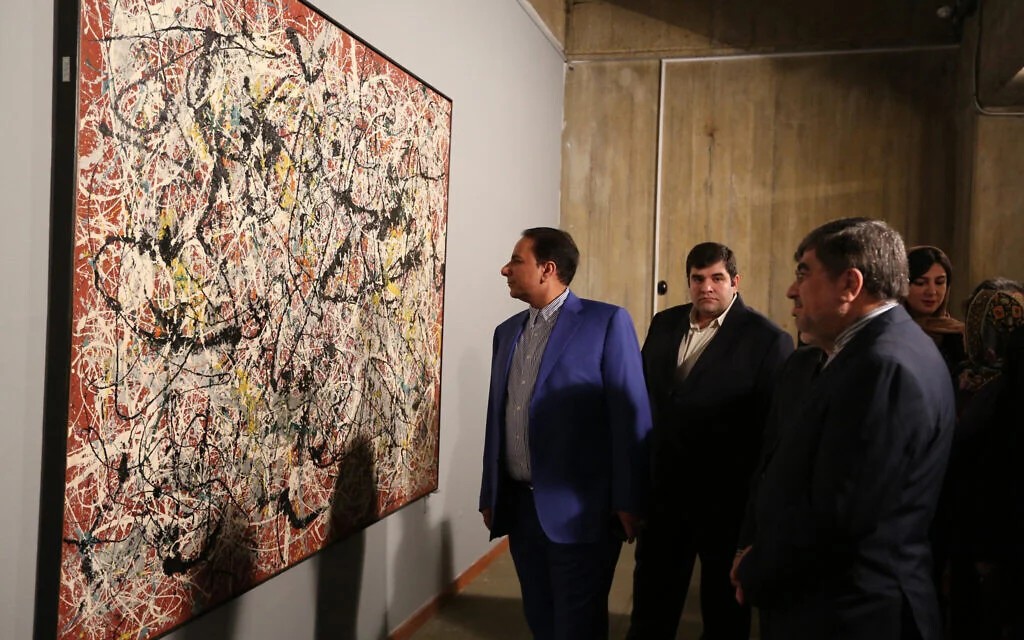
Iranian culture Minister Ali Jannati (R) looks at US artist Jackson Pollock’s “Mural on Indian Red Ground” (1950) during the opening ceremony of an exhibition of modern art at Tehran’s Museum of Contemporary Art, on November 20, 2015. (ATTA KENARE / AFP)
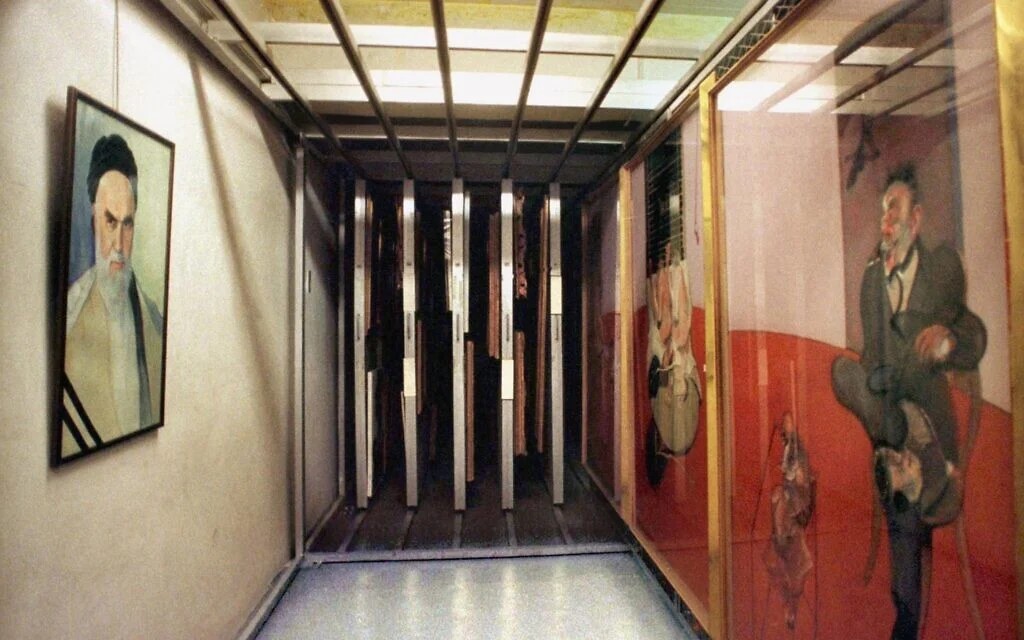
In the basement vault of Teheran’s Museum of Contemporary Art, a portrait of Ayatollah Ruhollah Khomeini oversees a vast collection of stored Western works. Here it is juxtaposed against two works by the British artist Francis Bacon, which have not been exhibited in Iran since the Islamic revolution of 1979. (ATTA KENARE / AFP)
A shame it wasn’t one of Francis Bacon’s popes – he was obsessed with Velázquez’s Portrait of Pope Innocent X. Pope vs Ayatollah across the corridor.
I wonder if AI would be up to that – an Ayatollah portrait in the style of Francis Bacon….
 Mick Hartley
Leave a comment